Get Full Government Meeting Transcripts, Videos, & Alerts Forever!
Get email alerts on the Driver License Penalties topic
No spam. Unsubscribe anytime.
Committee refers bill to increase penalties for driving on suspended or revoked licenses after injury or repeated offenses
Summary
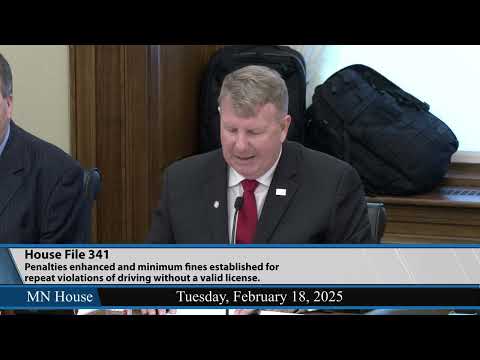
House File 341, a bill to increase penalties for people who drive on suspended or revoked licenses in cases that cause serious injury or involve repeated offenses, was moved and referred to the House Transportation Committee after testimony and questions in the House Public Safety Committee on Feb. 18, 2025.
House File 341, a bill to increase penalties for people who drive on suspended or revoked licenses in cases that cause serious injury or involve repeated offenses, was moved and referred to the House Transportation Committee after testimony and questions in the House Public Safety Committee on Feb. 18, 2025.
Representative Pat Heintzeman, the bill sponsor, said the measure is the product of nearly a decade of work and negotiation. She described the proposal as aimed at “increasing the penalty from a misdemeanor” when a person driving with a suspended or revoked license causes a collision resulting in substantial bodily harm or when a driver commits a third offense within 10 years. Heintzeman said Senator Limmer has a companion bill in the Senate.
The bill drew an emotional account from one of Heintzeman’s constituents, Sue Vanek of Nisswa, who described a 2015 crash in which an unlicensed driver struck her daughter head-on. "Our daughter still remains a vegetable in a local nursing home," Vanek said. She told the committee the offender had been caught driving unlicensed repeatedly before and after the crash and questioned why the criminal penalty remained a misdemeanor.
Committee members discussed the statutory language and practical issues with enforcement. Representative Erin Murphy (asked as Representative Mueller in the hearing) asked why the bill targets "substantial bodily harm" rather than the higher statutory tier of "great bodily harm." Heintzeman said the current language reflects prior negotiations and that she is open to amendments to refine the level of harm covered before the bill’s next committee stop.
Nonpartisan staff and committee staff also addressed fiscal implications. A staff member, Mr. Walz, told the committee he did not request a fiscal note because the bill, as drafted, does not create a felony; he said costs would likely be borne by local jurisdictions.
At the conclusion of debate Representative Heintzeman’s motion that House File 341 be referred to the committee on Transportation Finance and Policy was moved by the chair and carried by voice vote; no roll-call tally was recorded in the hearing.
The committee hearing record includes questions about enforcement practices (how repeated offenders are identified during traffic stops) and whether towing practices and dispatch records affect officers’ ability to prevent repeat driving by suspended individuals. Heintzeman and other members said law enforcement and stakeholders have long discussed the problem and that the bill represents one negotiated path forward.
House File 341 will next appear before the Transportation Committee per the committee referral.