Get Full Government Meeting Transcripts, Videos, & Alerts Forever!
Get email alerts on the Childcare Property Tax Exclusion topic
No spam. Unsubscribe anytime.
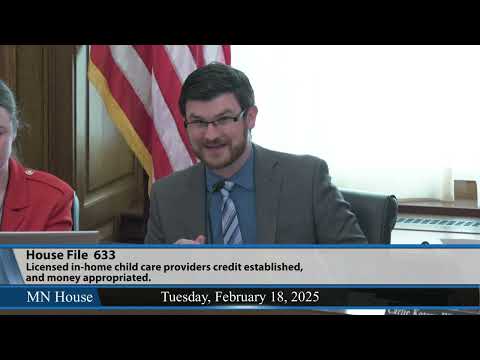
Panel adopts amendment and refers bill to taxes to cut property taxes for in‑home family child‑care providers
Summary
A Minnesota House committee adopted the DE1 amendment to House File 633 and voted to re‑refer the bill to the Committee on Taxes. The bill, as amended, would convert the original proposed state-paid tax credit into a 50% market‑value exclusion on property taxes attributed to net capacity levies for in‑home family child‑care providers, Representative Nadeau said.
A Minnesota House committee adopted the DE1 amendment to House File 633 and voted to re‑refer the bill to the Committee on Taxes. The bill, as amended, would convert the original proposed state-paid tax credit into a 50% market‑value exclusion on property taxes attributed to net capacity levies for in‑home family child‑care providers, Representative Nadeau said.
Representative Nadeau, the bill author, said the exclusion is aimed at stabilizing and incentivizing in‑home family child‑care providers. "The effect of this bill is a 50% exclusion on property taxes that are attributed to the net capacity levies. And this is only for in home family care providers," Nadeau said, describing the change from a state-funded credit to an exclusion that shifts some costs to local tax bases.
The bill comes amid testimony portraying steep child‑care costs and falling in‑home provider numbers. Grant Johnson, who said his wife operates a licensed in‑home program in Edina, told the committee that operating costs have risen sharply: "Our costs in utilities, insurance, taxes have skyrocketed in the last several years," he said, and added the industry is seeing few new providers.
Cindy Cunningham of Lead and Care Public Policy testified remotely in support, saying family child care provides culturally rooted continuity of care and that the measure would provide a kind of support providers have not been receiving. "With this credit or whatever it turns into, will give us support that we haven't been getting to have a business to pay property checks, to have all the expenses. We can, this can help, stabilize," Cunningham said.
Committee members pressed on policy design and distributional effects. Representative Kolter raised concerns that a market‑value exclusion would favor owners of higher‑valued homes and shift tax burden to surrounding properties, noting the exclusion would not be combinable with an existing homestead market‑value exclusion. "This market value exclusion will favor more expensive homes," Kolter said, adding that a refundable credit could target need more directly.
House Research analyst Jared Swanson told members how the exclusion differs from a credit in its fiscal mechanics. "Because it's structured as an exclusion rather than a credit, a bulk of the benefit provided to the property owners who would receive the exclusion gets paid for... by shifting that tax onto other nearby properties," Swanson said, and noted small increases to homeowner property‑tax refund costs are the typical scoring outcome for shifts like this.
Supporters including Chair Katiza Matoon and other committee members argued the exclusion provides a straightforward, direct reduction to providers' operating costs and could help retain or expand in‑home capacity, especially in rural areas where centers are less viable. Representative Henson and Vice Chair Hansen said they supported the bill's goal but encouraged exploring ways to target benefits to lower‑income providers or ensure savings are passed to families.
Representative Nadeau described the larger context the bill seeks to address: high market rates for center care (citing 2021 market rates of roughly $16,164 for infant center care and about $14,000 for toddler care), and a long decline in licensed family child‑care providers—from 12,000 in 2011 to 7,150 a decade later, with a license lookup on Jan. 1 of this year showing 5,782 active in‑home family‑care licenses, according to Nadeau's remarks.
After brief committee discussion, Representative Dole moved adoption of the DE1 amendment; the committee adopted the amendment by voice vote. The committee then voted—by voice vote—to re‑refer House File 633 as amended to the Committee on Taxes.
The bill will receive a revenue estimate and further review in Taxes, where members said the fiscal effects and targeting options (credit vs. exclusion, enrollment or geographic triggers, or other limits) can be examined.
Votes at a glance: • DE1 amendment (moved by Representative Dole): adopted (voice vote). • Re‑refer House File 633, as amended, to the Committee on Taxes (mover recorded as Representative Nadeau in the transcript): approved (voice vote).
Next steps: the bill was referred to the Committee on Taxes for a revenue estimate and further consideration; committee members requested fiscal staff input on scoring and potential targeting options.