Get Full Government Meeting Transcripts, Videos, & Alerts Forever!
Get email alerts on the Agency Overview topic
No spam. Unsubscribe anytime.
DNR outlines organization, budget and program footprint to House committee
Summary
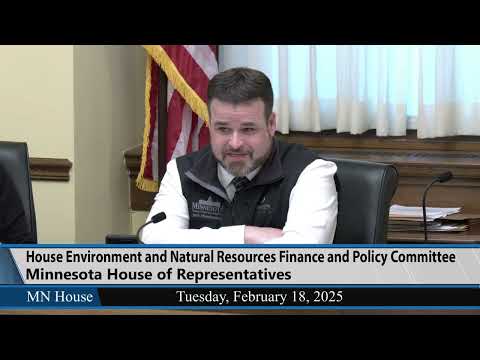
Assistant Commissioner Bob Meyer of the Minnesota Department of Natural Resources told the House Environment and Natural Resources Finance and Policy Committee that the department’s work is structured around recreation, economic development and natural‑resource protection.
Assistant Commissioner Bob Meyer of the Minnesota Department of Natural Resources told the House Environment and Natural Resources Finance and Policy Committee that the department’s work is structured around recreation, economic development and natural-resource protection.
“The mission of the DNR is to work with and I repeat with Minnesotans to conserve and manage the CH natural resources to provide outdoor recreation opportunities and to provide for commercial uses of natural resources in a way that creates a sustainable life,” Meyer said as he described the agency’s organizational chart and divisional responsibilities.
The agency reported about 3,100 full‑time equivalent staff when seasonal workers are averaged, roughly 2,850 reporting worksites and more than 2,900 owned or leased buildings statewide. Meyer said the DNR operates 64 state parks, 60 state forests, nine state recreation areas and nine state trails; it also manages 1,700 public water‑access sites and roughly 812,000 registered boats in the state.
Meyer summarized the department’s FY 2024–25 budget as spread across more than 50 funds, with the natural-resources funds (game and fish, water‑related accounts and similar user fees) and federal grants making up substantial shares. He said the general fund accounted for about 30% of the DNR’s budget in 2024–25 and that “large amount[s] of one time funding comes into the department and leaves through the department from the legacy funds and the environmental trust fund, outdoor heritage fund, parks trails fund, clean water fund, LCCMR.”
Meyer reviewed divisional activities: lands and minerals (managing 5.6 million acres of state lands and mineral leasing), ecological and water resources (including scientific and natural areas, aquatic invasive species inspections and groundwater permitting), forestry (reforestation and wildfire response), parks and trails (1.14 million overnight visitors in 2023 and 5,000+ campsites), fish and wildlife (1,500 WMAs covering about 1.3 million acres and ongoing hatchery work), and enforcement (54 conservation officer districts and 51,000 safety certifications annually).
On enforcement and public contacts Meyer highlighted non‑citation interactions the DNR uses for outreach: “If you’re fortunate enough to have your grandkids or children in your boat and they’re wearing their life jackets, I’ll give them a coupon for a ice cream cone or something like that. So it’s really creating those contacts.”
Meyer closed by reiterating the department’s commitment to work with local governments, tribes and the Legislature on conservation and resource management.
The committee directed questions about specific programs — groundwater areas, public waters inventory, reforestation grants, aquatic invasive species inspections and chronic wasting disease — to DNR staff for follow up.