Get Full Government Meeting Transcripts, Videos, & Alerts Forever!
Get email alerts on the Education Social Studies Standards topic
No spam. Unsubscribe anytime.
Minnesota committee re-refers bill to delay social studies standards, repeal ethnic-studies mandate
Summary
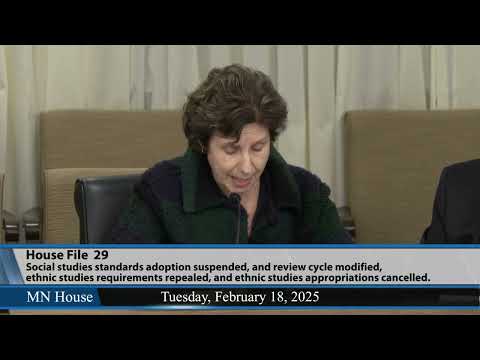
Representative Krisha opened testimony on House File 29, saying “students in Minnesota deserve the fundamental right to a quality education measured with academic success.”
Representative Krisha opened testimony on House File 29, saying “students in Minnesota deserve the fundamental right to a quality education measured with academic success.” The bill would delay the social studies standards review and implementation timeline, repeal the statutory requirement that ethnic studies be embedded in academic standards, and eliminate several appropriations tied to ethnic-studies work.
The measure drew large public turnout and sharply divided testimony from teachers, students, school officials and policy advocates. Supporters of HF 29 told the committee the state mandate diverts time from foundational reading and math instruction and places burdensome professional-development requirements on teachers. Opponents — including teachers, school district representatives, students and the Minnesota Department of Education — said the 2021 social studies standards, which include an ethnic-studies strand, were adopted after a multi-year review and that undoing them would disrupt districts already implementing the standards.
Why this matters: The bill would change both statutory requirements and state funding tied to ethnic-studies implementation, and the committee formally moved HF 29 on to the Committee on Education Finance. That re-referral preserves committee and floor consideration while opponents continue implementation work in districts.
Key facts and action
- Motion and referral: The chair moved that House File 29 be re-referred to the Committee on Education Finance. The motion passed on a roll call vote, 7 in favor and 6 opposed. The committee announced the motion prevails and HF 29 is re-referred to education finance.
- Vote tally (roll call): Chair Bennett — yes; Vice Chair Mueller — yes; Lee Jordan — no; Biermann — no; DePel — yes; Falconer — no; Fogelman — yes; Gordon — yes; Green — no; Hill — no; Keeler — no; Lawrence — yes; Roach — yes. The committee recorded 7 votes in favor and 6 opposed.
- Statutory changes proposed in HF 29 (as presented in the hearing): delay of the social studies standards review/implementation timeline; repeal of the statutory language defining ethnic studies (cited in testimony as "120B.25"); and cancellation or reduction of appropriations tied to ethnic-studies consultation, competitive school grants, and a Department of Education ethnic-studies specialist position.
What supporters said
Representative Krisha, sponsor of the bill, framed HF 29 as a way to ‘‘remove the distractions’’ from core academic instruction so teachers can focus on reading, math and science. She said mandates such as the ethnic-studies embedding requirement ‘‘steal time’’ from students and argued the bill simply reduces a state mandate rather than forbids local teachers from covering cultural or ethnic topics.
Several witnesses supporting the bill argued the ethnic-studies language mandates intrusive professional development and a statewide curriculum approach that they said goes beyond improving basic academic outcomes. Catherine Kersten, senior policy fellow at the Center of the American Experiment, said the Department of Education’s ethnic-studies framework delegates curriculum design to outside advocacy groups and portrayed the framework as prescriptive. Mike McCarthy of Fixing Stillwater Schools said the changes emphasize ‘‘equality over equity, merit over DEI, and academics over indoctrination.’’
What opponents said
Teachers, district representatives and students urged the committee to reject HF 29. The Minnesota Department of Education, through Edo Schooning, director of government relations, stated that "MDE would like to express serious concerns with eliminating the current social studies academic standards" and warned that reverting to older standards would cause disruption and added costs for districts that have already invested in implementation. Schooning also noted the standards-review cycle is intended to reflect current research and practice.
Multiple current and former teachers and social-studies professionals testified that the 2021 standards, including the ethnic-studies strand, were developed through a multi-year process and are intended to increase relevance and student engagement. Crystal Johnson, a social-studies teacher and committee member who helped draft the standards, said the work was ‘‘rigorous, inclusive and transparent’’ and that committee members received broad public feedback. Students from several districts described ethnic-studies courses as offering representation and civic skills; one student, Yael Buechle, said, "ethnic studies is more than just a class. It's an opportunity and it creates community." Other testimonies stressed that ethnic studies can improve engagement and achievement for historically underserved students.
Budget and implementation details discussed
Nonpartisan staff member Ms. Perra summarized appropriations changes in the bill: she said HF 29 modified three appropriations — (1) ethnic-studies consultation funding to the Department of Education, (2) competitive ethnic-studies school grants to districts and charter schools (a reduction of $700,000 overall), and (3) funding of $150,000 per year for an ethnic-studies specialist at the Department of Education.
MDE testimony noted that Minnesota’s 2021 social studies standards were scheduled for full implementation in the 2026–27 school year and that many districts have already spent staff time, materials, and professional-development dollars aligning curriculum to the 2021 standards; MDE cautioned reverting to 2011 standards would cause disruptions and costs.
Discussion highlights from committee members
Committee members debated whether the bill was primarily about reducing state mandates so teachers can focus on foundational skills, or whether it would amount to a rollback of inclusive curriculum changes. Supporters emphasized achievement gaps and the need to prioritize reading and math; opponents emphasized representation, research-based standard updates, the multi-year review process that produced the 2021 standards, and the voices of students and teachers who asked the committee to retain the standards.
Outcome and next steps
The committee renewed the motion and ordered HF 29 re-referred to the Committee on Education Finance by roll call vote (7–6). Re-referral means the bill proceeds in the legislative process and will face further consideration in the next committee.
Sources and quotes
- Representative Krisha (bill sponsor): "students in Minnesota deserve the fundamental right to a quality education measured with academic success." - Edo Schooning, director of government relations, Minnesota Department of Education: "MDE would like to express serious concerns with eliminating the current social studies academic standards." - Ms. Perra (nonpartisan staff): described appropriations cut: competitive grants reduced by $700,000 and $150,000 per year for a Department ethnic-studies specialist. - Student Yael Buechle: "ethnic studies is more than just a class. It's an opportunity and it creates community."
Ending
HF 29 will move to the House Committee on Education Finance for further consideration. Committee members on both sides indicated the debate will continue in the next hearing, where staff analyses, fiscal details and additional testimony may be considered.