Get Full Government Meeting Transcripts, Videos, & Alerts Forever!
Get email alerts on the School Transportation topic
No spam. Unsubscribe anytime.
Lawmakers hear from rural superintendents pushing to raise transportation sparsity aid
Summary
Superintendents from Bemidji, Forest Lake and Stillwater told the House Education Finance Committee that current state transportation funding disadvantages large, geographically spread districts and asked lawmakers to increase sparsity aid under House files 52 and 53. The committee laid both bills over for possible inclusion in an omnibus bill.
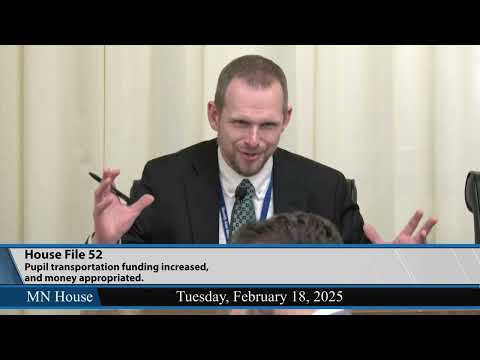
Members of the Minnesota House Education Finance Committee heard testimony Tuesday from superintendents in Bemidji, Forest Lake and Stillwater urging lawmakers to increase transportation sparsity aid for large geographic school districts.
The committee laid over House File 52 and House File 53 for possible inclusion in an omnibus bill after lawmakers and staff described how the current per‑pupil funding formula leaves rural and geographically large districts subsidizing transportation costs from general education dollars.
The bills, carried by Representatives Hill and Anderson, would increase the share of a district's transportation deficit covered by state sparsity aid. Representative Hill said the proposal follows a 2019 task force recommendation and seeks to raise the state’s contribution toward identified deficits to 70 percent of qualifying costs.
Jeremy Olsen, superintendent of the Bemidji district, testified that Bemidji serves about 4,800 students across a far larger geography than many metro districts and must provide transportation for charter, private and juvenile detention facilities within that footprint. “If you look at that map… Richfield has the same population. So therefore gets the same transportation funding as Bemidji Area Schools,” Olsen said, adding that the district must operate less efficiently or put students on buses for unacceptably long rides.
Steve Massey, superintendent of Forest Lake Area Schools, said his district covers roughly 220 square miles with nearly 6,000 students and runs about 55 bus routes that together drive “over 5,500 miles each day. This is the distance between Key West and Anchorage every day,” Massey said. He told the committee Forest Lake draws about $500,000 annually from its general fund to cover transportation deficits — roughly $7.5 million over 15 years — and has cut routes and classroom services to offset costs.
Mike Funk, superintendent of Stillwater Area Public Schools, said his district transports 8,073 students across about 53 square miles and spent more than $12 million on transportation last year, exceeding budgeted amounts by about $1.5 million. Funk described fixed costs such as driver pay, maintenance and fuel that “do not scale proportionally with student population density,” creating disproportionate pressure on more rural or geographically dispersed districts.
Nonpartisan staff walked members through a spreadsheet labeled “estimated data 2025–26 school year transportation sparsity adjustment,” explaining how qualifying expenditures, current sparsity revenue and proposed percent increases would affect individual districts. Staff said the sponsors’ proposal to raise the state contribution to 70 percent would roughly double the current adjustment for benefiting districts and increase total sparsity aid by several tens of millions of dollars on the spreadsheet presented to committee members.
After testimony and staff explanation, Representative Hill moved House File 52 and the chair laid the bill over for possible inclusion in an omnibus. Representative Hill then moved House File 53 and the chair likewise laid that bill over for possible inclusion at a later time.