Get Full Government Meeting Transcripts, Videos, & Alerts Forever!
Get email alerts on the Childcare Property Tax topic
No spam. Unsubscribe anytime.
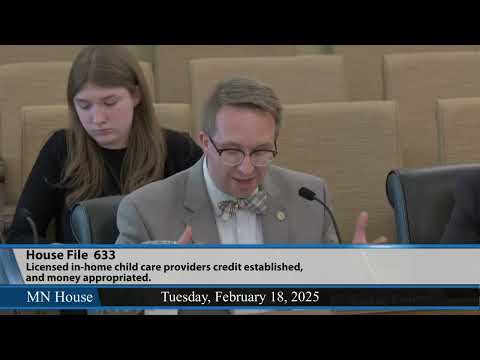
Committee adopts amendment converting proposed credit into 50% property tax exclusion for in‑home family child‑care providers and refers bill to Taxes
Summary
The House Children, Youth and Families Committee adopted an amendment that converts a proposed state-paid credit into a 50% market‑value property tax exclusion for in‑home family child‑care providers (House File 633) and re‑referred the bill to the Taxes Committee after public testimony and debate about distributional and fiscal effects.
The Minnesota House Committee on Children, Youth and Families unanimously adopted a DE1 amendment to House File 633 that converts an originally drafted state-paid credit into a 50% market‑value exclusion on property taxes for in‑home family child‑care providers, then voted to re‑refer the bill to the Committee on Taxes for a revenue estimate and further consideration.
Author Representative Jennifer Nadeau, who introduced the bill, said the exclusion applies to property taxes attributable to net capacity levies and is limited to in‑home family child‑care providers. “This bill is a very simple common sense bill that I hope helps stabilize in home family childcare providers,” Nadeau said during committee discussion.
Nut graf: Committee members and witnesses framed the bill as a targeted step to shore up falling family child‑care capacity — Minnesota has seen large declines in licensed family providers in recent years — while nonpartisan staff and several members warned the exclusion shifts costs onto local taxpayers and may favor higher‑value homes.
Nadeau presented statewide data about childcare costs and provider counts during her remarks. She cited 2021 market rates — infant care at centers reported at about $16,164 and toddler care at about $14,000 — and told the committee the number of licensed family‑care providers fell from about 12,000 in 2011 to roughly 5,782 active licenses as of Jan. 1 of this year for in‑home family providers. “As the number of providers for family care goes down, the costs and the wait lists go up,” she told members.
Two public witnesses spoke in support. Grant Johnson described his wife’s long experience running a licensed in‑home daycare in Edina and said rising utilities, insurance and tax costs have made the business less attractive to new providers. Cindy Cunningham of Leading Care Public Policy called the sector “in crisis” and said the change would signal state support for family child care and help providers cover business expenses.
Members asked technical and distributional questions. Representative Kolter and others noted the amendment’s exclusion would prevent eligible properties from also claiming the homestead market‑value exclusion, and that a market‑value exclusion tends to give larger absolute tax reductions to higher‑value homes — potentially concentrating benefits in wealthier areas. Kolter said she preferred a refundable state credit because a credit would direct state dollars to providers rather than shifting costs among local property taxpayers.
Jared Swanson of House Research explained how the change affects state and local finances: because the provision is structured as a market‑value exclusion rather than a state credit, most of the immediate benefit would be borne by local property taxpayers through tax‑base shifts; the state fiscal effect shows up as a small increase in homeowner property‑tax refunds (PTR) paid out. “Typically shifts like this score a small increase in PTR,” Swanson said.
Vice Chair Hansen and other members pressed the sponsor about safeguards to ensure the tax reduction yields lower child‑care prices rather than simply increasing provider household income; Nadeau said she would consider language to encourage or track how savings are used but had no specific provision at the hearing.
The committee adopted the DE1 amendment on a voice vote. After closing public testimony and further member discussion, the committee voted to re‑refer House File 633 as amended to the Committee on Taxes. No roll‑call tally was recorded in the transcript; the chair announced the motion prevailed.