Get Full Government Meeting Transcripts, Videos, & Alerts Forever!
Get email alerts on the Public Health Data Privacy topic
No spam. Unsubscribe anytime.
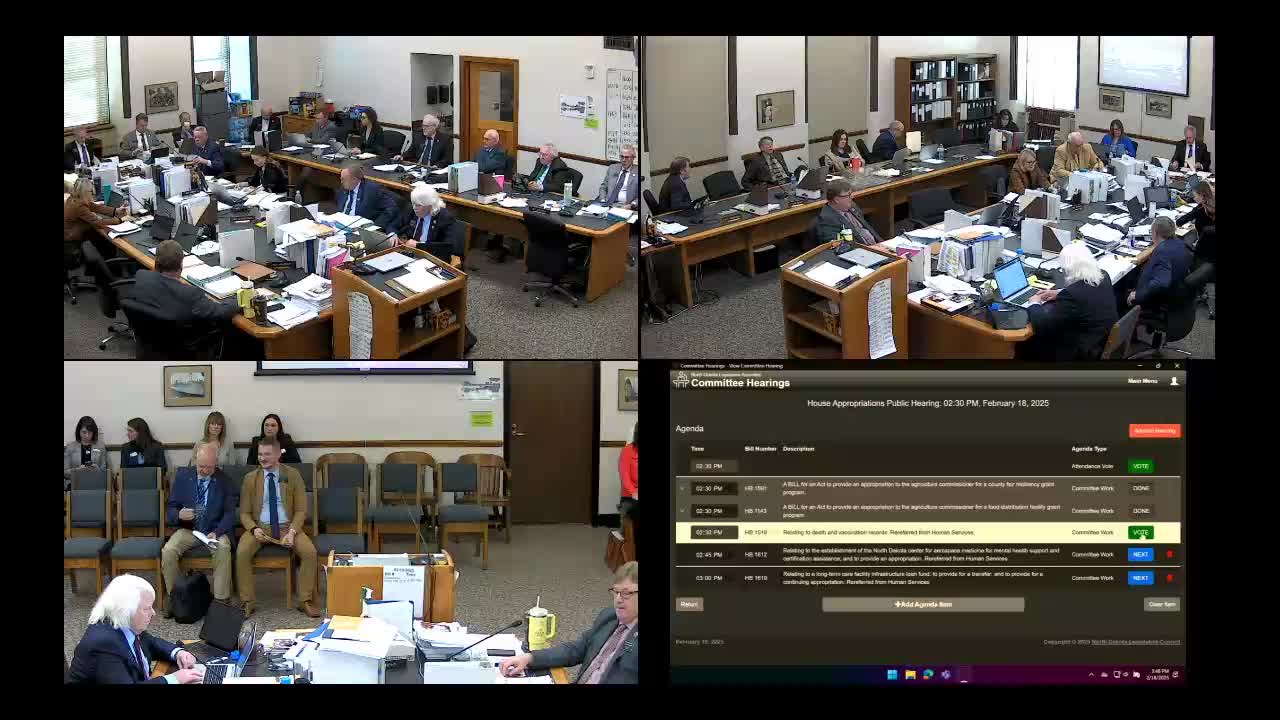
Committee votes not to advance bill requiring quarterly vaccine‑to‑death‑certificate summaries
Summary
The Human Services Committee moved a do‑not‑pass recommendation on House Bill 1519, which would have directed the Department of Health and Human Services to compile quarterly time‑series summaries linking vaccination records and death‑certificate data. Lawmakers cited privacy, HIPAA concerns and limited causal value of aggregated data.
Representative Matt Ruby introduced House Bill 1519, which would direct the Department of Health and Human Services to compile and publish a quarterly time‑series summary that links vaccine records and death‑certificate data for vaccine types administered to more than 20,000 individuals in a quarter.
Ruby described the proposal as a request for ‘‘pretty raw data’’ that supporters said could be used either to examine safety concerns or to reassure the public about vaccine safety. "My understanding is they would take everything that's on the death certificate, and then what is published would be... vaccine information as well," Ruby said during questioning about what fields the department would extract.
Several committee members raised privacy and procedural concerns. Representative Nathie, who has professional experience with death certificates, said death certificates contain personally identifiable information and family members guard that information closely; she said she had “a problem” with giving unrestricted access to the full certificates. Representative Murphy asked whether the fiscal note accounted for increased medical‑examiner or forensic costs if examiners were expected to produce new causation determinations; Ruby said the bill would present raw data and would not require additional forensic examinations to prove causality.
Representative Hansen cited testimony from public‑health vaccination experts who warned the bill could display personally identifiable information in ways that would run afoul of privacy protections; committee members referenced HIPAA in that context. Representative Richter and others questioned the utility of the data absent causality: collecting vaccination and death records without case‑level forensic follow‑up, some said, would not prove a link one way or the other.
Representative Murphy moved a do‑not‑pass; Representative Anderson seconded. The Human Services Committee adopted the do‑not‑pass recommendation by roll call recorded in the transcript as 20 yes, 0 no, 3 absent. The committee’s record and the roll call indicate the bill will not proceed from that committee.
Committee members who spoke urged caution around individual privacy, the limits of raw data to show causation, and potential administrative burden on DHHS or local medical examiners if the scope of inquiry were to expand.