Get Full Government Meeting Transcripts, Videos, & Alerts Forever!
Get email alerts on the Insurance Incentive Program topic
No spam. Unsubscribe anytime.
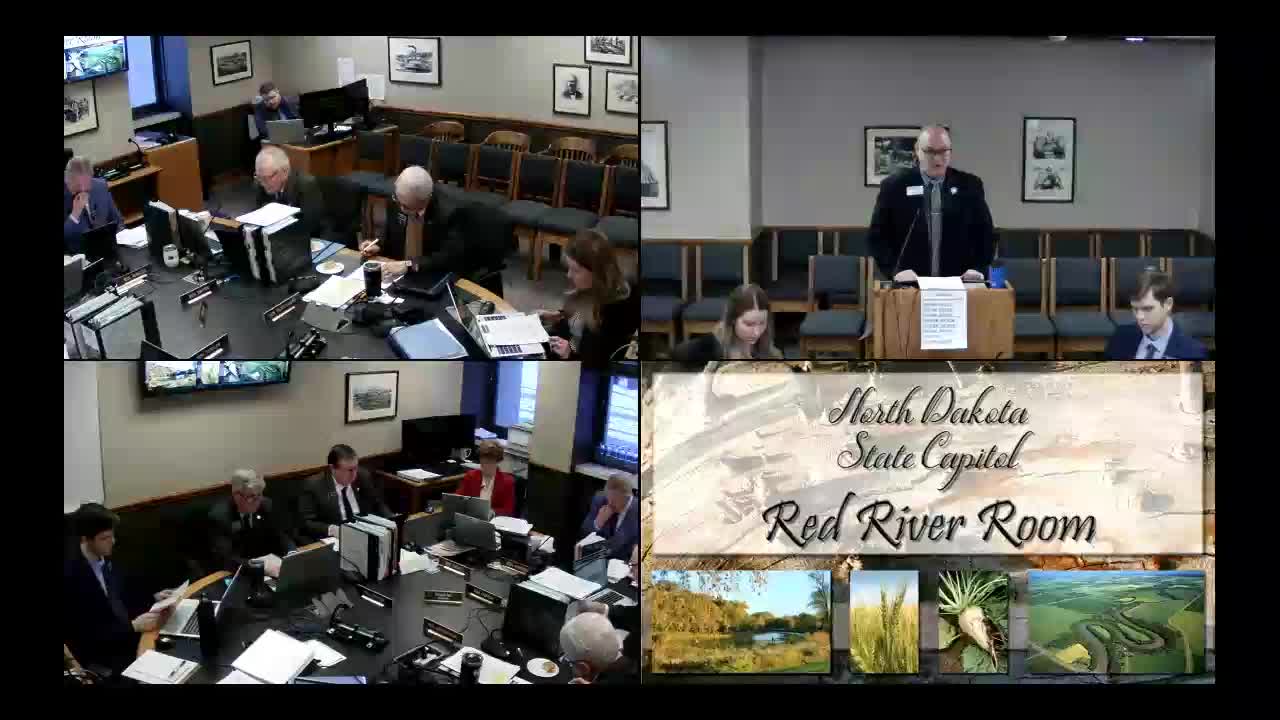
Committee hears proposal to create $20 million insurance incentive fund to attract property coverage in North Dakota
Summary
Deputy Insurance Commissioner John Arnold told the Legislative Appropriations Committee that the state should create a North Dakota Insurance Incentive Program to encourage insurers to write property coverage in the state.
Deputy Insurance Commissioner John Arnold told the Legislative Appropriations Committee that the state should create a North Dakota Insurance Incentive Program to encourage insurers to write property coverage in the state.
Arnold said the program would offer grants ranging from $2,000,000 to $10,000,000 that the insurer must match dollar-for-dollar; the state’s share would be paid out over five years (20% annually) contingent on benchmarks. “Insurers could apply for grants ranging from a minimum of $2,000,000 to a maximum of $10,000,000,” Arnold said. He added that grants would be tied to metrics insurers must meet before each annual payment is released.
Why it matters: Committee members pressed for detail because rising premiums, severe weather and limited insurer participation are driving affordability and availability concerns in North Dakota. Proponents framed the plan as a preventive measure to keep the market competitive and avoid the need for a costly state-run insurer of last resort such as Louisiana’s FAIR program.
Details of the proposal
- Match and payout. Grants would require a 1-to-1 private match and be paid 20% per year over five years. The minimum grant is $2,000,000; the maximum is $10,000,000.
- Performance benchmarks. Participating insurers must meet annual benchmarks to receive each payment. Arnold described a target that participating insurers generate at least $2 of new premiums for every $1 of combined grant plus insurer investment. Using his example: a $2.5 million state grant plus $2.5 million insurer investment (total $5 million) would be expected to produce roughly $10 million in new premium written.
- Eligibility safeguards. Arnold listed eligibility criteria intended to limit risk: a capital surplus of at least $10,000,000, satisfactory risk-based capital levels as shown in routine financial examinations, and an adequate reinsurance program.
- Domestic insurer carve-out. The plan would reserve at least 20% of incentive funding for North Dakota domestic insurers; Arnold told the committee domestic carriers currently write about 8.5% of the premium in the state, so the carve-out would be an over-allocation relative to current market share.
- Funding sources. As an initial funding mechanism, the department proposed earmarking $20,000,000 of premium tax receipts that now flow to the general fund. Arnold also proposed converting any excess dollars from the Insurance Regulatory Trust Fund (above the legislatively mandated retention cap) into the incentive fund until the $20,000,000 cap is reached; he testified the department typically rolls roughly $3,000,000 per year from that trust fund into the general fund under current practice.
Committee concerns and discussion
Committee members questioned whether the program would simply subsidize premiums or provide the capital necessary for new products and market entry. Senator Dwyer said it “sounds to me like we’re just subsidizing somebody’s premium,” and asked how the program would lower rates. Arnold replied the intent is to lower barriers to entry and attract new products and competitors, which in turn could stabilize or slow premium increases, and emphasized the benchmarks and review process before funds are disbursed.
Several senators noted North Dakota is not yet experiencing the scale of market collapse seen in some states, and that the policy committee earlier reported the bill without recommendation by a 3–2 vote. Committee members also pressed on oversight and measurement: Arnold said the primary metric of success would be new premiums written tied to the program (e.g., $10 of premium written for a $5 combined investment example) and that the department would require annual reporting and verification before making payments.
Unresolved points
The committee did not take a formal vote on the proposal during this hearing. Members expressed differing views about whether to proceed now or wait until market conditions deteriorate further. Questions remained about whether the initial $20,000,000 should be a one-time appropriation, how quickly the fund would be replenished if used, and whether the carve-out for domestic insurers sufficiently mitigates concerns about harming local carriers.
What happens next
Arnold closed by offering to take questions and to provide additional detail on program mechanics and fiscal estimates if the committee requests follow-up. No motion or final action on a bill implementing the program was recorded during the session excerpted here.
Ending: The department framed the incentive program as a proactive, performance-based option to increase market competition and expand coverage availability, particularly in rural areas; the committee left the measure under consideration with follow-up questions and no recorded vote.