Get Full Government Meeting Transcripts, Videos, & Alerts Forever!
Get email alerts on the Transportation topic
No spam. Unsubscribe anytime.
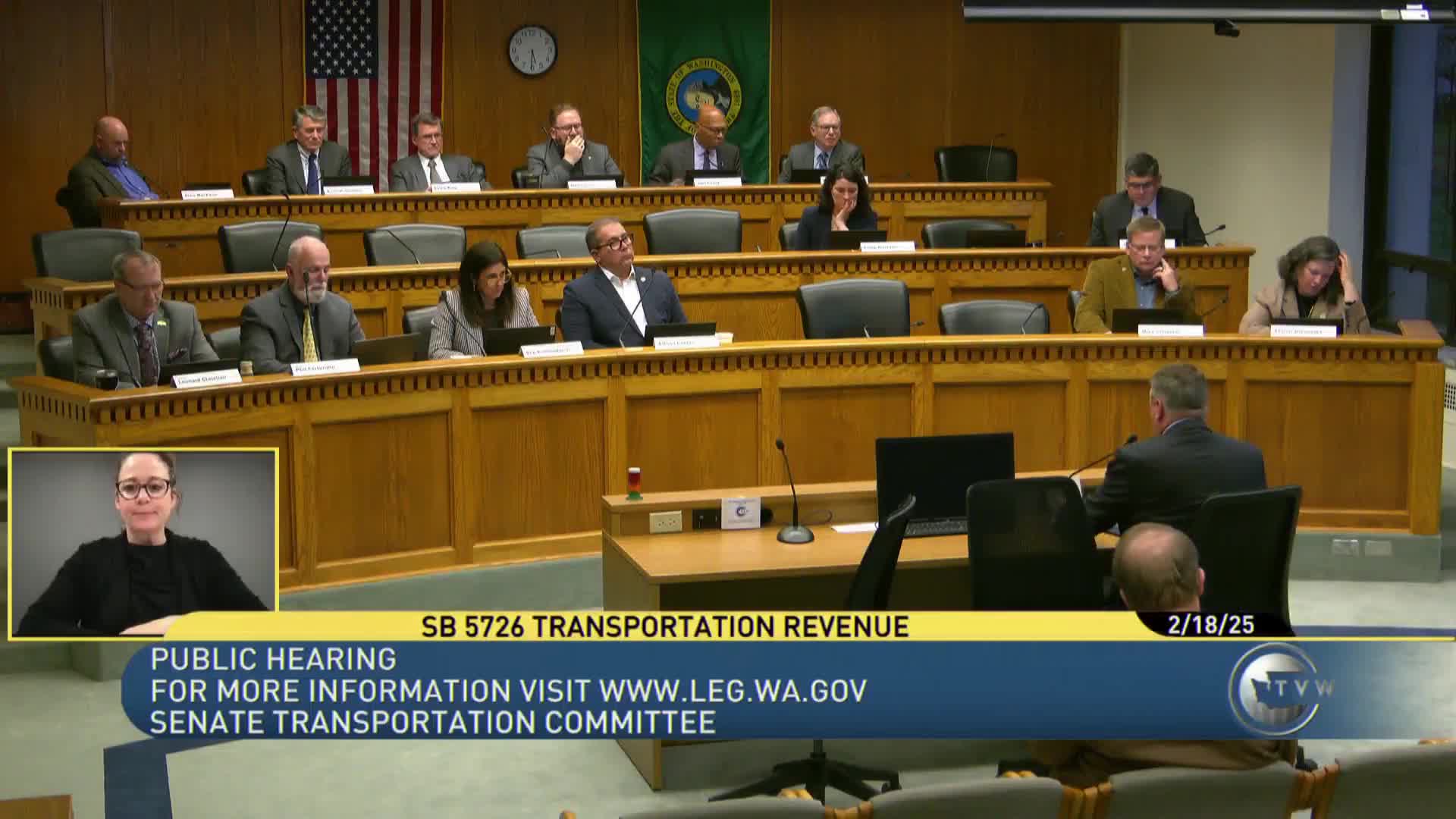
Senate Transportation Committee hears public comment on SB 5726 road-usage charge
Summary
The Senate Transportation Committee held a public hearing on SB 5726, a proposal for a per-mile road-usage charge with a surcharge to fund transit. Supporters including the Puget Sound Regional Council and car dealers praised the usage-based approach; rural residents, a nurse and others warned of added costs and access problems.
The Senate Transportation Committee heard public testimony on SB 5726, a proposal to charge drivers by the mile and impose a surcharge to fund transit, at a public hearing that concluded with the committee adjourning after public comment.
The bill drew support from regional planners and the auto-dealer industry and prompted concerns from rural residents and a nurse who said the measure would increase the cost of accessing health care. Chair Elias presided over the hearing and accepted testimony from residents, business representatives and regional agencies.
Joe Kunstler, a public commenter, said he “really appreciate[d] the surcharge to fund transit” and called for a clear voter mandate, urging supporters to place the question on a November ballot so opponents cannot force a later referendum. Scott Hazelgrove, representing new-car dealers, said dealers favor usage-based charges and warned that the industry must be able to handle enrollment and account reconciliation. “Dealers will be at the center of this proposal,” Hazelgrove said, adding that dealers had sent technical details the committee should address to make the program workable.
Ben Bekenta, director of regional planning at the Puget Sound Regional Council, told the committee the council’s long-range regional transportation plan, covering about 4,500,000 residents in King, Kitsap, Pierce and Snohomish counties, treats a road-usage charge as a sustainable revenue source for maintenance and preservation. “SB 5726’s approach to a per mile fee dedicated to maintenance and preservation along with an assessment to support alternative transportation modes, is consistent with the region’s adopted policy,” Bekenta said.
Fred Yockers, an electric-vehicle owner from the San Juan Islands, described his past payments for vehicle fees and estimated his contribution under a per-mile formula. “I paid $225 a year for 10 years. . . . I have therefore paid $2,250 in addition to local fees,” Yockers said, adding that by his estimate under the current formula he would have paid roughly $1,300. He said he supports the bill and expressed frustration with state ferry management, saying, “please do not believe anything Tim Imon says because he's responsible for the mess of our ferry system.”
Speakers who opposed the measure said it would disproportionately affect rural residents who must travel long distances for medical care or work. Dawn Hebert, a nurse from a rural area, said many of her patients must drive to distant hospitals and that extra per-mile charges would create a “trickle down effect” discouraging people from seeking care. Tia Levine, a resident of North Central Washington, said a neighbor who lives seven miles off a county road would face roughly $100 a month under the formula as explained to the committee, and that many farmers and ranchers travel long local distances that a straight per-mile charge might not fairly capture.
Crystal Moldenhauer, a Longview school board member who works in home care, said the measure could raise costs for care workers who travel, and questioned how the bill would account for mileage driven out of state by Washington-registered vehicles, citing her husband’s truck that is registered in Washington but works in Oregon.
Committee staff reported sign-in totals from the hearing: pro 229, con 5,763 and other 11. The committee did not take a vote during the hearing. Chair Elias closed the public comment period and adjourned the committee.
The hearing provided public comment and technical questions rather than committee action; no final vote or committee direction was recorded in the transcript.