Get Full Government Meeting Transcripts, Videos, & Alerts Forever!
Get email alerts on the Criminal Justice Sentencing topic
No spam. Unsubscribe anytime.
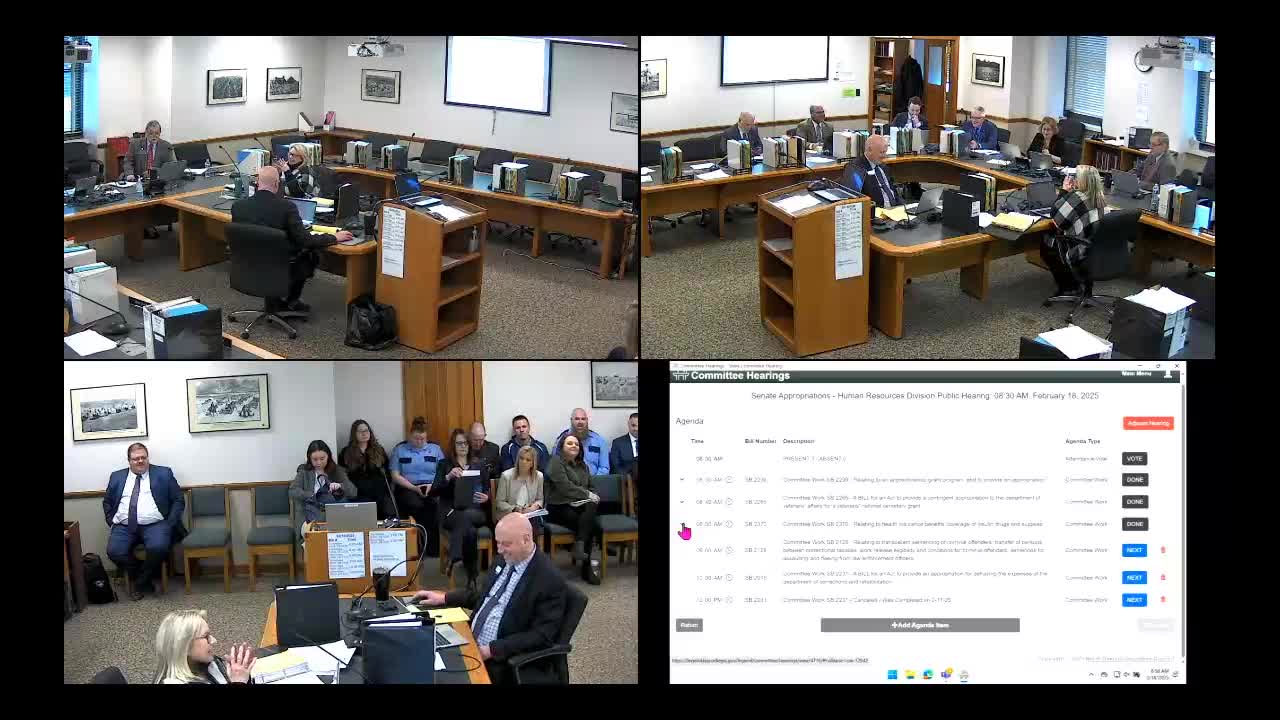
Appropriations HR panel delays action on Senate Bill 2,128 after lengthy debate over sentencing, parole and transitional facilities
Summary
The Senate Appropriations Committee, Human Resources Division, debated Senate Bill 2,128, a wide-ranging criminal-justice measure dealing with sentencing, parole eligibility and placements in transitional facilities, but postponed action while the Attorney Generals office and corrections officials reconcile language and a disputed fiscal note.
The Senate Appropriations CommitteeHuman Resources Division on Wednesday debated Senate Bill 2,128, a wide-ranging criminal-justice measure addressing sentencing, parole eligibility, placement in transitional facilities and short consecutive sentences for assaulting or fleeing from law enforcement, but did not act and set the bill for further consideration later in the week.
The measure prompted hours of discussion about a recent fiscal note from the Department of Corrections and Rehabilitation (DOCR), how the bill would affect parole and good-time calculations, and whether clarifying amendments would materially reduce projected costs. Claire Ness, chief deputy attorney general, told the committee an amendment being drafted would restore a prospective application clause and "with those clarifications approximately $242,000,000 of the fiscal note would be resolved based on my reading." She asked the committee to wait for a revised fiscal note after legislative counsel formalizes the change.
Why it matters: the bill would change when and where certain offenders may be housed and how much credit they earn toward release, which affects prison populations, DOCR operations, county jails and the state budget. Committee members and witnesses framed the debate as a tension between honoring judicial sentences and giving DOCR discretion to manage custody, rehabilitation and community supervision.
Key points from the hearing
- Amendment and fiscal note: Ness said senators Paulson and Castaneda worked with her office to draft language that would make the bill apply prospectively to offenders charged after July 31 and to clarify that rehabilitation and work programs inside DOCR facilities would remain available. She said the clarification should remove parts of DOCRs fiscal concerns and prompt a new fiscal note.
- DOCRs concerns: Colby Braun, director of the North Dakota Department of Corrections and Rehabilitation, told the committee the department spent many hours preparing the fiscal analysis and that certain readings of the bill could remove DOCRs ability to place inmates in some facilities or to allow earned program and work credits. He showed the committee how removing access to transitional beds reduces statewide available capacity and could require out-of-state contracts and additional staff.
- Parole and good time: Committee discussion focused on whether the bill eliminates parole or changes how good time is awarded. Ness said the amendment intends to preserve parole eligibility after an inmate has served 50% of a sentence while also clarifying how good time should be earned month by month; she told the committee the second fiscal note included an assumption that parole would be eliminated and that inmate labor would have to be replaced by civilians, leading to much higher estimated costs.
- Research and recidivism: Travis Fink, executive director of the North Dakota Commission on Legal Counsel for Indigence, summarized outside research presented to the Judiciary Committee and cautioned that "truth-in-sentencing as it's commonly labeled increases or sometimes will increase recidivism" in some studies. He asked the committee to weigh long-term evidence and systemwide costs.
- Front-line perspective: Sergeant Rebecca Hack of DOCR described day-to-day programming and treatment in facilities and said treatment, education and work opportunities contribute to better reentry outcomes: "The treatment and the education and the programming and the work ... truly are a valuable piece that makes the difference." She urged preserving evidence-based programming inside facilities.
What the committee directed and decided
- No final vote: Committee members agreed not to act on SB 2,128 during the session and to revisit the bill after legislative counsel formalizes the amendment and DOCR and other agencies have an opportunity to review a revised fiscal note. The chair said he expects to take the bill up again on Thursday.
- Amendment drafting: Committee members and counsel were asked to circulate the formalized amendment produced by legislative counsel to Claire Ness and Colby Braun, and the Attorney Generals office said the amendment would clarify the prospective application clause and the treatment and work eligibility language.
- Evidence and follow-up: Members asked DOCR and the Attorney Generals office to provide additional data and to explain how the amendment changes the fiscal calculations; the committee also heard that county jail capacity, transitional facility outcomes and parole-board practices would matter in any fiscal assessment.
Ending: The committee paused action to allow the Attorney Generals office and legislative counsel to finalize amendment text and to give DOCR time to prepare a new fiscal note. Members said they expect to resume consideration later in the week, after the formal amendment and revised fiscal estimates are posted.