Get Full Government Meeting Transcripts, Videos, & Alerts Forever!
Get email alerts on the Career And Technical Education Funding topic
No spam. Unsubscribe anytime.
Committee advances bill letting CTE centers allocate member fees by use and access
Summary
House Bill 1188 received a due-pass recommendation to allow area career and technical education centers to assess member school fees based on utilization, access or geography in addition to enrollment-based membership fees.
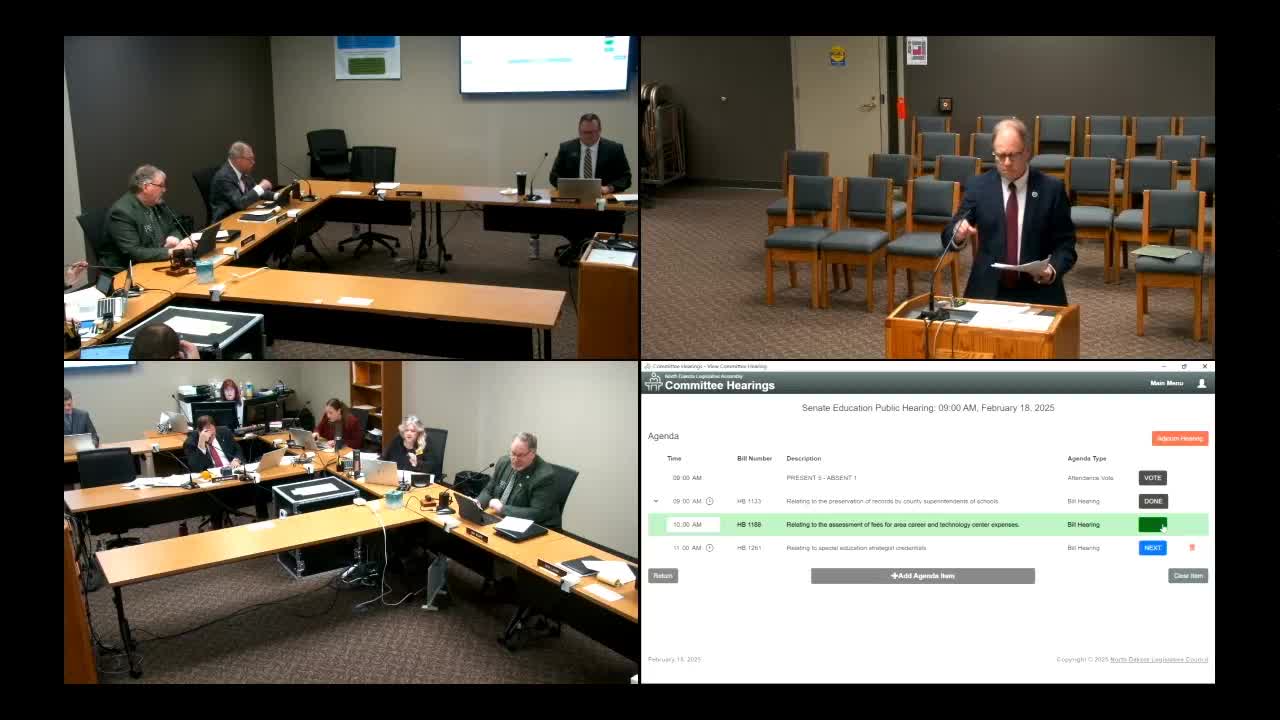
The Senate Education Committee voted to give House Bill 1188 a due-pass recommendation after hearing testimony that the measure would let area career and technical education (CTE) centers use flexible methods to allocate operating costs among member schools.
Representative Mike Lefor, District 37, introduced the bill and said recent investment and expansion of CTE centers created situations where the current enrollment-based fee structure is unfair to small, distant districts. "Under current law, these academies are required to assess their operational costs based on school membership and not on utilization or ability to access these programs," Lefor said.
Wade Sick, state director for the Department of Career and Technical Education, testified the bill was drafted by CTE center directors statewide and would keep a base membership fee tied to high-school enrollment while allowing boards to assess additional costs based on usage or access. "This would be especially advantageous as new centers continue to expand and allow member schools an on ramp as they take advantage of the great CTE centers have to offer," Sick said.
Aaron Anderson, director of the Southwest Area Career and Technical Education Academy in Dickinson, gave examples of how the present approach can price rural districts out of participation. Anderson said Beach High School, about 62 miles from the academy, currently has two students attending daily and uses mobile labs, but under the present statutory formula Beach would be assessed more than $82,157 to be a member. He said his center instead expects to charge a modest base membership fee—"about a 25 to $3,500 assessment"—plus an estimated $700–$800 per credit for class participation.
Committee members asked whether larger districts that would pay a bigger share had plans to absorb higher costs; witnesses said those districts had been engaged in planning and expressed willingness to support smaller partner schools. The committee heard no opposition testimony.
A motion for a due pass was made and seconded; the committee voted 5 yeas, 0 nays, 1 not voting. Senator Lem agreed to carry the bill.