Get Full Government Meeting Transcripts, Videos, & Alerts Forever!
Get email alerts on the House Bill 581 Floating Homestead topic
No spam. Unsubscribe anytime.
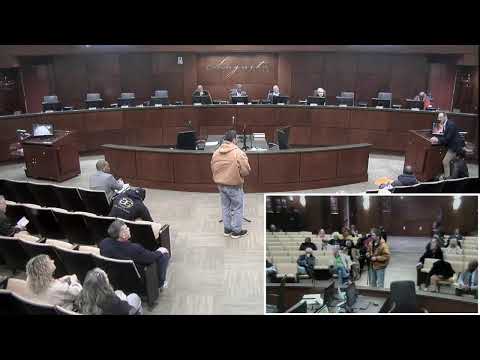
Augusta holds third public hearing on House Bill 581 floating homestead; commission has not decided whether to opt out
Summary
Augusta officials held a third public hearing on House Bill 581’s new statewide floating homestead exemption and the option for a local floating sales tax (FLOST), with staff outlining how the change would cap home taxable assessment increases at the prior-year consumer price index and public commenters split on whether the commission should opt out.
Augusta officials held a third public hearing on House Bill 581’s new statewide floating homestead exemption and the option for a local floating sales tax (FLOST), with staff outlining how the change would cap home taxable assessment increases at the prior-year consumer price index and public commenters split on whether the commission should opt out.
City staff said the statewide constitutional amendment implementing the floating homestead became effective Jan. 1 and that Richmond County’s voters approved the amendment in November by about 62% to 38%. Scott Rountree, Richmond County chief appraiser, told the hearing that “the homestead exemption applications are due April 1 of every year” and explained that the floating exemption would use a base year (2024 for existing homesteads) and limit taxable-value increases to the prior-year CPI (Rountree said the 2024 CPI used in examples was 2.9 percent).
The nut of the proposal, staff said, is that the floating homestead would exempt from taxation any increase in a homesteaded property’s assessed value that exceeds the CPI cap for the base year; the exemption remains with the property and owner while they occupy it, can transfer to a surviving spouse, and resets if the property is sold or substantially altered. Interim Finance Director Tim Schreier and Scott Rountree showed staff analyses that the program would raise total exemptions and shift tax burden to non-homesteaded property (commercial, multifamily and other classes) rather than reduce total local revenue, because taxing authorities would use a higher rollback rate to collect needed revenue.
Staff gave numerical examples: a $100,000 home that increased in market value to $110,000 but faced a CPI cap of 4% would be taxed as if its value rose only to $104,000 (leaving $6,000 exempted); the presenters said the example produced a roughly $15 annual savings at the county maintenance-and-operations millage in their simplified illustration. Staff also presented digest-level modelling showing residential share of the tax digest falling from about 53% to roughly 50% if the floating exemption had been in place since 2021, noting the exact effect depends on future appreciation and CPI.
If the commission remains "in" under the statewide structure, the county may place a FLOST on the ballot (Schreier said Augusta would be limited to a half-cent FLOST because of an existing Coliseum Authority sales tax). Schreier warned that a successful FLOST would shift more revenue toward sales tax — he described a hypothetical shift from an approximately 50/50 split of property-to-sales revenue toward a roughly 70/30 split favoring sales tax — and cautioned this concentrates revenue in a single stream that could fall in a recession. He said a FLOST referendum must be voted on every five years and that, per staff remarks, “as of today, there is no method to change after March 1.”
Public commenters voiced mixed views. Moses Todd, who identified himself as a disabled veteran, said, “I am for this commission opting in, not out. The voters opted in.” Resident Dan Funch said he was “distressed that 7 of our commissioners are not here” for the hearing and argued elected officials should respect the recent vote. Sue Parham, a consultant who advises the Augusta Metro Chamber Of Commerce, summarized a common business concern: “This is a cost shift, because the floating exemption only applies to homesteaded properties,” and warned higher costs on commercial property could pass to renters and customers in a county with many multifamily units.
Other speakers raised questions about how the change interacts with school and other taxing authorities; staff said the school board is facing the same decision process and that the board’s vote was scheduled for 6 p.m. the same day. Staff repeatedly emphasized their position that the statewide change is structured to be revenue-neutral for levying authorities overall because exemptions are intended to be offset by adjusted rollback rates rather than an absolute revenue loss.
The mayor closed the hearing by reiterating that the governing body has not taken a position: “We only get 1 chance at this. If we’re in, we’re in for good. But if we opt out, at least it gives us an opportunity to put something unique and very specific to Augusta,” he said, listing protections the county could pursue locally if it chooses to opt out. The public hearing record closed after commissioners invited last questions and thanked attendees; no formal vote or directive was recorded at the hearing.
Next steps noted at the hearing: the commission must decide whether to opt out (opting out requires a local action and preserves local authority to craft alternative relief), and if it remains in it must consider whether to place a half-cent FLOST question on the November ballot (FLOST referenda recur every five years). The school board was conducting its own hearings and planned a vote later that day.
Ending: The commission completed the third required public hearing on HB 581’s floating homestead and FLOST option; commissioners said they will use information from the hearings, digestion modelling and public input before taking a formal opt-in/opt-out vote.