Get Full Government Meeting Transcripts, Videos, & Alerts Forever!
Get email alerts on the Bond Covenants topic
No spam. Unsubscribe anytime.
Treasurer: bond covenants (the “bond lock”) link guardrails to investor protections; violating them risks litigation and downgrades
Summary
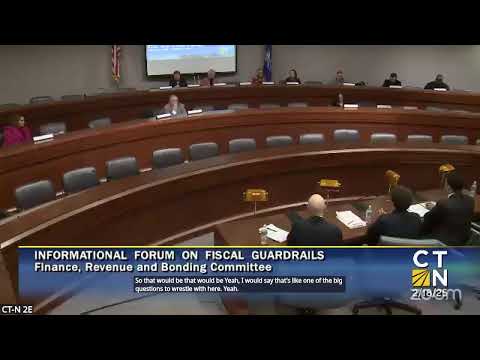
Connecticut State Treasurer told the committee that statutory bond covenants — the so‑called bond lock — tie compliance with the spending, revenue and volatility caps to bond contracts; the covenants were initially included in bonds sold 2018–2020, renewed by the legislature in 2023 and now expire in 2033 absent action
The state treasurer briefed the committee on the bond covenants (often called the bond lock), explaining that the covenants are contract terms in the state’s bond documents that refer to the statutory fiscal guardrails and prohibit certain statutory changes for the protection of bondholders.
The treasurer said the covenant is “a legally binding agreement that restricts actions of the issuer,” and that the intent is to protect bondholders and the issuer’s ability to make scheduled debt‑service payments. The covenants commonly include continuing disclosure and reporting requirements and promises not to alter the statutory frameworks that underpin the state’s fiscal controls without triggering the covenants’ mechanics.
Timing and scope: the treasurer outlined a timeline: the covenants were enacted in the 2017 statute, included in bonds sold from May 15, 2018 through July 1, 2020, expired on July 1, 2023, and were renewed by the legislature in January 2023; the current statutory schedule would let them expire July 1, 2033 unless the General Assembly adopts a resolution between January 1 and July 1, 2028 to change or amend the guardrails earlier.
Risks of violation: the treasurer identified three categories of consequences if the state violated covenants: litigation risk (bondholders could sue), reputational harm with the investment community, and potential rating‑agency actions that could increase the state’s cost of borrowing. The treasurer said the covenants have been a factor in the state’s communications with investors and rating agencies and in recent rating improvements.
Practical note: the treasurer explained that some statutory changes are explicitly contemplated in the guardrail statutes (for example, threshold adjustments to the volatility cap under specific circumstances) and that some mechanisms to alter controls would not automatically violate the covenant because the statute provides procedures for specified changes.
Ending: the treasurer concluded by offering to answer questions; committee members pressed about interactions with rating agencies and potential effects on borrowing costs and pension funding.