Get Full Government Meeting Transcripts, Videos, & Alerts Forever!
Get email alerts on the Data Centers Ai topic
No spam. Unsubscribe anytime.
Lawmakers hear competing views on AI/data-center growth, energy demands and the need for state standards
Summary
Developers, utilities, environmental groups and public-interest organizations debated whether Connecticut should create reporting and efficiency rules for large AI/data centers; testimony covered grid capacity, water use, noise, backup generation and how costs should be allocated.
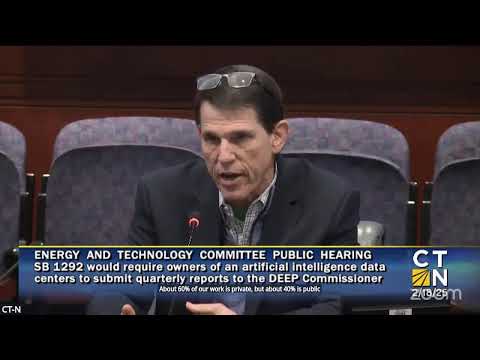
A lively debate over how Connecticut should regulate large-scale data centers and new AI computing facilities took center stage during the Energy & Technology Committee hearing.
Supporters of reporting and efficiency standards urged the committee to require quarterly disclosure of energy and water use and directed DEEP to set minimum energy- and water-efficiency standards for data centers (SB 1292). Environment and consumer groups said unchecked growth of large facilities can stress grid capacity, raise generation and system costs for all ratepayers, and concentrate water and noise impacts in host communities.
Witnesses from Eversource and other utilities said integration and procurement planning are necessary if large loads appear; Eversource asked for coordination with PURA and cited the need for clear interconnection and settlement timelines. Several environmental witnesses suggested linking new centers to renewable-energy commitments, and recommended standards that favor closed-loop cooling and limits on water-intensive cooling methods.
Developers and trade representatives countered that modern hyperscale and AI facilities use advanced air-cooled and closed-loop designs, can be sited on industrial land, and often invest millions in local infrastructure and host agreements. Project proponents said many projects plan behind-the-meter generation strategies that avoid diesel/gas backup and will pay public-benefit charges and interconnection costs so costs are not shifted to other ratepayers.
Committee members pressed for more data: what would be the impact on reliability if multiple large facilities came online, how much new generation would be needed, how to treat behind-the-meter arrangements in procurement, and how to protect communities from noise and water impacts. Witnesses pointed to other states— ongoing work (MA, GA, and others) and urged Connecticut to adopt clear standards for energy, water and community protections rather than ad hoc approvals.
Concluding note: the hearing surfaced trade-offs among economic development, job creation and environmental planning. Lawmakers signaled interest in measures that require reporting, set efficiency standards and ensure costs and environmental impacts are explicitly addressed before large AI facilities are cleared to proceed.