Get Full Government Meeting Transcripts, Videos, & Alerts Forever!
Get email alerts on the Fiscal Guardrails Overview topic
No spam. Unsubscribe anytime.
OFA: Connecticut fiscal guardrails will make $1.6 billion unavailable to FY26 budget; BRF at statutory cap
Summary
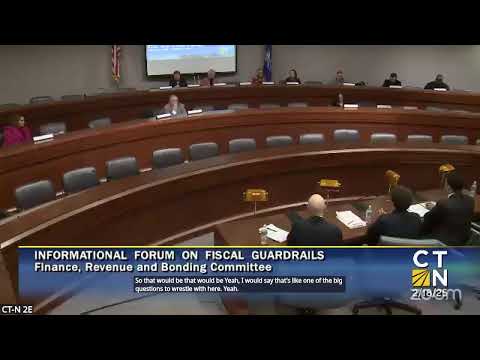
The Office of Fiscal Analysis told the Finance, Revenue and Bonding Committee that Connecticut’s fiscal guardrails will remove roughly $1.6 billion from amounts available to be appropriated for fiscal 2026, with most of that sum coming from the volatility cap.
The Office of Fiscal Analysis told the Finance, Revenue and Bonding Committee that Connecticut’s fiscal guardrails will remove roughly $1.6 billion from amounts available to be appropriated for fiscal 2026, with most of that sum coming from the volatility cap.
The presentation said the combined impact of the revenue cap and the volatility cap for FY26 is $1,600,000,000; the volatility cap portion is about $1,300,000,000 and the revenue cap about $300,000,000. Neil Ayers of the Office of Fiscal Analysis summarized the history and the current mechanics of the guardrails, saying, “the fiscal guardrails were adopted after the long and painful summer and fall of, 2017.”
Why it matters: those caps remove money from the pool of revenue that lawmakers may appropriate in the upcoming biennium. According to OFA’s slides and presentation, deposits above the BRF cap instead have been used to reduce unfunded pension liabilities, producing actuarial savings that have lowered future required contributions.
OFA described how the pieces interact. Bill Lederman and Chris Wetzel, who identified themselves as OFA cap experts, walked the committee through the mechanics: the volatility cap applies to estimated and final personal income tax payments and the pass-through entity tax; revenue above the volatility threshold is transferred first to the BRF (until the BRF hits its cap) and afterwards to pension and liability reduction. The BRF itself is capped at 18% of general fund appropriations in the current fiscal year; OFA projected the BRF balance at $4.2 billion for FY26.
OFA gave a short history and figures. Lederman said the volatility cap threshold is $4.1 billion for FY26 compared with projected E&F and PET collections of $5.4 billion, producing the $1.3 billion volatility transfer. Lederman also noted that OFA is using January consensus revenue estimates as the baseline for those FY26 numbers.
OFA also described the revenue cap mechanics: it limits the amount of revenue that can be appropriated to 98.75% of the revenue estimate (a 1.25% budgeted surplus), and there is a similar, smaller cap on the transportation fund (about $30 million). Chris Wetzel told the committee the spending (appropriation) cap growth factor for the upcoming biennium is 5.11%, based on the five‑year compound annual growth in personal income, which equates to about $1.0 billion of allowable cap growth for FY26.
OFA credited earlier deposits above the BRF cap with reducing the state’s unfunded liabilities and creating savings; the presentation said prior contributions toward the state employee and teachers retirement systems have generated roughly $727,000,000 in realized savings that affect FY26. As Lederman explained, those savings arise because additional deposits reduce actuarially determined employer contribution levels over time.
Legal and procedural context: OFA emphasized the statutory mechanics that accompany the fiscal guardrails. The presentation noted statutory exemptions (for example, federal funds, debt service and certain transfers are uncapped), base adjustments when appropriations move on or off budget, and the existing emergency override (a governor’s emergency declaration plus 3/5 vote of each chamber to exceed the spending cap).
No formal policy change was adopted at the hearing. Committee members asked questions and will continue deliberations; OFA and other presenters said they would provide additional detail on request.
Ending: presenters said the forum’s stated purpose was descriptive rather than prescriptive — to provide lawmakers with the data and the mechanics they will need for upcoming budget decisions.