Get Full Government Meeting Transcripts, Videos, & Alerts Forever!
Get email alerts on the Municipal Budget topic
No spam. Unsubscribe anytime.
Mayor and council spar over budget priorities: Gateway repayment, Browns negotiations, police overtime and lead-testing policy
Summary
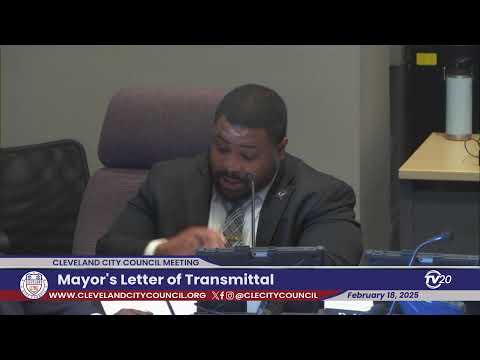
Mayor Justin Bibb and Cleveland City Council used a budget transmittal hearing to press administration officials for details about revenue assumptions and to demand follow-through on prior promises of restored funding for programs from which money was taken to support capital work at Gateway.
Mayor Justin Bibb and members of Cleveland City Council used a budget transmittal hearing to press administration officials for details about revenue assumptions and to demand follow-through on prior promises of restored funding for programs from which money was taken to support capital work at Gateway.
The hearing highlighted several potential budget risks and program priorities: a property reappraisal and income-tax growth that helped lift the general fund forecast; a pledge by city finance staff to restore $5 million moved last year from several programs to Gateway; concern from multiple council members about the Cleveland Browns’ negotiations and the city’s need to “be made whole” if the team moves; sharply higher police overtime costs even as officials said overtime hours have fallen; a dispute between city law and administration over whether lead-safe certificates require a lower-cost lead clearance exam or a more expensive lead risk assessment; and questions about EMS staffing, Cleveland Public Power, park and recreation staffing, and community-development funding.
City finance staff and the mayor framed the revenue side first. “As you recall, last year, there was a reappraisal of property values, which will increase the income significantly by $15,000,000 I believe,” said Paul, a finance staff member during the hearing, and he added the budget also reflects roughly 3% income-tax growth in recent results though the city is conservatively budgeting income tax at 2% going forward. The administration said those factors contributed to an increase in the general-fund projection from roughly $783 million last year to about $806 million this year.
Council members pressed the administration on funds diverted during last year’s Gateway financing. Councilman Kerry McCormick and others noted that money had been removed from a SWAT building, turnout gear, a minority business contractor program and approximately $5,000,000 from supplemental accounts. “That was a promise that was made when we took the funds out of those programs, and they will be, returned and funded this year, whether that's through borrowing or through an NCA,” Paul said.
Several council members, most vocally Councilman Michael Polensic, raised the Browns’ reported interest in moving to Brook Park and asked what the city will do if the team leaves the lakefront. “We have to be made whole in Cleveland,” Polensic said, noting the city’s ongoing debt service and capital obligations tied to the stadium. Mayor Bibb said the administration and the city’s litigation team at Jones Day are working to protect taxpayers and that legal remedies and model legislation have been pursued to preserve the city’s financial position.
Public-safety spending drew heavy attention. Council members pointed out that police overtime dollars rose sharply. “Police overtime has doubled from what it was last year,” Councilman Polensic said, citing a jump from $13,000,000 to $26,000,000. Mayor Bibb pushed back with department-level data to show overtime hours had declined year over year, saying, “In 2024, we had 425,641 hours of overtime. In 2023, we had 514,765 total hours of overtime, a nearly 90,000 hour decrease.” The administration and police leaders said some overtime spending supports enforcement details, warrant sweeps and violent-crime task forces while wage increases and 12-hour shifts have reduced the need for mandatory overtime.
Council members also raised EMS staffing shortages and projected overtime increases tied to vacancies. Finance staff said EMS had 17 vacancies in the adopted budget and that the administration would reassess staffing midyear if the vacancies were filled.
A separate and sharply debated operational issue was lead-safety testing for rental certificates. Councilman Chris Harsh said the council’s ordinance requires a lead-clearance exam and asked the mayor to rescind an executive order that the administration issued in practice requiring a lead-risk assessment instead. Mayor Bibb replied, “Not at this time. ... I have no intentions of rescinding my executive order,” and said the administration believes a risk assessment is the best available testing for determining hazards prior to issuing certificates. Council members said the higher-cost risk assessment could discourage landlord participation and create a mismatch between the council’s ordinance and the administration’s direction; both sides said they will continue to work together to align policy and practice.
Council members used the hearing to press on other policy priorities tied to the budget: ensuring promised funds for small-business contracting and minority business programs are restored after Gateway funding moves; maintaining support for Destination Cleveland, the Greater Cleveland Sports Commission and the Greater Cleveland Film Commission; investing in Cleveland Public Power infrastructure and considering CPP’s role in powering municipal facilities; and the new stand-alone division of urban forestry carved out of Parks and Recreation.
On homelessness, Mayor Bibb highlighted the administration’s Home for Every Neighbor program and said it remains a budget priority; the mayor said the city will seek county support and private fundraising to sustain the program.
The hearing closed with repeated commitments from the administration to return detailed plans: the finance team said it will provide a specific plan for restoring funds diverted to Gateway, the mayor said he will continue to brief council on Browns negotiations, and department chiefs will return with operational details on EMS recruitment, overtime drivers and Cleveland Public Power options.
The council scheduled follow-up operational hearings and midyear reviews to reconcile vacancies, monitor revenues versus conservative budget assumptions, and resolve policy conflicts such as the lead testing standard.