Get Full Government Meeting Transcripts, Videos, & Alerts Forever!
Get email alerts on the Reestablishment Of Parental Rights topic
No spam. Unsubscribe anytime.
Senate Judiciary Committee recommends due pass for bill allowing limited reinstatement of parental rights
Summary
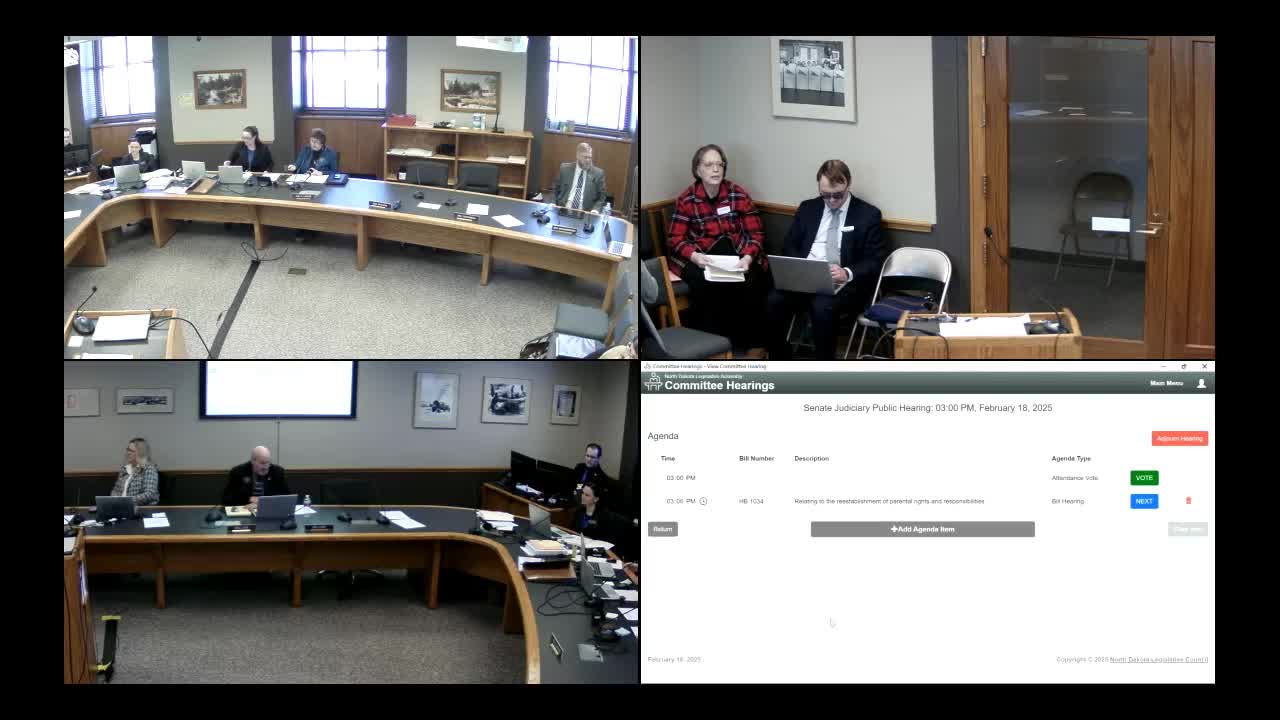
The Senate Judiciary Committee voted to give House Bill 1034 a committee recommendation after testimony that the measure would create a narrow, rarely used process for some parents to seek reestablishment of parental rights for children who have lingered in foster care.
The Senate Judiciary Committee voted to recommend passage of House Bill 1034 after hearing testimony that the bill would create a narrow process for some parents to seek reinstatement of parental rights when a child remains in foster care more than a year after a termination of parental rights.
Supporters told the committee the option would be used infrequently but could benefit children for whom adoption or another form of permanency has not been secured. Julie Hoffman, adoptions administrator with Children and Family Services at the Department of Health and Human Services, told the committee, “This bill addresses potential, reinstatement of parental rights.” Hoffman said the measure grew from an interim study directed by the 2023 legislative session and that a stakeholder work group reviewed statutes from other states and state foster-care data.
Under the bill as described to the committee, a petition for reestablishment may be filed only by a party to the original termination-of-parental-rights proceeding, must be filed at least 12 months after the final termination order, and cannot be filed if the child has been adopted or is under a formal pre-adoptive placement. The bill requires a prima facie review at filing and sets the petitioner’s burden of proof at clear and convincing evidence. Hoffman said the court “may consider the child's preference regarding the reestablishment of parental rights.”
Travis Fink, executive director of the Commission on Legal Counsel for Indigent and a member of the bill work group, said the drafting group tried to “make it as narrowly tailored as possible” and to build in safeguards to avoid a flood of petitions. Fink described several limits and protective features: exclusions for cases where termination was based on findings of abuse or where a parent has a conviction for intentional conduct that caused substantial bodily harm or death; a possible trial home visit supervised by the human service zone; appointment of counsel for the child regardless of income; and counsel for birth parents subject to an indigency determination.
Kim Jacobson, director of the Agassi Valley Human Service Zone and president of the North Dakota Human Service Zone Directors Association, told the committee the bill responds to a small group of children who have “lingered in our state's foster care system with no family connections and no permanent home.” Hoffman told the committee that, as of Jan. 1, 2025, there were 119 children in foster care whose terminations of parental rights were more than one year old; of those, 23 were in adoptive placements and six had final adoptions as of Jan. 7. Jacobson said roughly 12 children are currently in the category of having a termination and no permanency plan and that the measure would let the state assess whether changed parental circumstances could support reinstatement for a small number of cases.
Committee members pressed on practical questions. Senator Castaneda asked whether reinstatement would be possible after finalization of an adoption; Hoffman replied, “You're correct. Once an adoption is finalized, it would not be open to this, reinstatement of parental rights.” Senator Myrtle asked about appointment of counsel and whether the Commission on Legal Counsel for Indigent would represent parents; Travis Fink said the commission typically provides counsel for indigent parties and uses conflict counsel where needed.
Witnesses and staff acknowledged an uncertain fiscal impact for indigent-parent representation if petitions proceed to hearings. Fink said the work group could not determine how many cases would reach evidentiary hearings and that costs “may be that we come back after this law passes and we see that, okay, there was 2 or 3 and maybe there's a cost there.”
After testimony and brief discussion, the committee moved a recommendation of “due pass” on House Bill 1034 (motion moved by Senator Mehrdal; seconded by Senator Bromberger). A roll-call showed affirmative votes from Senators Myrtle, Brownberger, Paulson, Cory, Castaneda, Luke and Chair Larson. The committee announced the motion carried and that Senator Merdahl will carry the bill forward.
The bill's key procedural features described to the committee include: a 12-month waiting period after termination before a petition may be filed; petitioner eligibility limited to parties from the original termination proceeding; prima facie review at filing; evidentiary hearing only if the prima facie showing is met; a clear-and-convincing burden of proof; automatic appointment of counsel for the child; counsel for birth parents tied to indigency; a possible supervised trial home visit; express exclusions for terminations based on certain abuse findings or convictions; and a judicial option to bar subsequent petitions after denial.
No formal fiscal estimate specific to anticipated caseload was presented at the hearing; witnesses said they expect only a small number of petitions annually.