Get Full Government Meeting Transcripts, Videos, & Alerts Forever!
Get email alerts on the Inspections And Engineering topic
No spam. Unsubscribe anytime.
Engineers and building officials explain SIRS, milestone inspections and coastal risks
Summary
Panelists clarified that Structural Integrity Reserve Studies (SIRS) are financial planning tools while milestone inspections assess actual structural deterioration; coastal salt exposure and stormwater/runoff issues accelerate corrosion and may justify shorter inspection cycles in some areas.
Engineers and building officials told a Florida House subcommittee Jan. 23 that SIRS and milestone inspections serve different but complementary purposes and that coastal exposure accelerates structural deterioration.
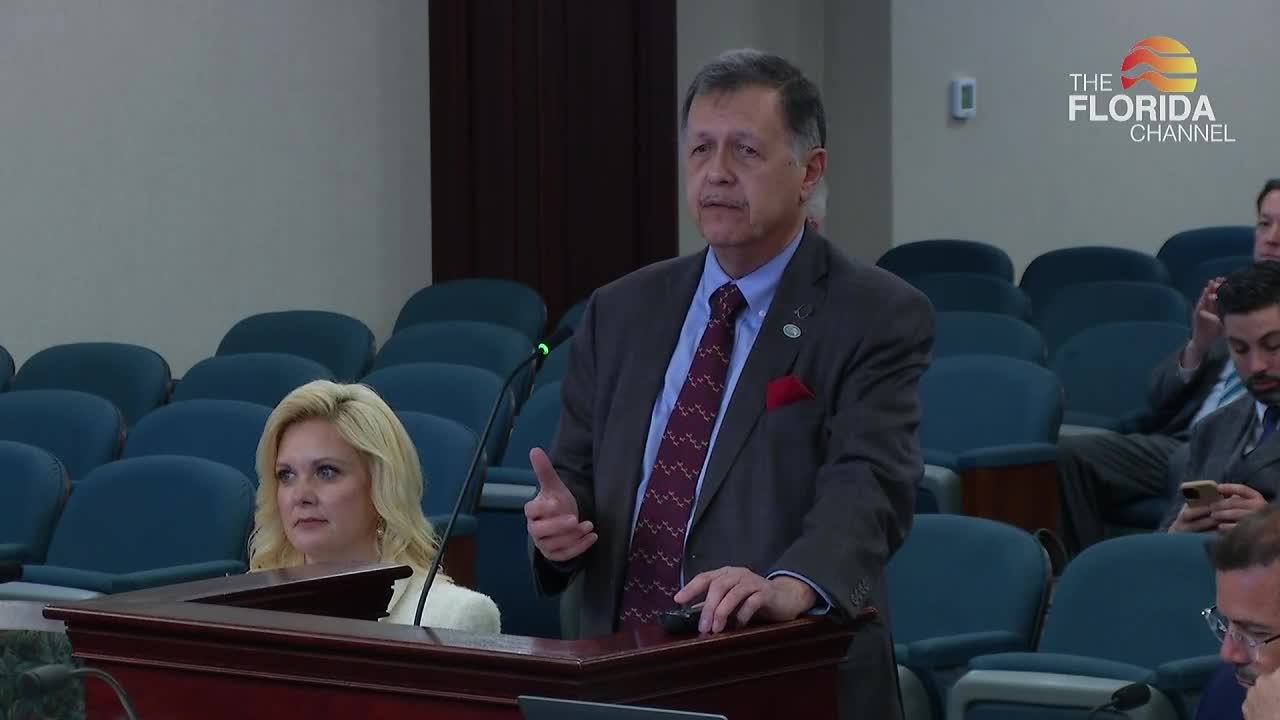
Walter P. Moore senior project manager Nogueira explained to the committee that a SIRS (Structural Integrity Reserve Study) estimates remaining life and funding needs for eight building elements, while a milestone or recertification inspection—required of certain buildings—assesses structural and enclosure deterioration. “The SIRS is focused on the financial lifespan of the building,” he said, while milestone inspections “are looking at the structural deterioration of the building.”
Building officials’ representative Ron LaSaika described the two‑phase process used in many jurisdictions: Phase 1 is a life‑safety visual survey by a licensed engineer or architect; Phase 2 is a more detailed evaluation and scope of repairs. LaSaika said jurisdictions vary on triggers and timelines; some use 30‑year cycles, while Miami‑Dade applies a coastal rule and uses 25 years for buildings within three miles of the shoreline.
Panelists emphasized coastal saltwater’s effect on reinforced concrete. Nogueira said steel reinforcement with insufficient concrete cover can corrode faster near the coast, causing expansion and spalling that accelerates structural damage. He described corrosion as behaving “like a cancer”: once it starts it can progress rapidly and require larger repairs if not corrected early.
Several witnesses recommended clearer, uniform statewide standards and earlier notice to owners. LaSaika said jurisdictions that notify associations two years in advance allow boards and managers time to obtain qualified engineers, prepare construction documents and plan finance options; witnesses suggested that a statewide 25‑year trigger would reduce confusion compared with mixed 25/30‑year rules.
Panelists also raised process‑level issues: many associations lack maintenance records and equipment logs, DBPR’s statewide database cannot currently generate trend analysis because submissions are voluntary and nonstandard, and there is uneven local capacity for inspection and permitting. Nogueira and LaSaika recommended coordination between milestone inspections and existing local recertification programs to avoid duplicative costs for associations.
Ending note: engineers urged prioritizing early inspection and maintenance to limit exponential deterioration and avoid the large, disruptive assessments that can follow deferred maintenance.