Get Full Government Meeting Transcripts, Videos, & Alerts Forever!
Get email alerts on the Autism Services topic
No spam. Unsubscribe anytime.
Committee advances bill to expand autism screening, extend Early Steps to age 4
Summary
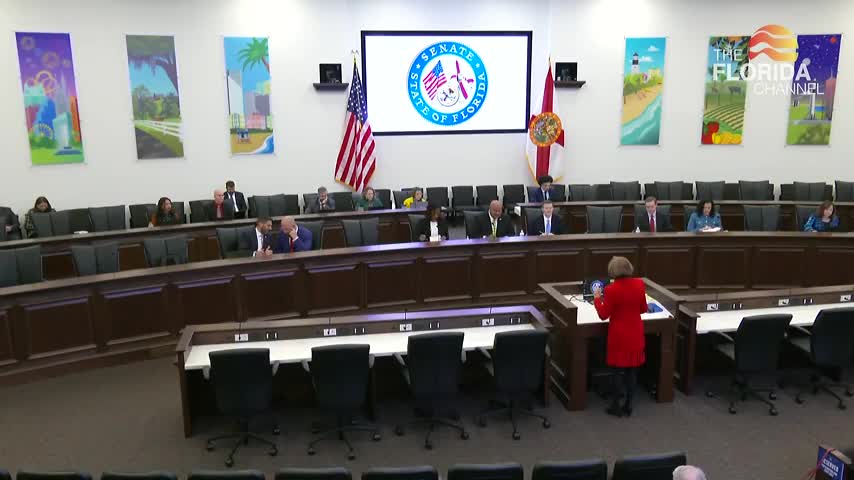
The Senate Committee on Education Pre-K - 12 advanced CS for SB 112, carried by Senator Harrell, a bill that expands autism screening, extends Early Steps services through a child’s fourth birthday and creates new grant programs and training to increase services for students on the autism spectrum.
The Senate Committee on Education Pre-K - 12 advanced CS for SB 112, carried by Senator Harrell, a bill that expands autism screening, extends Early Steps services through a child’s fourth birthday and creates new grant programs and training to increase services for students on the autism spectrum.
Senator Gayle Harrell, sponsor of the bill, told the committee the measure responds to a growing number of autism diagnoses in schoolchildren. “We have increasing numbers of children being diagnosed with autism every single year,” Harrell said, adding that earlier intervention improves long-term outcomes.
The bill does several things: it expands the Dr. and Mrs. Alfonso and Kathleen Sanati Healthcare Screening and Services Grant Program to include autism screening and referrals; it creates an “early steps extended option” that extends eligibility from the child’s third birthday until the child’s fourth birthday; it designates a university-level center as a statewide hub to coordinate autism awareness, research and grant administration; it establishes grants to create or expand autism-focused charter schools with priority for underserved and rural areas; it funds summer programs targeted to children with autism; and it creates a specialized autism micro-credential for instructional personnel and paraprofessionals, with an authorized stipend for credential earners subject to appropriation.
Harrell characterized the early-steps extension as a way to keep home-based services available until school-based services begin at age 4. She described the expansion of the grant program and the statewide hub as tools to centralize research, best practices and grant administration.
The committee adopted three Harrell amendments before voting on the bill. Amendment barcode 244,056 was a technical clarification to ensure the Early Steps extension consistently covers the period from the child’s third birthday until the fourth birthday; amendment barcode 710,906 expanded eligibility for the autism micro-credential to include pre-kindergarten instructors and childcare personnel and added a stipend subject to appropriation; and amendment barcode 893,798 corrected references to centers for autism and related disorders. Harrell closed on each amendment and each was adopted by voice vote.
Supporters who waived or filed testimony included James McFadden of Autism Speaks, Dean Justice of the Arc of Florida, Nathan Hoffman of the Foundation for Florida Future, and Raquel Regalado, a Miami-Dade County commissioner and former Miami-Dade School Board member, who spoke in support and described local early-intervention work. Regalado said local programs that expand the age range can reach children diagnosed later, particularly among African American and Hispanic children, and stressed the importance of early access to services.
Senator Berman asked about fiscal consequences; Harrell acknowledged the bill will have fiscal impact but said she expects to pursue state and federal resources and indicated the bill is intended to position the state to draw federal matching dollars through the relevant federal program and waiver process. Harrell told the committee that pursuing the federal option would result in roughly a 50/50 state–federal cost split for services tied to a federal waiver.
By roll call, the committee reported CS for SB 112 favorably.
The bill will move to subsequent committees for fiscal review and further consideration.