Get Full Government Meeting Transcripts, Videos, & Alerts Forever!
Get email alerts on the National Guard topic
No spam. Unsubscribe anytime.
Florida National Guard outlines operations and asks federal review of force structure; Senate memorial reported favorably
Summary
Florida National Guard officials briefed a Senate committee on force size, deployments and disaster response; a separate memorial asking the National Guard Bureau to examine Florida’s force‑structure allocation (SM 314) was reported favorably by the committee.
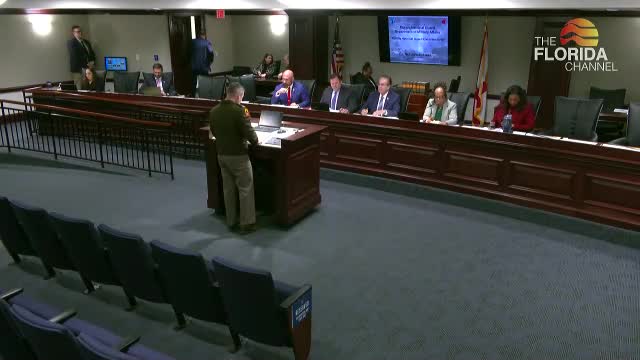
The Florida National Guard told a Senate committee it faces sustained high operational tempo at home and abroad while continuing a multi‑year effort to modernize facilities and grow its force. Colonel Jason Hunt, speaking for Major General James Haas and the Department of Military Affairs, described force structure, deployments and state support during recent hurricanes.
Hunt said the Florida Guard’s mission set includes federal deployments, state emergency response and community support. He described approximately 12,300 assigned guardsmen across the state, six major subordinate commands, 62 community armories and responsibility for more than 82,000 acres and 900 buildings. He also reported more than 450 personnel currently deployed overseas and roughly 1,200 members preparing to deploy in coming months.
Domestic activity was a central theme: Hunt recounted three consecutive hurricane responses in 2024 that mobilized thousands of guardsmen (3,500 for Hurricane Debbie, 4,000 for Helene and 6,800 for Milton), generating thousands of missions and tens of thousands of man‑days. He told the committee Florida ranks near the bottom nationally for guard personnel per population — a condition he said increases operational burden for responding units. ‘‘We are an undersized force,’’ he said, noting Guardsmen currently average roughly 93 days of duty per year when mobilized.
Committee members praised the Guard’s response and asked about infrastructure growth. Hunt pointed to new and upgraded facilities — including new armories in Immokalee and Zephyrhills and major construction at Camp Blanding — and credited state funding and the governor’s involvement in recent projects.
Separately, Senate Memorial 314 — carried by Chair Wright — asks the National Guard Bureau to reexamine Florida’s force‑structure allocation, which committee members said is based on outdated population ratios. The committee recorded a favorable report on SM 314. Chair Wright and several senators urged further advocacy in Washington to increase approved force structure for Florida.
Why it matters: the briefing highlighted the Guard’s dual federal‑and‑state workload and framed a formal request (SM 314) for federal review of force structure as a response to increasing disaster demands and population growth in Florida.
What’s next: the memorial was reported favorably and the Guard’s testimony gives committee members a record to use in follow‑up advocacy for more federal force structure and continued state investment in readiness and infrastructure.