Get Full Government Meeting Transcripts, Videos, & Alerts Forever!
Get email alerts on the Economic Development topic
No spam. Unsubscribe anytime.
Economic development seeks $213.3M; commissioners warn energy constraints could limit growth
Summary
The Department of Economic and Community Development requested $213.3 million and highlighted heavy use of reserves, rural investments and a push for nuclear‑supply and small modular reactor grants; commissioners and senators debated energy supply limits — particularly TVA capacity — and pipeline projects such as XAI.
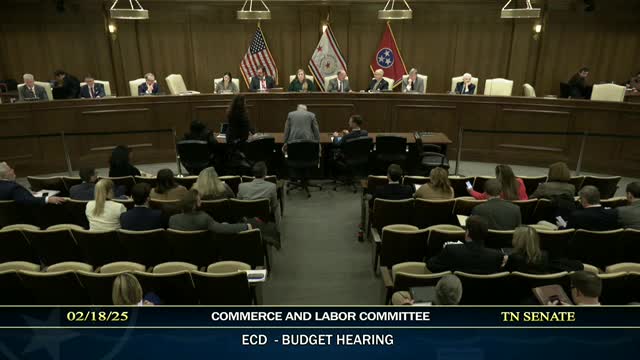
Stuart McWhorter, commissioner of the Tennessee Department of Economic and Community Development, presented a $213.3 million fiscal‑year request to the Senate Commerce and Labor Committee, framing the request as a strategic shift toward workforce development, research and development, site readiness and rural community investment.
McWhorter said $151.1 million of the request would be funded from department carry‑forward and that $62.2 million is new state appropriations (of which $10.2 million would be recurring and $52.0 million nonrecurring). He told the committee the department intends no new positions and described a multiyear pipeline of projects: since the start of the governor’s administration the department has landed roughly 605 projects representing about 100,000 net new jobs and more than $41 billion in capital expenditure; roughly half of recent projects and a large share of new jobs have been in rural Tennessee.
Nut graf: McWhorter used the budget hearing to summarize ECD’s recruiting and site‑development work, explain how the department proposes to spend reserve balances and to defend continued targeted grant spending on nuclear industry supply chain development and small modular reactor (SMR) support — measures he said are needed for long‑term energy resilience that supports large advanced manufacturing projects.
The commissioner reviewed several program lines members asked about: the headquarters relocation assistance program will be reduced now that qualifying rebates are complete; the site readiness program and broadband investments remain central to the agency’s pitch for competitiveness; and SBIR/STTR support and a proposed $10 million expansion for those federal commercialization programs are a part of the package.
Several senators pressed the commissioner on energy availability for large power users. Senator Taylor delivered extended remarks warning that energy supply — not only workforce — is becoming the limiting factor for attracting advanced manufacturing and data center projects. Commissioners and staff described current engagement with the Tennessee Valley Authority (TVA) and said TVA already is investing in additional peak capacity; McWhorter and deputy commissioners argued the state’s nuclear supply‑chain funds are designed to build a domestic supplier base and to support TVA’s Clinch River small modular reactor work. McWhorter said the state will consider a $50 million match for a Department of Energy grant tied to a TVA SMR project and that a separate $10 million nuclear industry initiative grant request would supplement earlier appropriations (the state previously set aside $60 million for nuclear supply chain efforts and has announced or accepted roughly $13.5 million of grants with about $17.3 million pending while dozens more projects remain under evaluation).
McWhorter and staff also described how the department handled TruGreen’s recent relocation decision: the department said incentives apply only to net new Tennessee jobs, and that baseline counts and accountability agreements are used to prevent incentives from subsidizing in‑state relocations that do not create net new employment.
Ending: After extended questioning on energy and rural infrastructure, the committee voted to move the ECD budget to the Senate Finance Committee for consideration.