Get Full Government Meeting Transcripts, Videos, & Alerts Forever!
Get email alerts on the Child Welfare Dcs Presentation topic
No spam. Unsubscribe anytime.
Tennessee Department of Children’s Services outlines staffing gains, prevention push and new placement capacity
Summary
Department of Children’s Services told the Children and Family Affairs Subcommittee it has reduced caseworker vacancies and turnover, expanded specialized teams and is building new intake and assessment facilities while prioritizing prevention programs in 15 high‑incidence counties.
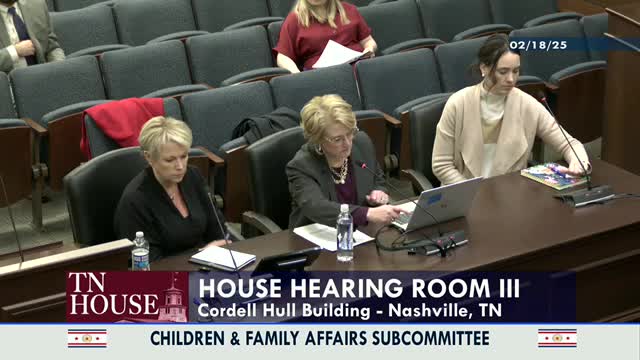
The Tennessee Department of Children’s Services on Thursday told the Children and Family Affairs Subcommittee that it has reduced staffing gaps and is shifting toward prevention and specialized placements to reduce foster‑care entries and disruptions.
“As the child serving agency in a position of public trust, it is vitally important that the Department of Children Services gets it right every time,” Commissioner Margie Quinn said in opening the department’s presentation. She later told members, “We have to get it right every single time. Every single time. We cannot afford to get it wrong, not 1 time.”
Quinn and her senior staff told the committee the department’s workforce and placement picture has improved in recent years and that the agency is investing in prevention, treatment teams and new real‑estate capacity. Deputy Commissioner Carla Aaron said the statewide child abuse hotline received roughly 151,770 calls last year and that DCS opened about 62,000 child protective services cases that resulted from those calls.
Aaron described specialized drug teams that work with infants and young children exposed to substances, saying those teams served “a little over 2,400 kids” last year and often respond at hospitals within hours of a birth. She also described a human‑trafficking investigative team that partners with law enforcement and a planned pilot in Shelby County to provide case management for custodial youth identified as trafficking victims.
Quinn described reductions in turnover and vacancies: first‑year case‑manager attrition fell from a 2021 high of about 97% to 18% in 2024; overall case‑manager turnover dropped from 29% to 16.8%; and vacancies declined from 692 to about 150. She said the department converted 47 long‑vacant positions in January and that the state is investing in tools to hire and retain staff.
On placements and facilities, Quinn said DCS is implementing a real‑estate plan that has identified nine properties: six intake facilities (12–15 beds each) and three permanent assessment centers (24 beds each). The department has opened 72 clinical assessment beds at the Clover Bottom campus and expects another 24 beds to come online soon. Quinn said a 24‑bed assessment facility in Gallatin for boys opened and is expected to reach full capacity this month. The department also plans to rebuild Wilder with 144 secure beds in Somerville and build a new Woodland Hills facility in Nashville.
Quinn said the agency is targeting 15 counties that together account for roughly 50% of foster‑care entries with an expansion of Intercept, an in‑home therapeutic program run with Youth Villages. DCS currently uses 550 Intercept slots and has asked to increase that number to focus services in those counties; Quinn said the Intercept program runs six to nine months and “has a 93 percent success rate.”
Committee members pressed DCS for more breakdowns of the data on calls, CPS cases and human‑trafficking referrals. Representative (first name not provided in transcript) asked whether the 151,770 hotline calls were unique; Aaron clarified the 151,770 figure represents incoming calls and web referrals, and that about 62,000 of those resulted in CPS cases (she emphasized those are case counts, not individual children). Members also asked for county and regional breakdowns of CPS activity, prosecution rates for trafficking cases and tracking of allegations against foster parents; Aaron said the department has county‑level data and a special investigations unit that handles foster‑parent allegations and offered to share those datasets with members.
Several members raised poverty, truancy and youth running from care as underlying drivers. Aaron said the department trains case managers with a poverty‑simulator exercise to improve empathy and that poverty by itself is not treated as child abuse. On truancy and school attendance for youth in the department’s care, Aaron told members the state does not physically force youth to attend school and that truancy often reflects deeper family or behavioral issues; she said the Intercept and prevention strategies are meant to keep youth at home and address root causes rather than defaulting to custodial placement.
Quinn and DCS staff also urged volunteer and community engagement through the Every Child Tennessee initiative, which they said generated “an overwhelming” volunteer response since launching in August 2024 and is intended to provide supports — from mentors to practical help for foster parents — that reduce disruptions and support placements.
The presentation prompted a range of follow‑up requests from members for more detailed, disaggregated data and for prosecution statistics from law‑enforcement partners. The department said it would provide further county and region breakdowns, allegation types and information about foster‑parent investigations on request.
The subcommittee did not take formal action on the presentation itself; the session returned to the committee agenda after questions and comments.