Get Full Government Meeting Transcripts, Videos, & Alerts Forever!
Get email alerts on the Maternal Health Screening topic
No spam. Unsubscribe anytime.
Committee advances bill to add pregnancy syphilis and hepatitis C screening; one dissent
Summary
House Bill 0111 would require an additional syphilis screening in late pregnancy and add hepatitis C testing at the first prenatal test; the Population Health Committee advanced the bill 6-1 after Department of Health testimony about rising congenital syphilis.
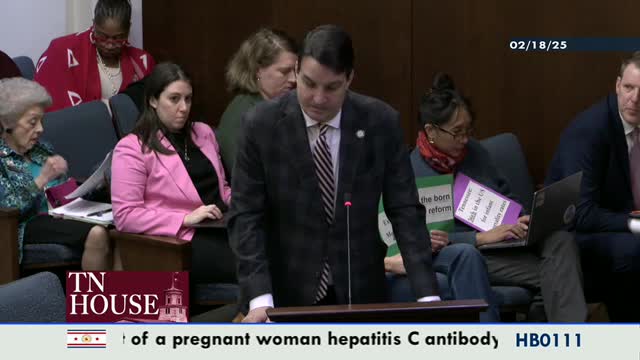
House Bill 0111, sponsored by Representative Martin, advanced from the Population Health Committee by a 6-1 vote after the Department of Health explained the public-health rationale for the changes.
Representative Martin said a constituent and public-health data prompted the bill. He said Tennessee reported a 548 percent increase in congenital syphilis cases between 2019 and 2023 and that, for babies born with congenital syphilis in 2022–2023, at least 53 percent of cases could have been prevented with timely screening. The bill would add an additional syphilis screening in late pregnancy (between about the 28th and 32nd week of gestation) and require a syphilis test at delivery. It also would add hepatitis C testing to the initial prenatal screen and leave hepatitis B testing to a physician's discretion, the sponsor said.
Grayson Carter, a liaison from the Department of Health, told the committee the current code requires mandatory testing at the first prenatal visit (or at delivery if prenatal care begins at birth) for syphilis, rubella immunity and hepatitis B; the department proposes adding hepatitis C to that first test and making the later syphilis (and hepatitis B) screen mandatory for all pregnancies rather than only for those previously classified as high risk. Carter said the department's recommendation responds to a recent rise in congenital syphilis and emphasized that syphilis is a bacterial infection that "can be treated easily with antibiotics." The committee briefly questioned the need for the change; Chairman Clemens asked the department to explain the impetus for mandatory additional testing.
The clerk read the vote as 6 ayes and 1 nay. The committee chair said the bill will move to full Health Committee review.