Get Full Government Meeting Transcripts, Videos, & Alerts Forever!
Get email alerts on the Banking Regulation topic
No spam. Unsubscribe anytime.
State banking regulator urges tailored oversight as Tennessee loses community banks
Summary
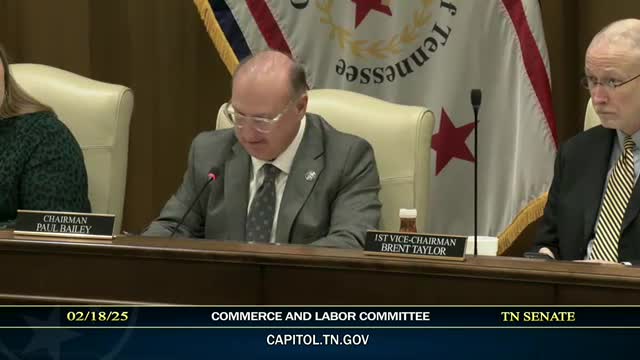
Commissioner Gonzales of the Tennessee Department of Financial Institutions told the Senate Commerce and Labor Committee the agency favors tailored oversight to preserve community banking and flagged staffing, examiner training and rule‑reduction work as the department’s priorities.
Commissioner Gonzales of the Tennessee Department of Financial Institutions told the Senate Commerce and Labor Committee that the department’s goal is to preserve a safe, sound banking system while avoiding “one‑size‑fits‑all” regulation that can harm community banks.
Gonzales said state regulators oversee state banks, credit unions, trust companies and many non‑deposit entities and that Tennessee has seen a long decline in the number of state‑chartered community banks. “Since ’92, we have gone from 207 Tennessee state banks to 104 today,” he said, adding that the number would be lower if federally chartered banks that later converted to state charters were excluded. He said the department has not seen a new state bank since 2008 in many cases, and that reversing that trend is an objective.
The commissioner told the committee the department is funded by the entities it regulates and that state law calls on the department to provide a safe and sound system. He said federal regulatory policy changes can create unfunded work for state supervisors and that Tennessee seeks a regulatory balance that supports local economic development. Gonzales suggested efficiency measures — such as having state examiners perform the examinations of the smallest federally supervised institutions and sharing those exams with federal partners — as one way to shorten examination timelines and improve timeliness for well‑rated, lower‑risk banks.
Nut graf: Gonzales framed his testimony during the department’s budget hearing as a policy and operational briefing: he described long‑term declines in community banks, ongoing efforts to reduce departmental rule burdens, staff vacancies and the multiyear training pipeline for examiners — and he asked the legislature to consider narrowly targeted statutory authority related to deposit insurance characteristics so Tennessee can respond if federal deposit‑insurance policy changes.
On staffing and training, Gonzales said it historically takes about five years to train an examiner and that the department has shaved only a few months off that schedule because much training is mandated or provided through federal courses. He credited recent salary support from the governor and legislature with improved recruitment and retention but said vacancies remain and that absorbing a larger exam workload — if federal responsibilities were shifted to the state — would require careful staffing and funding decisions.
Gonzales also reviewed the department’s rule reduction work, saying the agency has repealed three entire rule chapters and is processing four more, plus partial repeals and amendments to two other chapters, as part of an effort to eliminate unnecessary regulation.
On policy proposals, Gonzales asked the legislature to consider a narrowly drawn bill that would give the department explicit authority to require certain deposit‑insurance characteristics for state banks so the state can coordinate if deposit‑insurance policy is debated at the federal level. He said the request is intended to preserve Tennessee’s ability to work with federal partners and the governor’s office if deposit‑insurance rules change in Washington.
Ending: After questioning from committee members about examiner training and possible efficiencies, the committee moved the department’s budget to the Senate Finance Committee; the clerk recorded the budget motion as adopted and the committee closed the DFI portion of its agenda.