Get Full Government Meeting Transcripts, Videos, & Alerts Forever!
Get email alerts on the Property Tax Relief topic
No spam. Unsubscribe anytime.
Comptroller warns property‑tax relief reserve will be exhausted within two years without action
Summary
The Comptroller’s office told the Senate Finance committee that the state’s property tax relief program for low‑income elderly, disabled residents and 100% service‑connected disabled veterans is drawing on reserves and will require additional recurring appropriation or policy changes to avoid proration by FY2027.
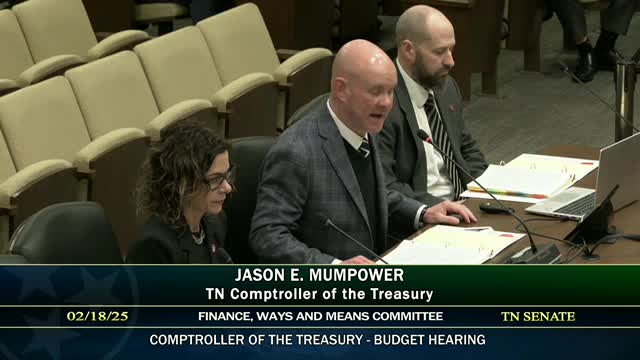
The Comptroller of the Treasury told the Senate Finance, Ways and Means Committee on Feb. 18 that Tennessee’s property‑tax relief program for low‑income elderly, disabled residents and 100% service‑connected disabled veterans is being funded in part from reserves and will require additional recurring appropriations or program changes within a two‑to‑three year window to avoid proration.
Jason Mumpower, comptroller of the treasury, said the program’s current FY26 appropriation is $41.2 million but that the program will pay an estimated $47.3 million in benefits this fiscal year. “By FY2027 … we will need an additional $10.3 million in order to fund the program,” Mumpower said, describing current enrollment growth and trends pointing to continued increases in claims, particularly in the disabled‑veteran category.
Ken Morel, division of property assessments, presented multi‑year projections at the committee’s request. Morel said current trends imply materially larger funding needs over the next several years; committee discussion referenced a scenario where cumulative additional funding needs could total roughly $60 million over a multi‑year horizon if current growth continues.
Comptroller staff identified three options for addressing the funding gap: (1) make no changes and allow the program to be prorated (the statute allows prorated payments if funds are insufficient); (2) change eligibility or benefit levels now (for example by changing value limits or income thresholds); or (3) appropriate additional recurring general‑fund dollars to fully fund the program. Staff cautioned that proration would change the timing and amount of relief for recipients because the program historically pays relief in advance and sometimes directly to county trustees.
Committee members and staff asked specific questions about drivers of growth. Staff attributed most of the near‑term growth to an increase in the number of 100% service‑connected disabled veterans and surviving spouses, citing roughly 14.5% growth in that recipient group in the past year. The Comptroller noted that the low‑income elderly and disabled recipients make up about two‑thirds of program recipients but receive roughly one‑third of benefits; the 100% service‑connected disabled‑veteran cohort is smaller by count but receives a larger share of total benefit dollars.
Members asked about policy options being considered in this legislative session. Staff reported several bills had been filed that would expand or alter eligibility and noted that those changes would increase program costs; conversely, reducing benefit levels or tightening eligibility would reduce cost but change benefit amounts for recipients.
Comptroller staff said the program did not require additional appropriations for FY26 but that the office will continue to use reserves this year and that the committee and administration should plan for a recurring funding action or program redesign to avoid proration in FY27.
The Comptroller’s office provided committee members a handout with multi‑year projections and said staff would provide additional reserve breakdowns and the statutory citations that establish committed or assigned reserves upon request.