Get Full Government Meeting Transcripts, Videos, & Alerts Forever!
Get email alerts on the State Finance Acfr topic
No spam. Unsubscribe anytime.
State accountants tell finance committee Tennessee’s 2024 ACFR shows positive net position but smaller gain than prior year
Summary
Comptroller staff presented the 2024 Annual Comprehensive Financial Report to the Senate Finance Ways and Means Committee, saying Tennessee ended FY24 with a positive net position but a smaller year‑over‑year increase than FY23, and noting much of the prior year’s larger increase reflected one‑time federal receipts that have now diminished.
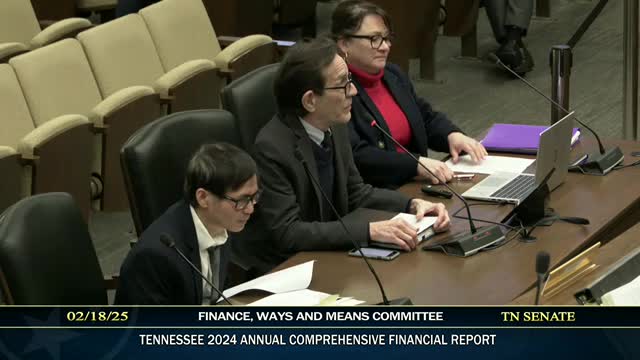
State financial officers briefed the Senate Finance, Ways and Means Committee on Feb. 18 about Tennessee’s 2024 Annual Comprehensive Financial Report (ACFR), saying the state ended fiscal 2024 with a positive net position but with a smaller increase than the prior year, in part because large one‑time federal inflows during the pandemic period have largely run off.
“Last year’s net position increased by approximately $6 billion. This year’s increase was only about $2 billion,” Michelle Hernandez, deputy chief of accounts, told the committee, explaining the change in the context of federal dollars that boosted prior years’ totals.
The ACFR, prepared by the Division of Accounts, covers government‑wide statements and fund financial statements across 65 funds and 11 component units and received an unmodified audit opinion, the highest level of assurance from external auditors. Hernandez said the ACFR is a primary source for bond rating agencies and creditors and shows the state’s resources and restrictions, noting Tennessee ended FY24 with net position of approximately $62.4 billion.
Staff highlighted several elements of the report for members: the statement of activities (which shows operating versus program revenues), the fund statements (which present major fund activity such as the highway fund), extensive footnotes, and a high pension‑funded ratio (presenters said the state’s pension funding was about 95% funded at fiscal year end). Tuan Lee, director of financial reporting, walked members through schedules that compare total pension liabilities, assets in trust and resulting funded percentages.
Committee members used the presentation to ask for context about the meaning of net position and the drivers of year‑over‑year change. Comptroller staff affirmed that a large portion of last year’s stronger increase reflected federal pandemic‑era receipts that have waned and reminded members that ACFR totals mix state, federal and other public dollars.
Presenters also reviewed debt metrics, saying Tennessee’s debt to personal income remains low (presenters cited a 0.48% ratio for 2024) and noted recent GASB accounting changes (leases and subscription‑based IT arrangements) that added liabilities to the schedules and therefore slightly raised presented debt loads for recent years.
Committee members asked for source details used in schedules (presenters said personal‑income figures came from the Haslam Center’s economic report) and for follow‑up materials on committed and assigned portions of unrestricted net position (presenters said those amounts reflect statutory or appropriation directives such as highway modernization funds, TennCare reserves and education trust funds and that staff would provide a detailed list of reserves and their statutory authority).
Comptroller staff closed by noting the ACFR’s management’s discussion and analysis, notes and schedules offer detailed information relevant to upcoming budget deliberations and pledged to send committee members the reserves listing upon request.