Get Full Government Meeting Transcripts, Videos, & Alerts Forever!
Get email alerts on the Cal Waters Launch topic
No spam. Unsubscribe anytime.
State Water Board previews Cal Waters launch; $60 million program, digitization and June data freeze set timeline
Summary
At a public Upward Advisory Group meeting, State Water Resources Control Board staff demonstrated the Cal Waters portal that will replace ERIMS, outlined a multi‑million dollar budget and digitization plan for about 7 million paper records, and set a June freeze and mid‑July go‑live window followed by outreach before annual reporting seasons.
State Water Resources Control Board staff on Oct. 12 described Cal Waters, the division’s new web platform to replace ERIMS, and gave users a timeline for migration and outreach.
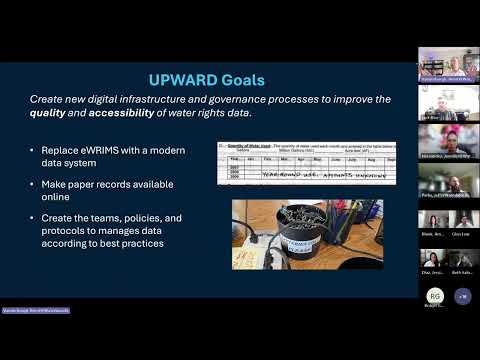
Brent Vanderberg, supervising geologist and project director for Upward California, told the Upward Advisory Group (UAG) the project is “not just developing an IT system. We’re developing a sustainable division” and that the program combines an IT build with data governance and operating policies. He said the project was funded in 2021 and that “the funding was 60,000,000 approximately it was funded over 2 years and about 40,000,000 of that is going to this IT system.”
The board plans to freeze incoming edits to the legacy systems on June 9 so data can be migrated. Staff said the current schedule anticipates staff access in early July and public registration shortly after, with staff available for outreach during the summer and an emphasis on enrollment and data correction during the first year. Jeff Parks, product owner, described a staged rollout so reporters can link existing records and staff can handle initial issues before the next major reporting deadlines in October and January.
Nut graf: The system aims to modernize how California collects and serves water‑rights information, make paper files accessible online, and improve data quality. Cal Waters combines a Salesforce‑based front end, Esri mapping, and a document management stack; staff emphasized the project pairs an IT build with policy changes and a standing governance team to maintain data quality after go‑live.
Supporting details: staff described a three‑part program: a new Salesforce‑based case and reporting management system; a large digitization effort to convert roughly 7 million physical records stored at CalEPA; and a telemetry research unit to analyze advanced metering under Senate Bill 88. Staff said consultants Gartner and Deloitte supported planning and that the California Department of Technology advised on state contracting and security requirements.
Vulnerabilities in the paper archive were part of the rationale for digitization. Vanderberg said some records are already degrading, and “we were probably gonna end up losing water rights documents” without scanning. Staff noted digitized records will enable modern search tools and could later be analyzed with machine‑assisted methods such as language models to find relationships and gaps.
Staff also described governance changes: a permanent data governance team will follow the development team, and training and desk aids will be prepared after the UI stabilizes. The project team will send a short survey to the UAG after the meeting and invited UAG members to test the system during an evaluation window planned for late April–May prior to public registration.
Ending: Staff asked UAG members to continue sending feedback to upward@waterboards.ca.gov. They said the next months will focus on enrollment and fixing legacy data issues rather than enforcing new reporting workflows, and that outreach to large reporters and communities will begin before the system is used for mass annual reporting.