Get Full Government Meeting Transcripts, Videos, & Alerts Forever!
Get email alerts on the Police Technology Lpr topic
No spam. Unsubscribe anytime.
Senate committee advances bill limiting law enforcement use and retention of license-plate reader data
Summary
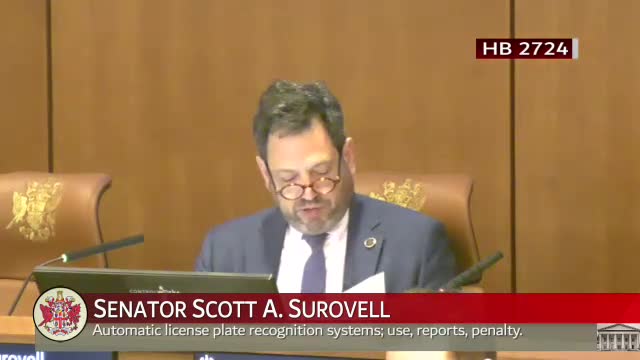
A Senate Courts of Justice Committee on-recorded hearing Wednesday reported House Bill 27 24 as amended after several hours of debate over data retention, sharing rules and oversight for automatic license-plate readers (LPRs).
A Senate Courts of Justice Committee on-recorded hearing Wednesday reported House Bill 27 24 as amended after several hours of debate over data retention, sharing rules and oversight for automatic license-plate readers (LPRs).
The bill, carried in the House as HB 27 24 and considered in the Senate committee, would limit how long LPR data may be kept to 21 days under the proposed substitute, require officers to record the name and justification when they query LPR data, restrict most interjurisdictional sharing, and task the State Commission (the committee referred to it as the Scribe Commission) with auditing and reporting on LPR use.
Why it matters: Virginia currently has no statewide limits on LPR retention or many commonly discussed transparency safeguards. Supporters said the substitute creates statutory guardrails — including audits and public reporting — that do not exist now, while opponents argued a shorter retention window will reduce the effectiveness of LPRs for investigations.
The substitute and the compromise
Majority Leader Leah Herring, who brought the substitute forward, said the agreement reduces the retention period and adds oversight measures reached after stakeholder negotiations. "This bill limits the way data can be shared in all feasible ways, though it cannot wholly avoid Federal warrants and subpoenas," Herring said, and noted the substitute cut data retention from 30 to 21 days.
Herring also told the committee the substitute would require officers to log their name, reason for a search and a case or call-for-service number when querying LPR data and would prohibit routine sharing with other states or the federal government "except for subpoena duces tecum or search warrant, which requires authorization by a judicial officer."
Supporters’ testimony
Monica Sarmiento, executive director of the Virginia Coalition for Immigrant Rights, told senators the bill provides protections that local communities lack. "These guardrails are long past due for our communities," Sarmiento said, urging the committee to pass the measure.
Solomon Ayoyelu of African Communities Together said the bill "limits how long data can be kept to 21 days," restricts certain kinds of data sharing, and requires auditing and transparency measures to prevent misuse of data for immigration or reproductive-health surveillance.
Opponents’ concerns
Representatives of law enforcement groups said the shorter retention period would make LPR systems less effective. John Jones of the Virginia Sheriffs’ Association said, "We can no longer support the bill because the retention time has been reduced to 21 days and that lessens the effectiveness of the program." Tina Schwab, representing police chiefs, said they opposed the substitute for the same reason and raised operational concerns about delayed enactment language.
Civil-liberties groups and a national privacy expert also testified in the hearing and urged stricter protections: Alastair Whitney of the Institute for Justice contended there should be a warrant requirement for searches of archived LPR data, saying, "There absolutely needs to be a warrant requirement before any office." Other witnesses representing immigrant and community groups urged adoption of the substitute because, in their view, it affords protections communities currently lack.
Debate over timing and scope
Committee members also debated whether the bill’s expansion provisions should take effect immediately, be delayed, or be placed in a reenactment/sunset clause to return to the General Assembly after a trial period. Senator (Favola) proposed a reenactment/delay approach for the expansion portion; after procedural confusion and reconsideration, the committee adopted a version that placed a limited reenactment/sunset-like timing on the expansion piece so the expansion would come back for review in later years while regulatory safeguards would take effect sooner.
Legal definitions and limits
Committee members asked whether the bill restricted sharing with federal authorities; supporters explained the bill constrains state and local sharing but cannot override federal warrants or subpoenas. Herring and other bill proponents referred the committee to the bill’s definitional language and to how the proposal narrows the statutory definition of "law enforcement" in order to focus the sharing restrictions on state and local agencies defined in the code.
Action and next steps
Senator Favola moved, and the committee recorded, that HB 27 24 be reported as amended; the roll call showed the bill reported out of the committee (Ayes 10, Noes 4, Abstentions 1). The committee clerk recorded that the bill will proceed to the finance committee later in the day.
What remains unsettled
Although the committee adopted the substitute and reported the bill, disagreements remain about the retention period’s public-safety effect, the precise mechanics of law-enforcement auditing, and whether the expansion provisions should be delayed or revisited in future sessions. Supporters say the statutory reporting and audit schedule will allow the state and the commission to evaluate effectiveness; opponents say the reduced retention harms investigative utility.
Proponents and opponents signaled they will continue work on details in later committees and on the floor. The bill’s language on who may query LPR data, the precise auditing standards and the handling of cross-jurisdictional requests are likely to draw further attention in downstream committees.
Ending note
The committee’s decision moves a compromise substitute forward while leaving key operational and constitutional questions to be addressed in later stages of the legislative process. The vote recorded in committee reflected a divided panel: some senators emphasized civil-liberty safeguards and local concerns; others emphasized investigative utility and operational impacts on law enforcement.