Get Full Government Meeting Transcripts, Videos, & Alerts Forever!
Get email alerts on the Solar Siting topic
No spam. Unsubscribe anytime.
Committee deadlocks on statewide solar‑siting standards after hours of testimony
Summary
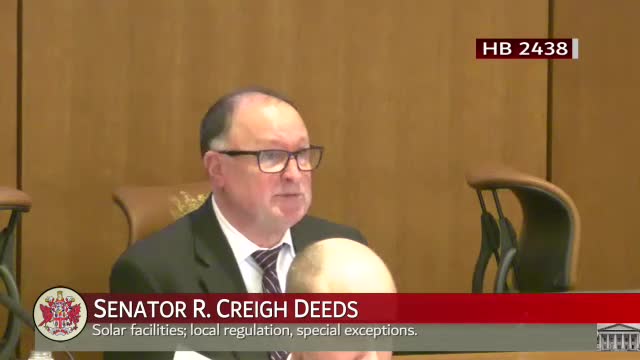
After more than an hour of public testimony both for and against, the House bill to create a model set of standards for siting large solar and storage projects (HB 24‑38) failed to move out of committee when the vote tied 7‑7 with one abstention.
A bill that would have created a standard set of criteria for large‑scale solar and energy storage siting across Virginia failed to clear the committee after a tie vote following lengthy public comment.
Delegate London King, sponsor of House Bill 24‑38, told the panel the measure was intended to “create a standard set of siting criteria so that localities understand what a good quality siting agreement can look like,” and said the bill preserves each locality’s authority to approve, modify or deny projects.
The bill’s proponents — including representatives of Sierra Club, the Atlantic Renewable Energy Coalition, American Clean Power Association, AES Clean Energy, Apex Clean Energy and union representatives — argued the measure would speed project negotiation, bring predictability for developers and protect landowners. “We think that it’s reasonable at a time of growing electricity demand to consider standards for all projects in the state,” Evan Vaughn of the Atlantic Renewable Energy Coalition said.
Opponents, led by local‑government and environmental groups, urged caution. Joe Lerch of the Virginia Association of Counties told the committee the measure “prescribes what must be in an ordinance for consideration” and removes flexibility for local officials to set standards that fit their communities. Kyle Shreve of the Virginia Farm Bureau and speakers from the Chesapeake Bay Foundation, Piedmont Environmental Council and Virginia Conservation Network said the bill’s prescriptive list of required criteria — setbacks, resource protections and other specifics — could undermine local planning and natural‑resource protection.
“Every locality is different,” Lerch said. “Those prescriptions, we feel, need to be decided by the locality.”
Delegate London King said the bill was intended to be a framework and pointed to language added via amendment allowing localities to continue to permit or disallow projects and to go beyond the baseline standards in the bill. She also cited provisions explicitly preserving local land‑use authority and requiring localities be able to require more stringent protections.
After public testimony that ran more than an hour, a motion to report the bill was placed before the committee. The roll call was 7 in favor, 7 opposed with 1 abstention, producing a tie.
With the vote tied, the bill did not advance from the committee during this hearing; members did not agree on a path to report it with the changes offered during testimony.
The debate highlighted a continuing tension in Virginia’s energy transition: how to reconcile faster deployment of renewable generation with local control and natural‑resource protections.
Members of both sides said they expected to continue discussions between stakeholders and localities in coming weeks.