Get Full Government Meeting Transcripts, Videos, & Alerts Forever!
Get email alerts on the Consumer Privacy topic
No spam. Unsubscribe anytime.
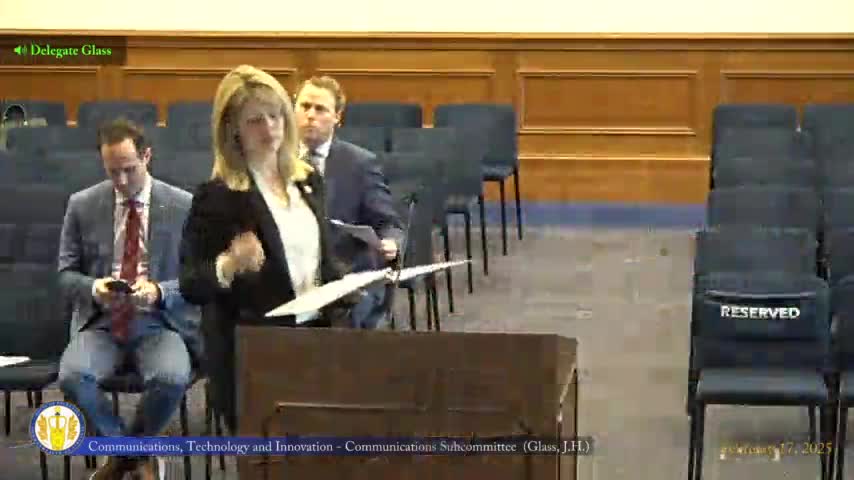
Subcommittee tables Senate Bill 1023 after divided testimony on banning sale of precise location data
Summary
The Subcommittee on Communications, Technologies and Innovations laid Senate Bill 10 23 on the table 6-3 after hearing proponents who said the measure would block sale of precise geolocation data and opponents who said existing Virginia law already covers it.
The Subcommittee on Communications, Technologies and Innovations laid Senate Bill 10 23 on the table after a 6-3 vote following testimony for and against a proposed ban on the sale of precise geolocation data.
Senator Perry introduced the measure as “Senate Bill 10 23,” saying the single-line bill would make it unlawful “to sell or offer for sale precise geolocation data concerning a customer.” The sponsor told the committee the ban would protect people whose daily travel patterns to sensitive facilities can be bought and sold by data brokers.
The bill’s supporters described concrete harms they said flow from the commercial trade in location data. Irene Leach of the Virginia Citizens Consumer Council said precise geolocation data has been used in stalking cases and other consumer harms. Matt Swartz, a policy analyst with Consumer Reports, told the committee that location information “is some of the most sensitive information about us” and said the multibillion-dollar industry of data brokers often traffics in that information without consumers’ knowledge.
Opponents argued existing law already addresses sensitive geolocation data. Margaret Durkin, Mid-Atlantic executive director for TechNet, said the Virginia Consumer Data Protection Act (VCDPA) already includes precise geolocation as sensitive data and that the current framework provides opt-in and other consumer protections. William Chanas Martinez, counsel for the State Privacy and Security Coalition, urged referral to JCOTS to assess the bill’s interaction with Virginia’s privacy framework. Brianna January of Chamber Progress also urged an unfavorable report, echoing concerns about upsetting the VCDPA balance.
Sponsor responses and clarifications: Senator Perry said enforcement would typically be handled by the attorney general’s office and defended state action in the absence of federal legislation. He also cited similar laws in other states and argued a ban would prevent data brokers from selling lists that can be used to target vulnerable populations.
Action and vote: Delegate Lopez moved to lay Senate Bill 10 23 on the table; the subcommittee voted to lay the bill on the table by a vote of 6–3.
Why it matters: Proponents said the ban would prevent sale of highly sensitive movement data that can reveal medical visits, places of worship and workplaces; opponents said Virginia’s existing statutory framework already regulates sensitive data and urged more study of how a new ban would interact with that framework. The vote means the bill will not advance from the subcommittee at this time.
What’s next: The committee’s recording shows the item was tabled; the transcript does not specify whether proponents or opponents intend to refile or amend the measure for future consideration.