Get Full Government Meeting Transcripts, Videos, & Alerts Forever!
Get email alerts on the Public Health Mask Policy topic
No spam. Unsubscribe anytime.
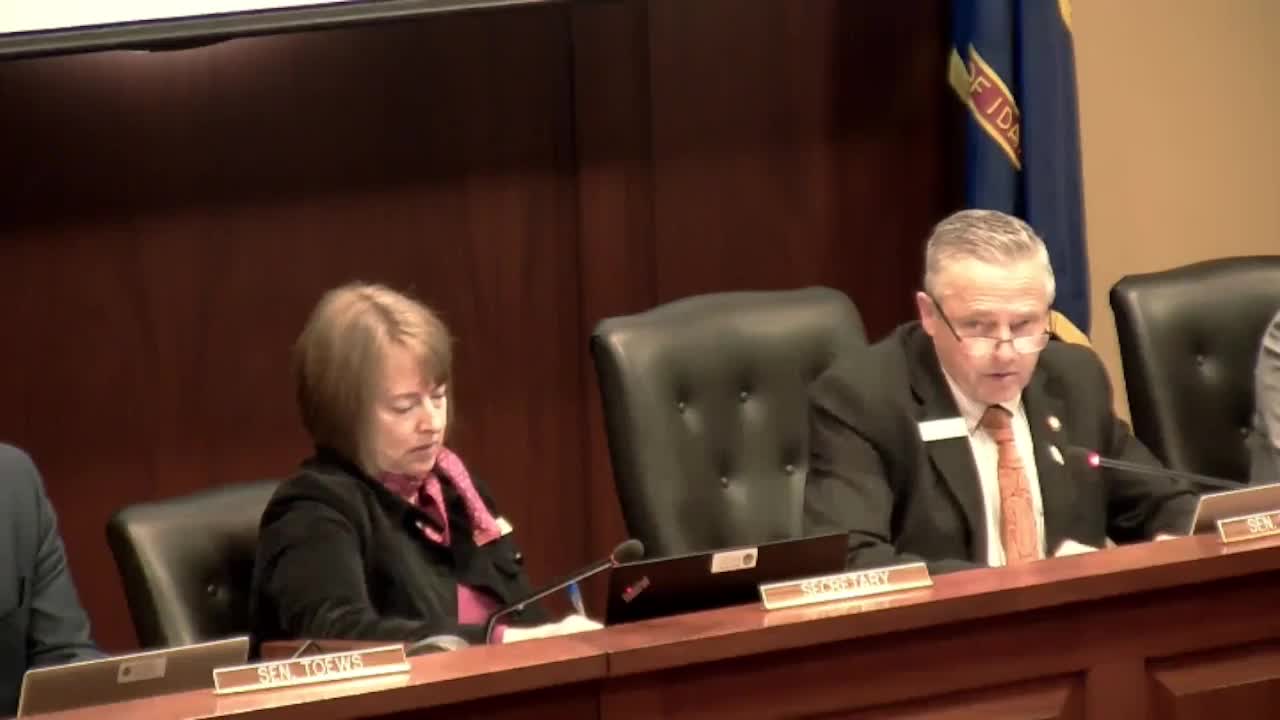
Senate State Affairs sends bill limiting government mask mandates to the floor
Summary
The Senate State Affairs Committee voted to send House Bill 32 to the Senate floor with a recommendation that it pass. The bill would prohibit state and political subdivisions from imposing mandatory public-health mask requirements while preserving exemptions for vocational/occupational protective uses.
The Senate State Affairs Committee voted to send House Bill 32 to the Senate floor with a recommendation that it pass, after extended testimony for and against limits on government mask mandates.
House Bill 32, introduced by Senator Brian Lenney (R-13 Nampa), would bar state agencies and political subdivisions from imposing compulsory face-mask requirements in public settings while explicitly preserving requirements where masks are an integral, compulsory safety component of required job duties (for example, certain vocational settings and health-care procedures). Lenney said the bill is intended to “draw a line between advisory and compulsory” measures and stressed that it would not prevent any individual from choosing to wear a mask.
The bill drew substantial public comment. Supporters included Thad Butterworth, chair of the Ada County Republican Party, who urged the committee to move the bill and said “the vast majority” of his party opposes mask mandates. Several witnesses described personal, religious or professional objections to mandates; Dr. Brandon Couchman and Misty Gardner each spoke in favor. Opponents included Kelly Packer, executive director of the Association of Idaho Cities, who said the bill would limit local authority to respond to emergencies, and John Evans, mayor of Garden City, who called the bill an “absolute” and urged caution because future threats or technologies could require different public-health responses.
Committee members debated the tension between protecting individual liberty and preserving local flexibility. Several senators said the bill includes exemptions for health-care and vocational uses; others warned language such as the requirement that recommendations be accompanied by a notice that they are not mandatory could create redundancy or ambiguity. Multiple members said they worried the measure could restrict local officials who are elected to respond to on-the-ground public-health threats.
After debate, the committee voted to send House Bill 32 to the floor with a recommendation that it pass. The vote was taken by voice; the transcript records several senators opposing the recommendation and records two senators as voting no on the motion. The bill will next be scheduled for floor consideration.
The committee’s action does not itself change existing local orders or guidance; it forwards the bill for full Senate consideration.