Get Full Government Meeting Transcripts, Videos, & Alerts Forever!
Get email alerts on the Education Schoolchoice topic
No spam. Unsubscribe anytime.
Senate committee advances parental-choice tax-credit bill after hours of public testimony
Summary
The Idaho Senate Local Government and Taxation Committee voted 6-3 to send House Bill 93 — a refundable parental tax credit to help parents pay for nonpublic education and related expenses — to the Senate floor after nearly three hours of testimony for and against the proposal.
At a hearing of the Idaho Senate Local Government and Taxation Committee, members voted 6-3 to send House Bill 93, a proposal creating a refundable parental tax credit for K–12 nonpublic education expenses, to the full Senate with a due-pass recommendation. The committee heard roughly two hours of public testimony and questions before taking the vote.
The bill as presented by Senator Lori Den Hartog, District 22, would allow parents to claim a refundable tax credit based on documented K–12 education expenses up to $5,000 per eligible student and up to $7,500 for eligible students with disabilities. The measure would apply to Idaho residents ages 5–18 (5–21 for students with disabilities), establish a $50 million annual cap on total credits the tax commission may approve, and set an effective date of Jan. 1, 2025 for qualifying expenses. Applications would open Jan. 15, 2026 for expenses in the 2025 tax year and remain open for a 60-day window; the tax commission would notify applicants within 30 days and maintain a wait list if demand exceeds the cap.
Senator Den Hartog described the bill as a family-centered program, saying, "school choice first and foremost is about kids and families, and it's not about the type of school or the type of system." She explained the program structure places responsibility on parents to retain documentation showing a child received instruction in the four specified academic areas (English language arts, mathematics, science and social studies) and to affirm the accuracy of applications. The bill provides an option for lower-income families (those at or below 300% of the federal poverty level) to request a one-time advance payment subject to recapture if the funds are not properly used; proponents said advance payments and a recapture mechanism are intended to increase access while managing misuse risk.
Committee questioning and public testimony focused on accountability, access and fiscal risk. Opponents raised concerns that private schools and micro‑schools would be able to refuse students and that the bill lacks the routine oversight applied to public schools. Sylvia Cheriton, testifying for the American Association of University Women, said the group "strongly oppose[s] HB 93" and urged investment in public schools instead of taxpayer funds flowing to private and religious schools. Quinn Perry of the Idaho School Boards Association said the bill "does nothing to ensure that the private schools or learning pods have even the most basic minimal oversight," including background checks and student‑access protections.
Supporters argued the credit funds parents rather than schools and would expand options for students whose needs are not met in their assigned public school. Jeff Himas, vice principal at Legacy Academy in Nampa, said the proposal could spur competition and encourage public schools to reduce unnecessary bureaucracy. Chris Cargill of the Mountain States Policy Center noted the proposal is separate from the public school budget and described research he said supports improved outcomes in jurisdictions with similar programs.
Senators and testifiers also discussed implementation details the bill assigns to the Idaho State Tax Commission: the commission must process applications, publish cumulative totals of credits claimed and remaining, notify applicants, and administer audits. Senator Den Hartog said a revised fiscal note adds personnel for the tax commission: two to three full‑time equivalent staff (the sponsor referenced three in committee discussion) and a small number of part‑time seasonal staff to support application processing, with the estimated personnel and a $125,000 software cost to be absorbed within the $50 million cap.
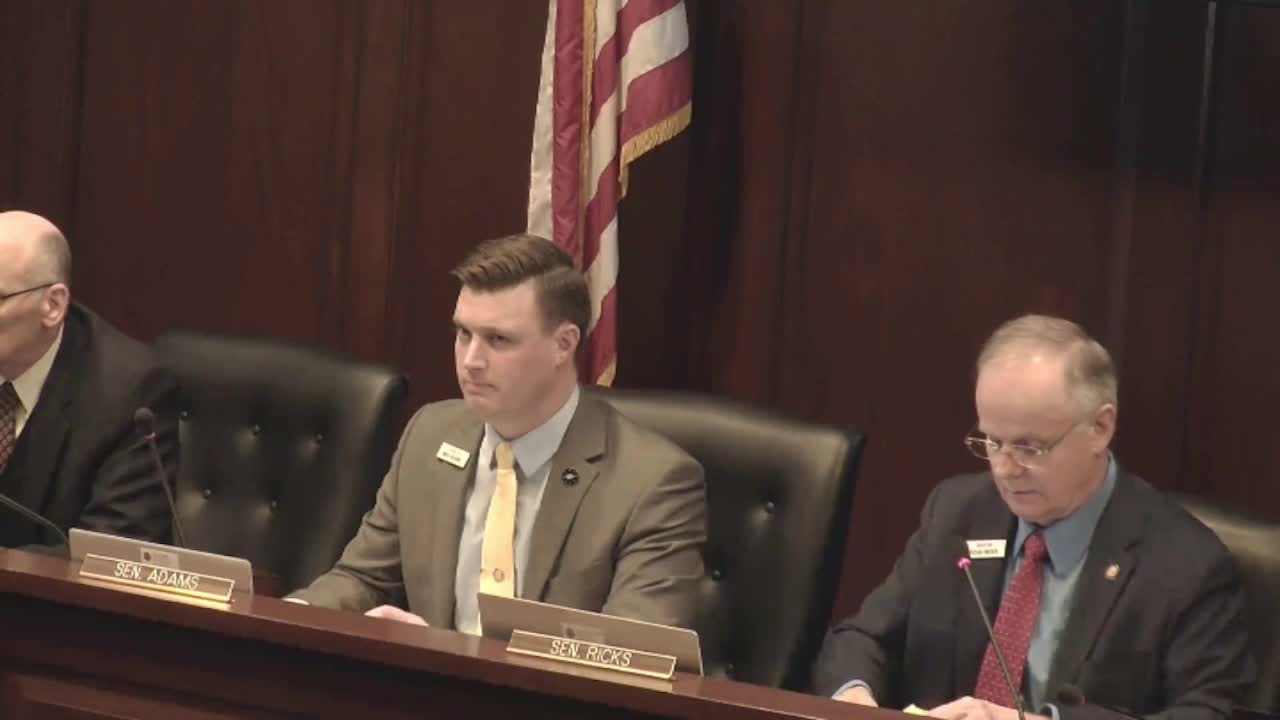
Formal committee actions recorded during the hearing included voice approvals of committee minutes from Jan. 30 and Feb. 4 and the final motion on HB 93. Senator Curtis Grohl moved that the committee send the bill to the floor with a due‑pass recommendation; Senator Jim Toews seconded. The substitute motion to hold the bill in committee failed on a recorded voice/roll call, and the committee approved the due‑pass motion on a roll call vote of 6–3. The recorded roll call on the due‑pass motion was: Senator Ricks — aye; Senator Adams — aye; Senator Grogg — aye; Senator Anthon — aye; Senator Burnt — no; Senator Den Hartog — aye; Senator Toews — aye; Senator Robby — nay; Senator Taylor — nay.
The hearing transcript documents a breadth of perspectives: parents and students described individual experiences with public and private school options and urged different outcomes; education groups, faith‑based school leaders and policy organizations offered data and constitutional or fiscal arguments; and several senators emphasized continued, separate investments in K–12 public education. With the committee’s due‑pass recommendation, HB 93 will proceed to the full Senate for floor debate and a final vote. Committee members and witnesses said more detailed discussion about safeguards, rural impacts and implementation capacity will likely continue on the Senate floor.
Ending: The committee adjourned after the vote. The bill’s next step is consideration by the full Idaho Senate, where senators indicated they expect a broader floor debate before a final disposition.