Get Full Government Meeting Transcripts, Videos, & Alerts Forever!
Get email alerts on the Tribal Voting Access topic
No spam. Unsubscribe anytime.
SB220 would require at least one satellite election office for each reservation; supporters cite access gains, counties warn of cost and operational complexity
Summary
Senate Bill 220 would require counties and tribes to provide permanent satellite election offices and other accommodations on tribal lands to increase access for Native American voters. Supporters described geographic and access barriers; county election officials warned of fiscal and operational challenges and urged collaborative solutions.
Senator Jonathan Windiboy introduced Senate Bill 220 as a response to gaps in on‑reservation voting access and court orders arising from litigation about Native voting rights. Windiboy said the bill would authorize tribes to select at least one permanent satellite election office within reservation boundaries (or a location that best serves tribal members where a tribe lacks reservation land) and would clarify use of tribal identification for voting purposes.
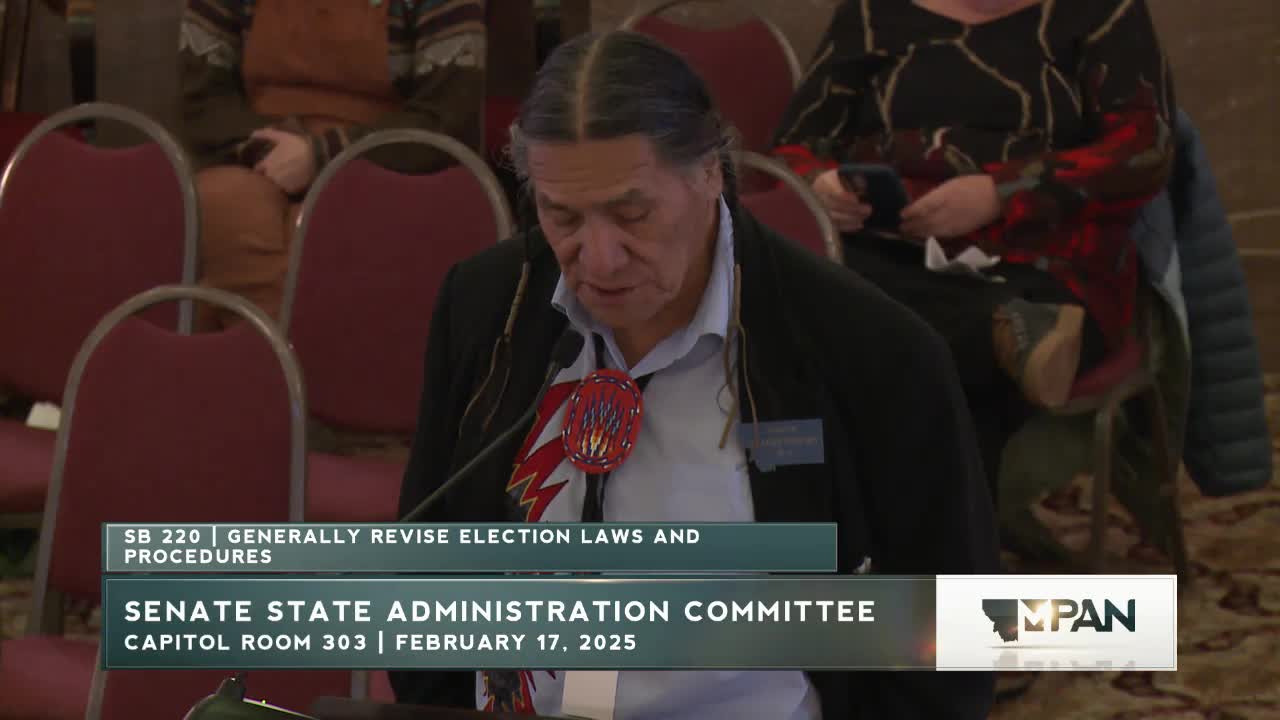
Multiple tribal, civic and nonprofit witnesses testified in favor. Lance Forster of the Montana American Indian Caucus and Keaton Sunchild of Western Native Voice described the travel distances, fuel costs and other practical barriers that make county seats difficult for some tribal residents to reach. “You're paying to vote,” Sunchild said, urging lawmakers to reduce those costs by bringing services closer to home. The Campaign Legal Center, League of Women Voters of Montana, the American Civil Liberties Union of Montana and other groups supported the bill as a fairness and access measure; several advocates cited settlement agreements and court orders that have previously required on‑reservation or satellite services.
Proponents and legal witnesses pressed two core concerns: (1) many reservation homes lack traditional residential addresses or reliable home mail delivery, and (2) tribal members have sometimes faced hostility or intimidation when traveling off reservation to vote. Jacqueline De Leon of the Native American Rights Fund urged stronger, clearer provisions so counties provide equitable services on the reservation rather than ad hoc or uneven satellite offerings.
County and election administrators voiced operational, legal and fiscal worries. Shelby DeMars, representing Rosebud County, and Tony Kramer, speaking for the Association of County Clerks and Election Administrators, said existing agreements (cited in testimony as the Wandering Medicine settlement) and past practice already provide alternate offices in some places and that the bill's uniform requirements could impose substantial new costs—one witness cited a local estimate in the “roughly $964,000 to slightly over $1 million” range for a small county—plus added staffing and security burdens. Lake and Yellowstone county election officials described variable local arrangements and said needs differ by county; Yellowstone's administrator flagged address and undeliverable‑mail issues when ballots are mailed.
Committee members asked about how the bill would work across multiple counties that overlap with a reservation, the definition and use of tribal ID (the bill would say tribal photo ID need not include a residential address or expiration date to be valid), and how permanent satellite offices would interact with the Wandering Medicine settlement terms. Sponsor Senator Windiboy and informational witnesses said amendments could clarify language about non‑reservation tribes (the bill includes a provision allowing a tribe without reservation land to select a location that best serves its members) and address timelines and fiscal details.
Ending: The hearing closed with the sponsor saying he will circulate amendments; members requested fiscal and directive materials including the Wandering Medicine settlement language and county cost estimates before further committee action.