Get Full Government Meeting Transcripts, Videos, & Alerts Forever!
Get email alerts on the Mepa Categorical Exclusions topic
No spam. Unsubscribe anytime.
House bill 466 would codify categorical exclusions under Montanas MEPA; supporters call it clarity, opponents warn of transferred discretion
Summary
Representative John Fitzpatrick introduced HB 466 to define and authorize categorical exclusions under Montanas environmental-review law, saying the change responds to DEQ work-group recommendations and would align some state practice with federal categorical exclusions.
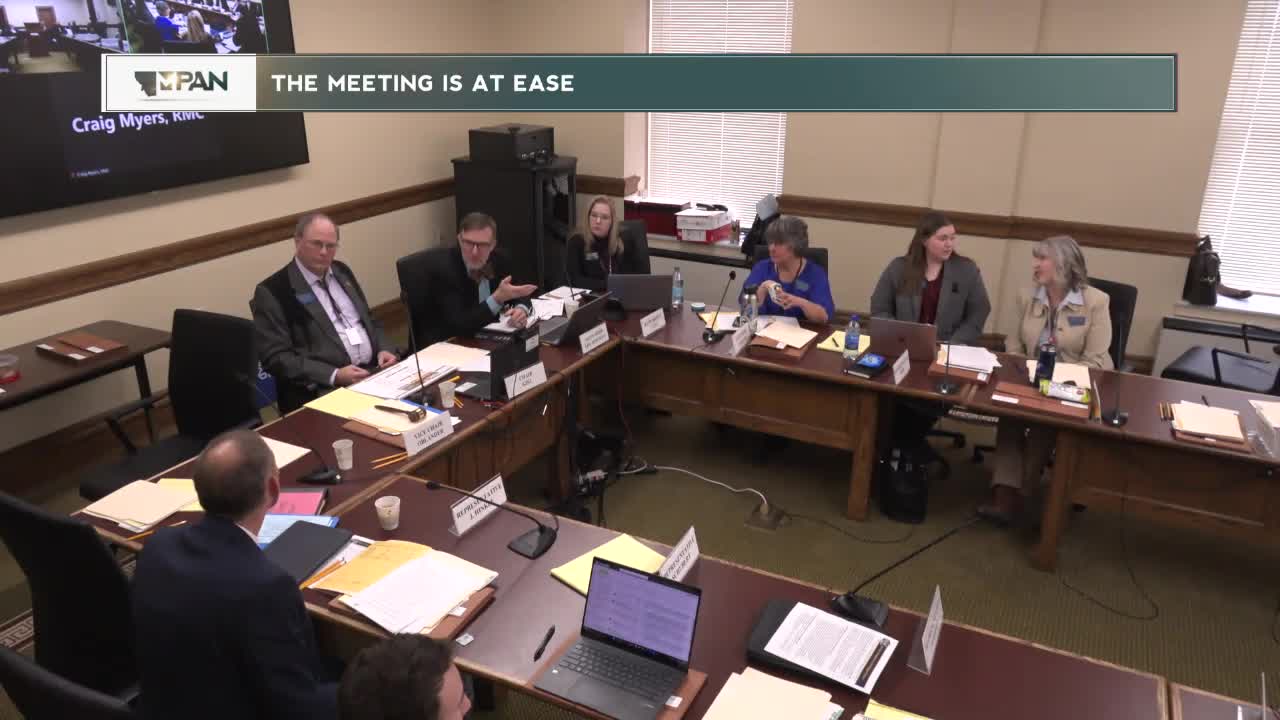
Representative John Fitzpatrick opened the hearing on House Bill 466, a measure to codify a definition of categorical exclusions under Montanas Environmental Policy Act (MEPA), adopt federal categorical exclusions where appropriate, and provide a process for agencies to identify actions that do not require environmental analyses.
Fitzpatrick said the bill responds to a DEQ MEPA work-group recommendation to clarify statutory terms that have caused uncertainty and increased litigation. He described three central features: directing state agencies to identify actions that meet a categorical-exclusion definition; adopting federal categorical exclusions to avoid "starting from scratch"; and creating a rebuttable presumption that a categorical exclusion applies unless extraordinary circumstances exist. Fitzpatrick highlighted two targeted exemptions in the bill: Section 3 would exempt specified Department of Administration building and renovation activities on state-owned land that are undertaken through the procurement statute; Section 4 would exempt the Department of Commerce when authorizing historic-preservation grants.
Proponents included policy and industry representatives: Tanner Avery (Frontier Institute), Alan Olson (NorthWestern Energy), Matt Vincent (Montana Mining Association), John Iverson (Treasure State Resources Association), Brian Thompson (Montana Chamber of Commerce) and others. They argued the bill would streamline routine, low-impact state actions (maintenance, minor repairs and in-kind replacements), reduce unnecessary administrative delay, and allow agencies to focus resources on projects that may cause significant environmental effects. Proponents emphasized that the bill retains oversight: agency rulemaking, programmatic review and statutory guidance would control exclusions, and the bill includes a reporting mechanism to the Legislature.
Opponents included the Montana Environmental Information Center (Durf Johnson), Montana Audubon (Peter Dudley), Montana Conservation Voters Education Fund (Natalie Wright), Northern Plains Resource Council (Kirk Panasuk) and several individuals. Opponents cautioned that the bills definition gives agencies broad discretion to declare projects exempt from environmental analysis. Durf Johnson pointed to the federal definition in 40 CFR 1508 and said HB 466s definition lacked an explicit tether to a finding that the action "does not have significant effects on the human environment," leaving too much discretion to agencies. Opponents also argued the bill could be unconstitutional if it effectively cedes legislative power to agencies and reduces public participation and transparency for projects that may have meaningful environmental effects.
Several opponents urged amendments: require the Legislature to approve any new categorical-exclusion list or require publication and public review of agency categorical-exclusion lists; explicitly tie categorical exclusions to a demonstration that impacts are de minimis or not significant; and preserve the Legislatures role in defining exclusions rather than delegating the core policy decision to agencies. Beth Kading, a former NEPA compliance specialist, said she would support codifying a definition but asked that the bill also require agencies to publish concrete lists of exclusions for public review before agency use.
Informational witnesses included Sonya Nowakowski (DEQ director), Russ Katherman (Department of Administration Architecture and Engineering Division), Sean Thomas (DNRC Forestry and Trust Lands), Anna Pakenham Stevenson (DNRC Water Resources) and Jeff Hindoien (FWP chief legal counsel). Sponsors said an amendment from the Department of Administration (proffered during the hearing) would limit the Department-of-Administration exemption to projects procured under Title 18 procurement authorities and that Section 4 could be voided if an alternate bill on grant exclusions passed.
Representative Fitzpatrick said he would consider technical amendments and invited opponents and stakeholders to draft clarifications addressing constitutional and public-participation concerns. The committee did not record a final vote in the excerpt provided.