Get Full Government Meeting Transcripts, Videos, & Alerts Forever!
Get email alerts on the Child Welfare Staffing Budget topic
No spam. Unsubscribe anytime.
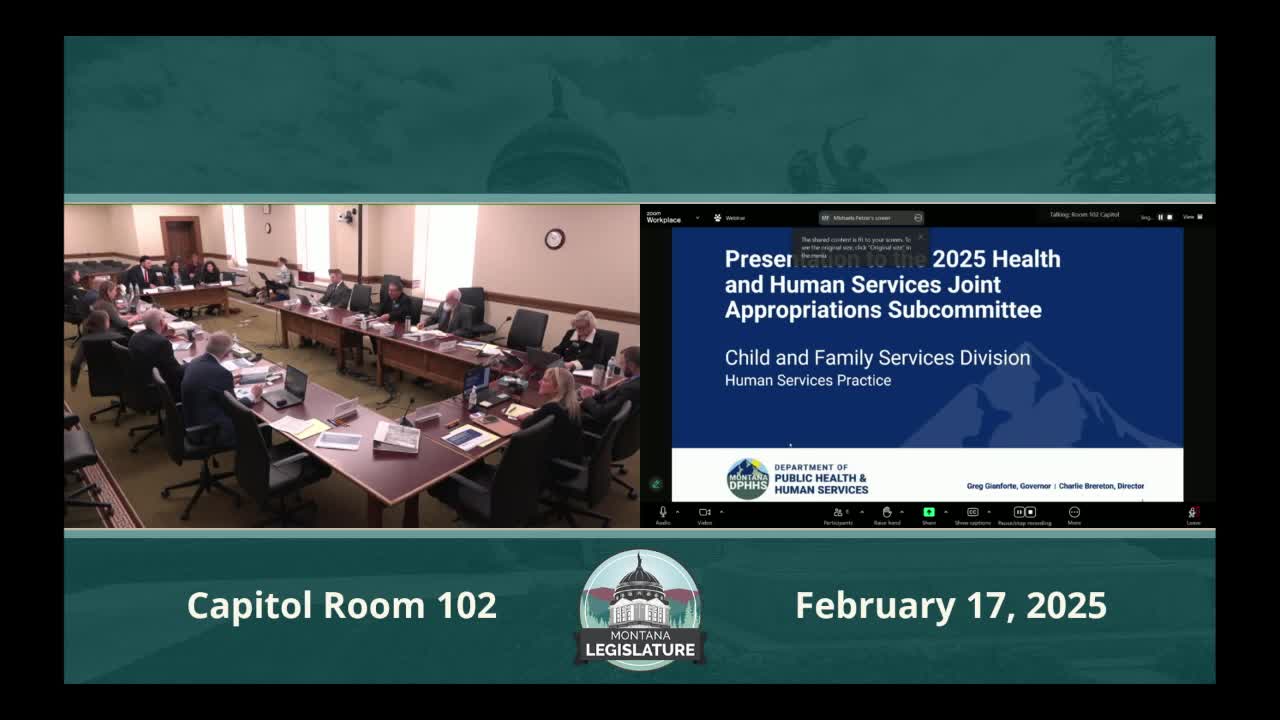
State officials outline child welfare staffing, caseload and budget pressures
Summary
Department presenters told legislators that statewide child welfare operations are driven by regional caseload swings, vacancies and travel costs; department leaders cited a $33.1 million field-staff baseline in fiscal 2024 and said funding splits and a federal random moment time study affect how costs are charged.
State staff told a legislative committee on an unspecified date that Montana’s Child and Family Services division is managing uneven caseloads, persistent vacancies and high travel costs while seeking roughly $34 million in field-operations funding for the 2026–27 biennium.
Kim, a staff member leading the presentation, said “this is the administration and staffing component of child and family services,” describing a six-region structure and work to align supervision, office space and case coverage with fluctuating staffing levels. Nikki, a staff member who followed Kim, walked lawmakers through regional caseload snapshots, vacancy counts and the division’s licensing, intake and centralized functions.
The presenters told the committee the division’s field-staff reporting level totaled about $33,100,000 in state fiscal 2024, rose to $35,100,000 in 2025, and the request shown for 2026–27 is roughly $34,000,000. Division leaders said personal services make up the largest portion of the budget and that the department’s overall personal-services ask approaches $36.7 million in 2026–27.
Why it matters
Lawmakers were shown that geography, out-of-state placements, specialty courts and workforce turnover change everyday workloads and the division’s ability to meet accreditation-type expectations. Presenters warned that federal–state funding splits are sensitive to how staff time is coded; the department uses a federally approved random moment time study (RMTS) to allocate staff time among federal funding streams and state funds, and officials described a roughly 70/30 general-fund-to-federal split in recent quarters.
Major details
- Regional structure and vacancies: The division is organized into six regions. Presenters said Region 1 had five vacant positions at a recent snapshot and that Region 3 (Billings) accounts for a large share of children in care and rent/operating costs. Region 4 (Helena, Butte, Bozeman) was described as having three larger hubs and unique supervisory arrangements. Region 6 was described as geographically compact but having hiring and housing challenges.
- Caseloads and supervision: Staff described caseload measurement as “more of an art than an exact science,” pointing to frequent short-term workforce reductions (for example, several employees on medical leave) and local differences in court requirements such as ICWA or drug court that increase staff time. They cited an accreditation benchmark of about 15 youth per worker and noted many regions remain above the low end of the teens.
- Travel, motor pool and operating costs: Presenters said motor pool leases and travel are significant line items because staff must visit children and families across large geographic areas; about half of travel spending is in-state travel for coverage and supervision, and the other half is for out-of-state visitation when children are placed out of state. Rent and lease costs in larger offices (Billings, Great Falls, Kalispell, Missoula, Butte, Helena) were highlighted as primary operational drivers.
- Funding allocation and RMTS: The department described use of a random moment time study (RMTS) — a federally accepted sampling method — to allocate field staff time across federal funding sources and state funds. Officials said changes in RMTS returns over recent years moved the division’s cost split (general fund vs. federal) and that a roughly $700,000 sensitivity exists between those allocations in the biennium request.
- Licensing and resource-family work: Licensing staff (resource family specialists) have a separate reporting level. Presenters said there are 31–32 resource-family specialist positions statewide, licensing and relicensing foster and kinship homes, performing background checks, and supporting permanent placements and adoption finalizations. The division reported roughly 600–650 licensed foster homes on hand in the period reviewed and provided counts of foster-home licensing timeliness (for SFY 2024: 29 licensed in under 60 days; 33 in 60–120 days; 23 in 120–180 days; 18 longer than six months).
- Centralized intake and eligibility: Centralized intake handles initial reports and referrals and is 100% general-fund funded, presenters said. The division also described IV‑E and SSI eligibility units and grant management functions that interact with field operations.
- Training, retention and wellness: The division described expanded onboarding and supervisor training, adding a fourth week to new-worker training and running cohorts for supervisors. Officials said the department is tracking wellness, doing exit and stay interviews, and deploying recruitment strategies including faith-based partnerships to identify placements for children with significant needs.
Committee questions and risks
Committee members asked whether pay and working conditions are adequate to retain staff. Miss Grossberg, a staff member who answered questions, said pay is only part of the problem and emphasized the intensity of child-welfare work, the scrutiny the division faces and steps the department is taking on wellness and organizational supports. Lawmakers also asked how travel and reunification are supported when children are placed far from parents; staff said the division provides transportation supports such as gas vouchers, bus passes and virtual visits when appropriate.
Officials cautioned that the RMTS and resulting federal–state funding mix are a material risk to budgeting: changes in how staff time is coded can alter the federal match and the general-fund requirement for the division.
What’s next
Staff indicated some technical adjustments to overtime and pay-plan allocations were under consideration and that detailed questions could be addressed in a subsequent hearing. The presentation moved next to licensing and complaint-processing slides and the committee scheduled follow-up items for the next session day.
Ending
Presenters left legislators with regional spreadsheets and monthly snapshots to monitor vacancies and caseload trends and said the department will continue to refine data collection through a new CCWIS case-management system and ongoing RMTS work.