Get Full Government Meeting Transcripts, Videos, & Alerts Forever!
Get email alerts on the Article V Convention topic
No spam. Unsubscribe anytime.
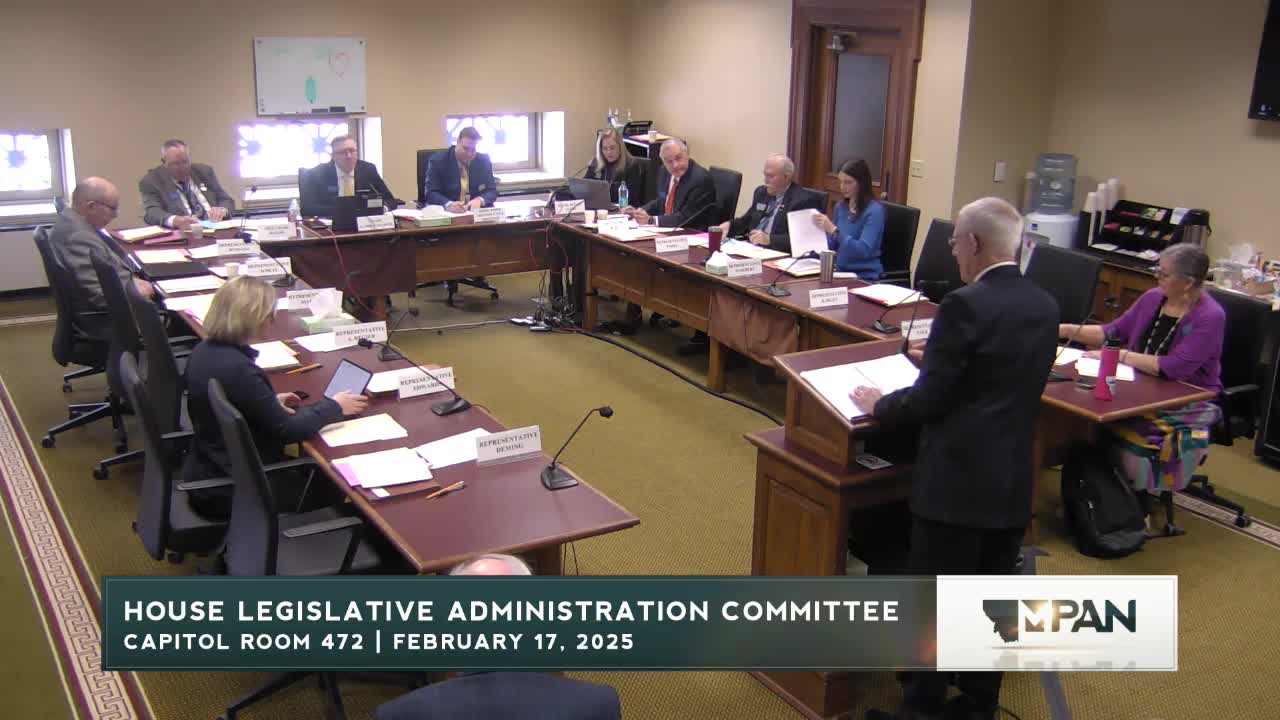
Montana committee hears bill to set rules for Article V convention commissioners
Summary
Senator Tom McGilvray introduced SB 120 to create selection, oath and recall procedures for Montana commissioners to a possible Article V convention; proponents said the bill prepares the state if other states call a convention, opponents warned it could create false security.
HELENA — Senator Tom McGilvray, R‑Billings, told the Legislative Administration Committee on March 1 that Senate Bill 120 would create a process for selecting and supervising Montana’s commissioners should states call a convention under Article V of the U.S. Constitution.
"I'm bringing you today Senate Bill 120 . . . to set up administrative processes where they can take an oath," McGilvray said, describing the bill’s provisions for commissioner qualifications, selection by a joint legislative session, an oath to limit commissioners to instructions from the legislature, and recall authority.
The bill, as McGilvray outlined, places definitions in sections 1–3, gives the legislature a role in selecting commissioners in section 4, requires commissioners to take an oath in section 6, sets compensation and administrative details in sections 7–9, and creates an advisory committee in section 12 to monitor the delegation. Section 13 would allow a commissioner or delegation to be recalled, McGilvray said.
Proponents from the public said the bill fills a gap if multiple states pursue an Article V convention. Shane Klakken, who identified himself as a resident of House District 37, said Montana needs a process so the state will not be "caught between sessions" if states move toward a convention. Doug Carey, a supporter, said, "We the people, through our state legislatures, must begin the hard work of restoring the constitutional government before it is too late." Dan McLean, a volunteer with Convention of States Action, and other supporters echoed that the bill would clarify selection, authority and oversight.
Opponents raised constitutional and design concerns. Daniel Keder, who identified himself as a retired Air Force officer and volunteer with the John Birch Society, told the committee the bill may create a "false sense of security" because Congress could control some practical aspects of a convention, citing Congressional Research Service material and the view that funding, delegate apportionment and some procedures could be congressional decisions.
McGilvray responded to that objection by saying congressional control is inconsistent with the purpose of an Article V convention and cited court decisions he said support that view. "To suggest from that point of view that Congress would control is inconsistent with the whole purpose of the convention," McGilvray said.
Several witnesses described safeguards they said limit the chance of a "runaway convention": proposed amendments must stay within the topics in an application, any proposed amendment would need approval by delegations from 26 states in the convention, ratification requires 38 states, and state attorneys general could challenge out‑of‑scope action in court, a citizen witness said.
Committee members asked procedural questions about how quickly a convention could be called, the number of commissioners, and whether current legislators should serve as commissioners. McGilvray said the statute would require an odd number of commissioners but left the specific number (3, 5, 7, etc.) for the legislature to decide and argued legislators’ familiarity with procedure makes them suitable delegates.
The committee did not take a final recorded vote on SB 120 at the hearing. The chair said the panel would "pass consideration EA on our 2 bills" and later indicated executive action on the bills would occur at a future meeting. The hearing record shows public testimony, committee questioning, and the sponsor’s closing remarks but no formal committee roll‑call on SB 120 during the session.
Why it matters: SB 120 would define how Montana chooses and constrains any delegates to a possible multistate Article V convention, a process proponents say protects state interests and opponents say raises constitutional and practical questions about who controls convention procedures and scope.
The committee closed the SB 120 hearing and moved to consider a separate bill on legislative staff holidays; the committee announced it intended to take executive action on both bills at a later meeting.