Get Full Government Meeting Transcripts, Videos, & Alerts Forever!
Get email alerts on the Investments Precious Metals Crypto topic
No spam. Unsubscribe anytime.
Montana hearing on HB 429 would let Board of Investments place limited funds in precious metals and large-market digital assets
Summary
Supporters said HB 429 would give the Board of Investments tools to protect purchasing power; opponents urged caution about a $50 million transfer and fiscal risk. Witnesses discussed custody, market-cap limits and how legislative appropriations would control withdrawals.
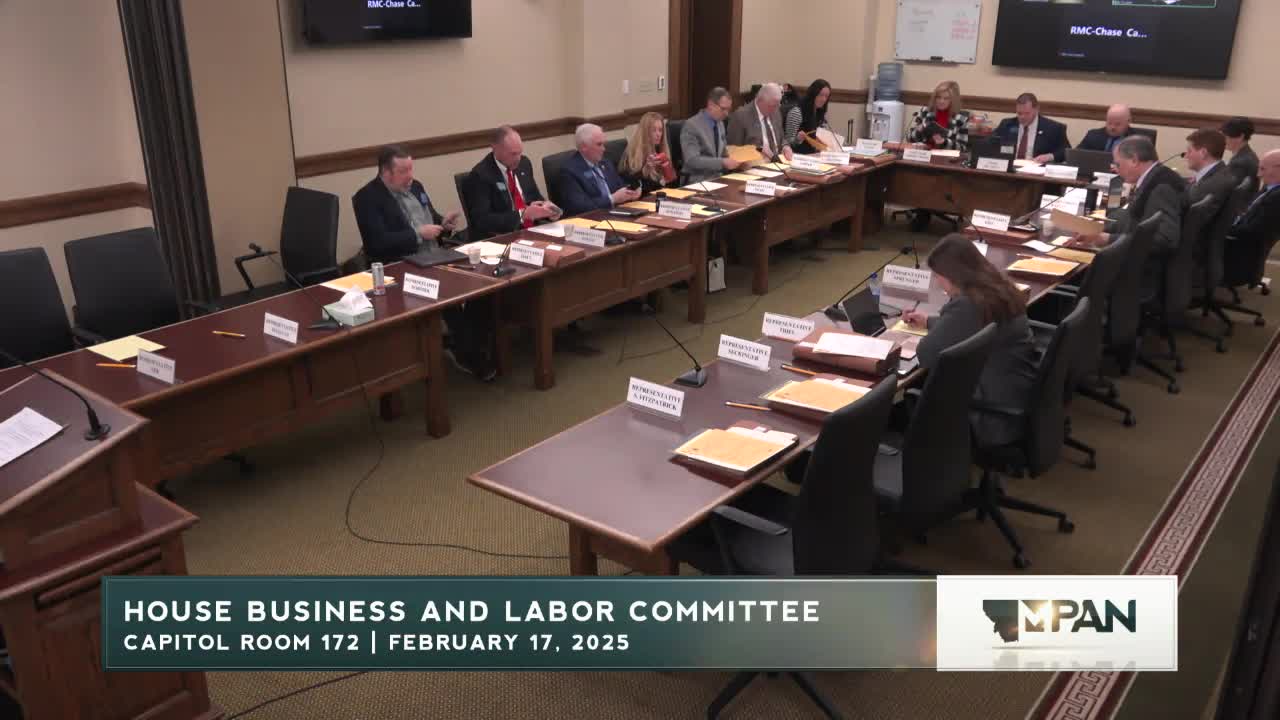
Representative Schomer, sponsor of House Bill 429, introduced the bill to the House Business and Labor Committee, saying it would give Montana a new option to protect state funds from inflation.
The bill would allow — but not require — the Board of Investments to invest up to $50,000,000 of state funds in “precious metals” and in qualifying digital assets. Proponents described the change as a limited, optional diversification tool; opponents said the proposed transfer and new investment risks warranted a “do not pass.”
"House Bill 429 is a good bill," Representative Schomer told the committee at the opening of the hearing. "All of us have been to the grocery store lately. All of us have had to buy the same groceries." He framed the measure as one way to help public funds cope with declining purchasing power.
Scott Bollinger, who identified himself and displayed an example silver bar for the committee, said the bill’s precious-metal option would generally use refined bullion or coins held by an independent custodian. "These bullion products are defined as pure refined bullion or coin products," Bollinger said.
Dan Villa, who identified himself to the committee as an executive director and spoke about constitutional and account-structure limits, walked members through how the investments would be held and managed under current law. Villa said Article 8, Section 13 of the Montana Constitution restricts ownership of private corporate stock outside some pension pools, and that the bill as drafted would require custodial arrangements or separately managed accounts. He told the committee that purchases would be routed through custodians and that custody fees historically run about 40 basis points annually.
Ms. O'Loughlin of the Montana Budget and Policy Center opposed the bill in the hearing. She circulated a Legislative Fiscal Division chart and argued that the bill proposes a $50,000,000 transfer into a state special revenue account at a time when revenue projections and proposed tax changes could lead to a structural imbalance. "We have substantial concerns about what's being proposed here and would urge a do not pass," she told the committee.
Witnesses and committee members pressed for detail on several points. Committee members asked whether precious metals would be held in refined form (Bollinger: yes, refined bullion or coin), whether other states had pursued similar authority (petitioners cited Utah and noted activity in Arizona, Oklahoma and other states), and whether digital-asset exposure would be limited to large-market tokens. The bill draft includes a market-cap threshold for digital assets; witnesses said that threshold would initially restrict holdings to Bitcoin.
Committee members also asked about mechanics: who would decide when to liquidate holdings, whether the legislature or the Board of Investments would control sales, and what custodial standards would apply. Villa said the legislature, by appropriations, would determine when funds leave the special revenue account and that custody and counterparty selection would follow the board’s fiduciary due-diligence processes.
Representative Carlin asked about the statutory definition of a "qualified custodian" and pressed for clarity on the phrase "a company regulated by the state." Villa said custodial relationships would be established through underwriting and due diligence and that the board could not outsource custody to an unvetted vendor.
At closing, Representative Schomer framed HB 429 as optional authority that would give Montana an additional tool to respond to inflationary periods. "This gives us the option," Schomer said. "I think we need to give Montana a fighting chance." The committee recessed before any executive action on the bill was recorded.
Ending: The bill remains at the hearing stage; committee members asked staff to review custody language, the fiscal note and the proposed $50,000,000 transfer before any executive action.