Get Full Government Meeting Transcripts, Videos, & Alerts Forever!
Get email alerts on the Pretrial Drug Courts topic
No spam. Unsubscribe anytime.
Judicial branch seeks to convert drug courts and pretrial programs from OTO to base funding
Summary
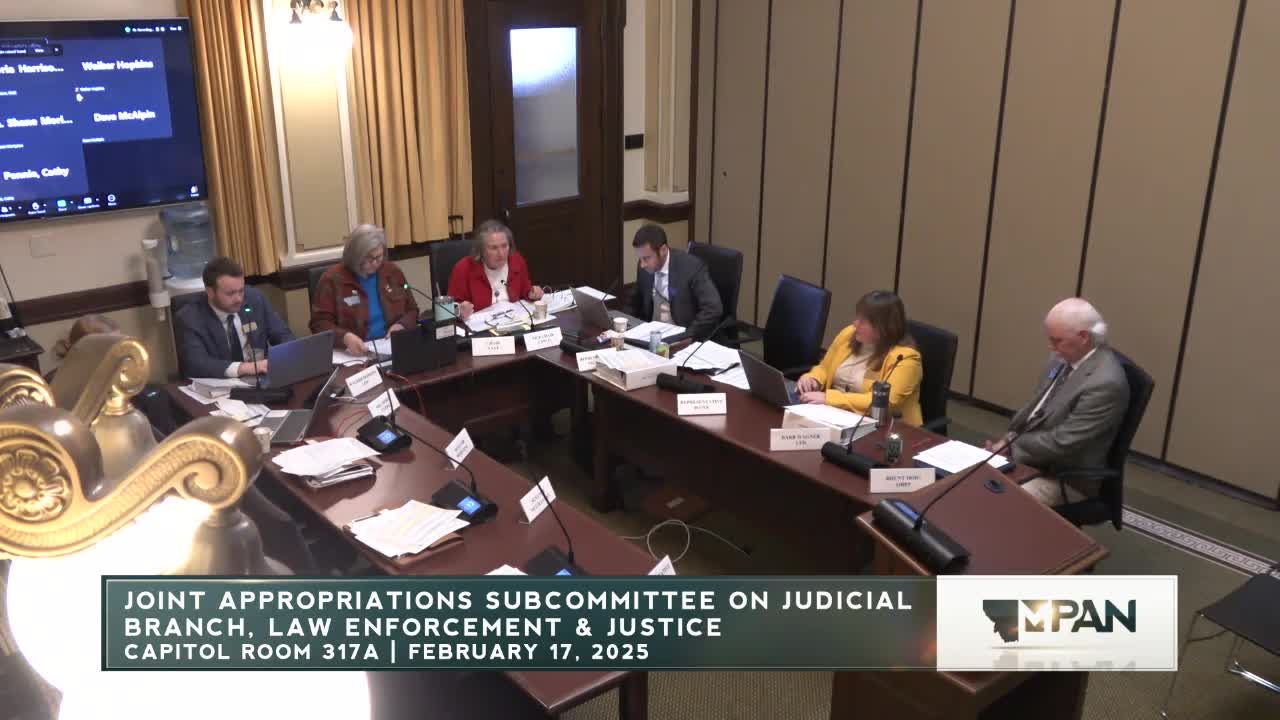
Committee heard requests to shift drug courts and pretrial programs from one-time (OTO) funding to base general fund and asked for county-level expenditure breakdowns and program detail.
Judicial-branch officials asked the subcommittee to permanently fund drug courts and the statewide pretrial program that previously were supported largely by federal grants or one-time appropriations.
Finance director Kathy Penny told members DP107 seeks additional spending authority to spend fees collected in a state special account established for drug-court activities; DP103 asks to move the pretrial program into the base and add 2.5 FTE. Penny and court-administration staff said the pretrial positions are not new: they were funded OTO since 2017 and the request would convert those OTO positions into the base (permanent) funding.
Committee members sought more granular history and county-level detail. Committee staff and the court administrators said pretrial coverage currently includes Lewis and Clark, Butte-Silver Bow, Lake, Missoula and Yellowstone counties, with pilot work in Cascade and Big Horn counties. The court administrator said pretrial funding covers personnel (risk-assessment coordinators and assistants) and non-personnel monitoring such as testing and electronic monitoring; staff offered to provide county-level breakdowns for the last three fiscal years and a written personnel-and-services breakdown for each county.
On drug courts, staff explained that some courts were shifted from federal-grant funding to the Department of Justice’s consumer education and settlement account; DP107 would increase authority to spend fees currently collected for treatment-court purposes and DP102 would transition some drug-court funding to general fund because the opioid-settlement sources are nearly exhausted. Staff said DP102’s general-fund increase annualizes around $37,000 in additional costs while state-special authority declines accordingly to consolidate funding.