Get Full Government Meeting Transcripts, Videos, & Alerts Forever!
Get email alerts on the Criminal Law:indecent Exposure topic
No spam. Unsubscribe anytime.
Heated hearing on bill to broaden indecent‑exposure law draws opposition from advocacy groups and defense counsel
Summary
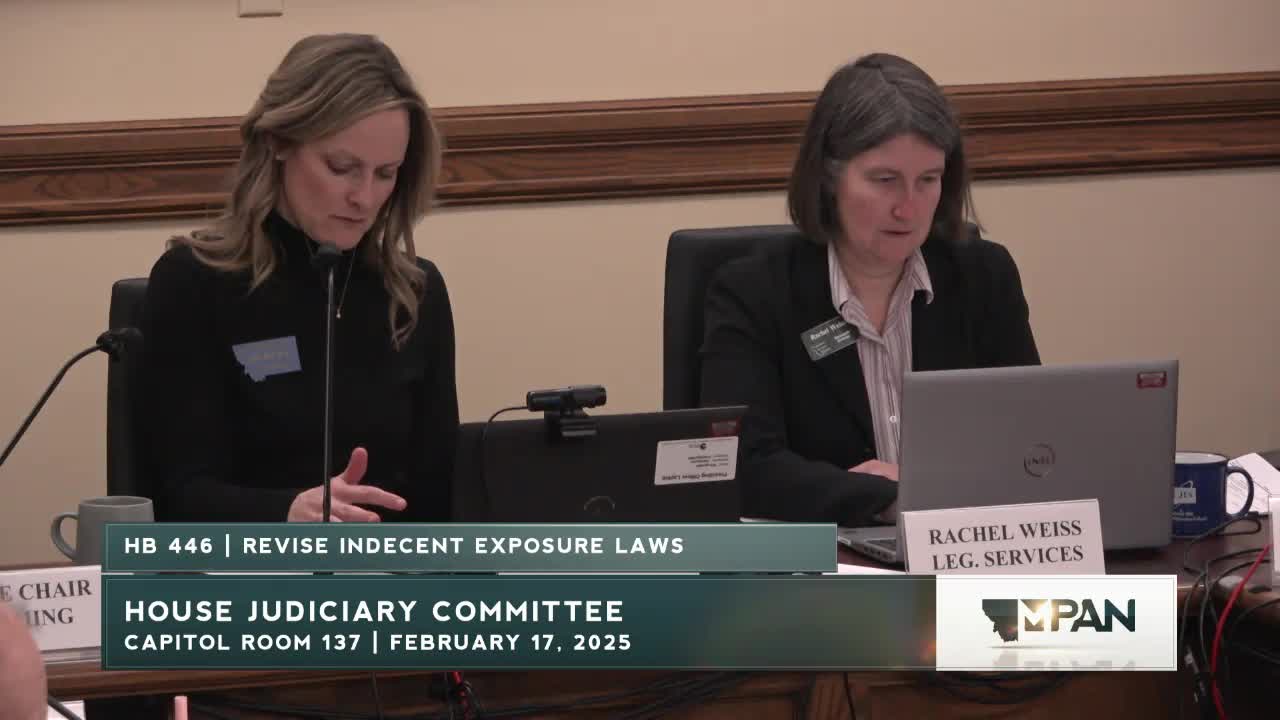
Representative Jedidiah Hinkle told the House Judiciary Committee House Bill 4‑46 would update Montana’s indecent exposure law to make it chargeable in public places and to link the statute to the state Constitution’s protection of human dignity.
Representative Jedidiah Hinkle opened the hearing on House Bill 4‑46 saying the bill would update Montana’s indecent exposure law and make clear the offense can be charged in public places.
“Subsection 4 of the bill makes it clear that indecent exposure can be a chargeable offense in public places,” Hinkle said. He framed the change as protecting the dignity of victims and aligning statutes with Article II, Section 4 of the Montana Constitution.
Why it matters: The hearing turned into a prolonged dispute about statutory language and constitutional values. Opponents — including domestic‑violence and civil‑rights groups, health‑care providers and defense counsel — said the bill’s drafting could remove the mental‑state requirement for some prosecutions and disproportionately affect transgender and non‑binary people who use public restrooms and locker rooms.
Opposition and testimony Kelson Young of the Montana Coalition Against Domestic and Sexual Violence said she opposed the bill and told the committee she believed the measure was aimed at excluding transgender and non‑binary people from public spaces rather than addressing classic indecent‑exposure misconduct.
“I really believe that we have indecent exposure laws for a reason,” Young said, but added the bill “feels personally targeting and mean spirited.”
Multiple opponents testified they feared the bill removes the required showing that a defendant acted with intent to humiliate, harass or arouse — a mental‑state element currently in the law. Robin Turner of LegalVoice and Brett Shandelson, director of the Office of the State Public Defender, warned the bill creates vagueness and constitutional problems, particularly by adding the phrase “violate the dignity of another” without a clear objective standard.
Defense counsel’s view Shandelson told the committee that current indecent‑exposure law requires proof of a mental state (knowingly or purposely exposing intimate parts) plus an intent that the conduct be likely to cause affront, alarm or to humiliate. He said HB 4‑46’s new subsection could remove the intent element for offenses in public places, creating what he described as “strict liability” exposure offenses that a prosecutor could bring without proving malicious intent.
Public‑health and civil‑rights testimony Representatives of BridgerCare and other health organizations described harms the bill would create for transgender patients who regularly use public facilities for hygiene and exercise. Multiple trans witnesses warned the measure would make ordinary changing or showering in a gym or pool locker room a potential criminal act if a complaint were made or surveillance footage captured the exposure.
Sponsor’s closing and committee status Rep. Hinkle said the bill does not aim at any particular community but at conduct that exposes intimate parts to members of the opposite biological sex. He argued the bill fills gaps in existing law and invoked the Montana constitutional protection of human dignity. The hearing record contains extensive legal questioning from committee members and legal observers; no committee vote on the measure was recorded in this hearing.
Ending: The committee received detailed legal commentary and heated public testimony. Defenders of existing law said prosecutions of indecent exposure already cover public incidents; opponents warned HB 4‑46 would broaden criminal liability, introduce vagueness, and could be used to target transgender and non‑binary Montanans.