Get Full Government Meeting Transcripts, Videos, & Alerts Forever!
Get email alerts on the School Food Service topic
No spam. Unsubscribe anytime.
Antigo board votes to request RFPs from DPI for school food service after extended discussion
Summary
The Unified School District of Antigo Board of Education voted to send requests for proposals through the Wisconsin Department of Public Instruction to solicit food‑service management companies, a step board members described as an informational fact‑finding process rather than a decision to outsource.
The Unified School District of Antigo Board of Education voted to send requests for proposals (RFPs) through the Wisconsin Department of Public Instruction to invite food‑service management companies to submit proposals for the district’s food program. The motion was made by Doctor Barto and carried after discussion at the board meeting.
Board members and staff said the RFP is a fact‑finding step, not a decision to outsource. Board members repeatedly described the RFP process as a way to gather information, noting that the district can interview companies and choose to stay with its current in‑house operation if the proposals are not acceptable.
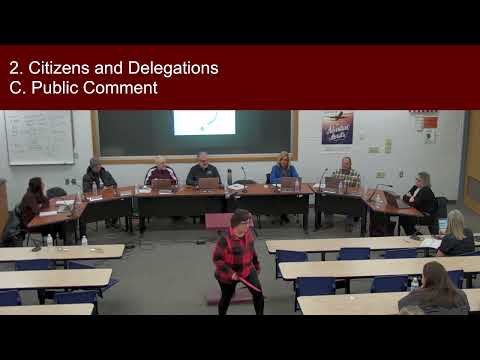
The item drew a public comment from Lisa Beneshek, who identified herself as the district’s kitchen coordinator and said she opposes outsourcing. “It’s difficult to understand why this would be considered with our food service department being self supporting,” Beneshek told the board, saying the department covers wages, insurance and benefits and brings in additional revenue through a la carte sales and catering. She asked board members to visit the kitchens and meet staff before making any changes.
Board members and staff described the formal RFP pathway for food service: the district submits a posting through DPI’s procurement portal, companies decide whether to bid, proposals are returned to the district, and the district opens and reviews proposals. Staff and board members said RFP responses typically include a management fee proposal, details on whether a company would rehire current staff, and menu and nutrition plans. Board members said that, where they had investigated examples in other districts, some companies also run classroom nutrition programming and work with local agricultural programs.
Sarah (identified in the meeting as the district food‑service director) described how federal commodity dollars and program rules shape menus and costs. “Last year, I ended up getting $100,000 in commodity money,” she said, explaining that many entrees and frozen fruit/vegetable items are provided through the USDA commodity program and that commodity availability can vary by year. Sarah also said the district participates in the Community Eligibility Provision (CEP), so all students K‑12 receive free meals; she gave participation estimates she tracks: roughly 70% of high‑school students, about 80–85% of middle‑school students, and about 75–80% at the elementary level eat school lunch on a typical day.
Board discussion touched on several recurring concerns: whether outside management would offer higher wages and rehire current staff; whether contracting would improve food quality and student nutrition; how commodity product selections and food‑buying groups limit or expand healthier options; the cost and structure of a management fee; and timing relative to the district’s planned new elementary building (which would allow more on‑site preparation at the elementary level). Multiple board members urged gathering additional cost and staffing information before any final decision.
Board members and staff also described contract mechanics discussed in committee: a management company typically proposes a management fee; an initial contract term would be one year with renewals available (district staff described a common structure of renewals up to four additional years after the first year, but told the board the district would follow DPI rules and the RFP rubric). Staff emphasized the RFP rubric weights (cost, reporting transparency, service capability, staffing plan, menu options and other factors) will be set by the district and used to score proposals.
The motion to send RFPs to DPI was framed by supporters as an informational step. “RFPs are at no cost to the district,” one board member said during the discussion. Opponents and concerned board members asked for specific follow‑up items if the RFP proceeds, including: likely cost impact to the district, examples of companies and their rehiring rates, effects on salary and benefits for current staff, and concrete nutritional differences between commodity‑based menus and alternative offerings.
Votes at a glance - Consent agenda (approval of agenda, minutes, financial reports and check/ACH lists): motion carried (motion made by Bobby Braun). The record includes board recusal requests on specific check/ACH items (recuse from check number 242500993 and ACH number 242500977). Specific roll‑call tallies were not read into the record; the chair announced the motion carries. - Motion to send RFPs to DPI for the district food‑service program: motion carried (motion made by Doctor Barto). The board opened the RFP process to solicit proposals; no outsourcing decision was made at the meeting. - Motion to adjourn into closed session under Wis. Stat. § 19.85(1) (personnel): motion carried; the meeting entered closed session by roll call.
What happens next District staff said they will begin assembling the required documentation for the DPI RFP posting and will provide additional cost and staffing details at upcoming committee meetings. Board members asked that committee work and staff briefings run in parallel with the RFP timeline to gather internal options and to track any potential impacts to current staff and budgets.
The board’s discussion and the public comment from the kitchen coordinator indicate the district’s food program is likely to receive close scrutiny from both staff and the community as the RFP process proceeds.