Get Full Government Meeting Transcripts, Videos, & Alerts Forever!
Get email alerts on the Mandatory Overtime Pension Cap topic
No spam. Unsubscribe anytime.
Lawmakers and workers press for change to PERS overtime cap calculations for mandatory-overtime jobs
Summary
House Bill 3363 would clarify how the 300-hour overtime cap for tier 3 PERS members is calculated and require the Department of Administrative Services to use actual overtime averages by class and geography; corrections, mental health and crisis workers described sustained mandatory overtime, safety concerns and staffing gaps
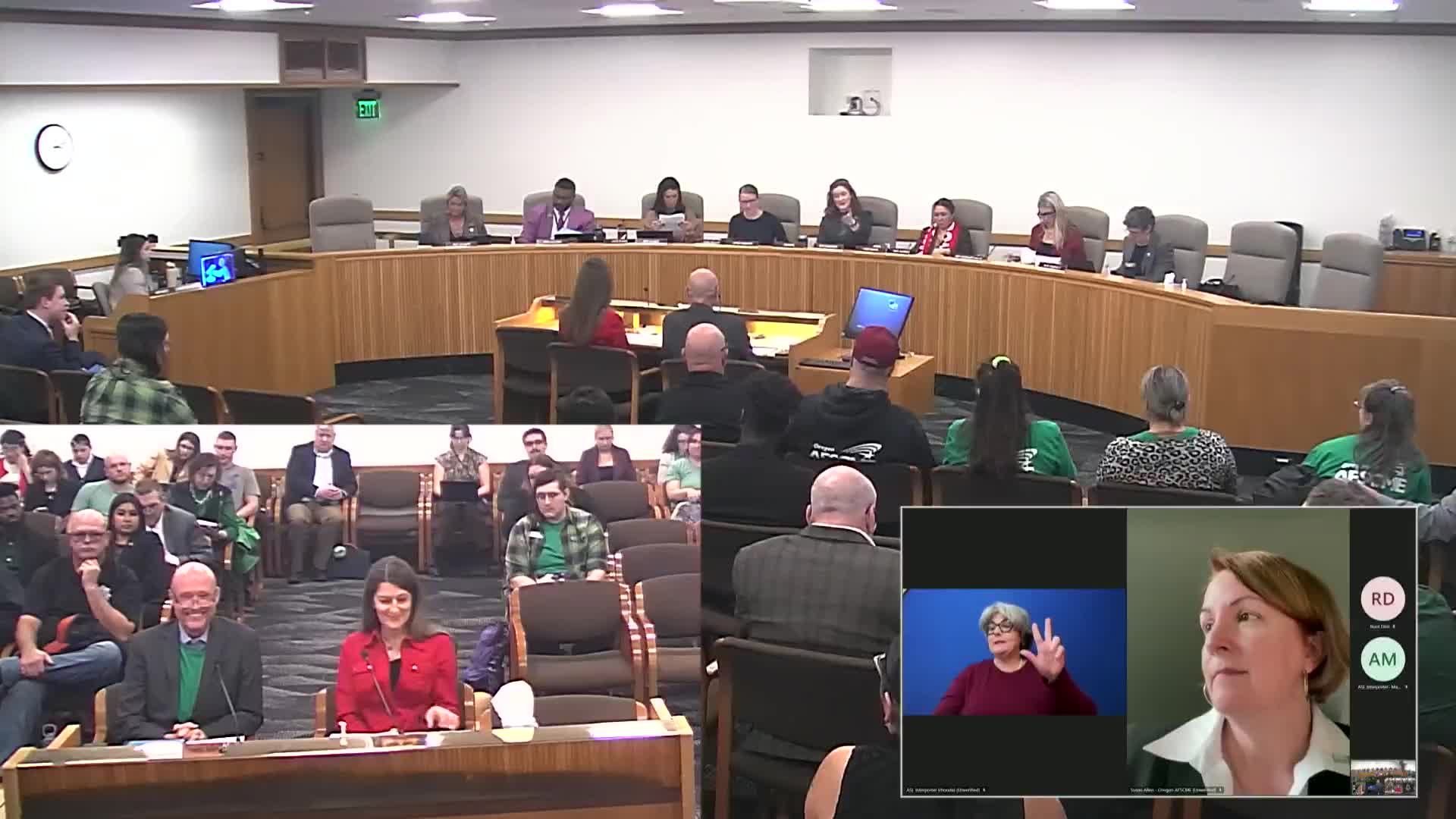
House Committee on Labor and Workplace Standards members heard extensive testimony Feb. 17 on House Bill 3363, a proposal to clarify how the overtime cap that applies to tier 3 PERS members is calculated and to require recalculation when actual overtime averages materially exceed the statutory cap.
Sponsor Representative Courtney Nieron described the bill as a "course correction" for tier 3 public employees who now often see only 300 overtime hours counted toward their final PERS calculation even though some workers routinely accrue far more. "That doesn't mean that they are capped at working more than 300 hours. It simply means they can only claim 300 hours on retirement paperwork," she told the committee.
The bill retains the existing statutory concept that the Department of Administrative Services may establish different overtime averages by class and geography, and it sets a trigger for recalculation: if the actual class average exceeds the current cap by 5%, the agency must recalculate the cap using actual hours worked and distinguish overtime by class. Supporters said the change would better align retirement benefits with the realities of mandatory overtime in 24/7 public institutions.
Multiple legislators and dozens of frontline employees from corrections, state hospitals and crisis units testified in support. Senator James Ivory Manning Jr., a former corrections officer, said officers "can't turn it down" and cited workloads of "800 to a thousand hours" of mandatory overtime. Senator Gorsuch told the committee that Coffee Creek Correctional Facility alone reported about 7,500 overtime hours per month and that the state-run prison system houses roughly 12,000 adults in custody and employs about 4,450 people, slightly more than half as security staff.
Union and frontline witnesses described recurring practices such as "bucketing" (assigning employees unexpected double shifts), chronic vacancy rates and the effects on families, safety and staff health. Correctional counselor Kate Oldfield, representing Local 2376 AFSCME, said she has "come home safely 2,210 nights" because coworkers respond when they are called for help, but she described loss in life expectancy and family disruptions tied to the work. Eastern Oregon Correctional Institution officer Donald Carlisle said EOCI had 277 open positions the week he testified, creating 2,216 hours of overtime that week alone.
Nurses and crisis staff at Oregon State Hospital and the Stabilization and Crisis Unit testified that their facilities average comparable overtime. David Lynch, a registered nurse and union president at OSH, told the committee nursing staff averaged "1,000 hours of mandatory overtime a week" during a recent period and described how rotating mandatory shifts erode mental and physical health.
Supporters said HB 3363 is intended to improve retention and safety by ensuring retirement calculations reflect actual hours worked. Some committee members and witnesses cautioned the bill does not, on its own, solve underlying staffing shortages; Representative Boshart-Davis said removing the cap "is not a recruiting tool" and urged attention to root causes such as recruitment and staffing policy.
The committee closed the public hearing on HB 3363 without taking a vote. Several legislators and witnesses asked the committee to advance the concept and to consider additional measures to address staffing and safety in affected agencies.