Get Full Government Meeting Transcripts, Videos, & Alerts Forever!
Get email alerts on the Bicycle Infrastructure topic
No spam. Unsubscribe anytime.
Public safety committee votes to finish Central Avenue bike lanes with buffered, protected design
Summary
The Homewood City Public Safety Committee voted unanimously Feb. 17 to complete Central Avenue striping using engineering drawings that add a 2-foot buffer and a 4-foot bike lane, directing staff to proceed with the final striping and related signage and enforcement steps.
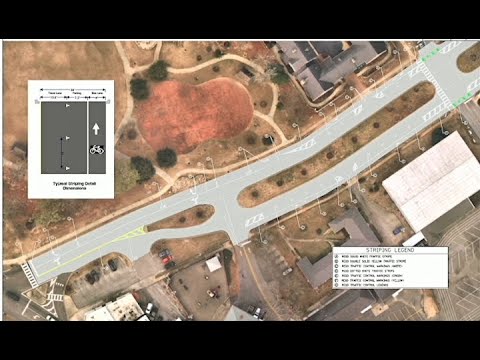
The Homewood City Public Safety Committee voted unanimously Feb. 17 to complete bike-lane striping on Central Avenue according to the engineering drawings presented by Clark Bailey of Kimley-Horn, with the addition of a 2-foot buffer and a 4-foot bike lane, committee members said.
Committee members and consultants said the finished configuration is intended to create a parking-protected, separated facility that connects to planned trail work and lowers vehicle speeds along the corridor. Clark Bailey, the project engineer, described the approach as part of a broader move toward separated bike lanes: "It is becoming kind of more standard practice to have, we'll call it separated bike lanes." Bailey also presented cross-sections showing typical dimensions used in the design: a 10.5-foot travel lane, a 7.5-foot parking lane and the bike-lane area adjusted to include a 2-foot buffer.
The decision follows months of community feedback after temporary striping was placed during resurfacing last year. Carolyn Buck, director of the Red Rock Trail System and a Homewood resident, told the committee: "This is the new standard ... it's a safer environment for everyone." Proponents argued the finished striping would improve connections to the forthcoming TAP grant work on Griffin Creek Trail and broader Red Rock Trail plans.
During discussion, committee members and residents raised concerns about motorists parking in bike lanes, debris collecting in the buffer area, and the effect of physical devices on street sweeping. Several speakers said paint and signage alone had not prevented vehicles from occupying the temporary lane; one member summarized local experience as cars parked "right smack in the bike lane." Staff and consultants described three escalation options: clearer permanent striping and legends, signage, and physical devices in the buffer (sometimes called "armadillos" in committee discussion). Bailey warned that some devices can trap debris and complicate street sweeping; committee members debated maintenance trade-offs and whether the city has resources to perform additional sweeping or clearing.
Committee members also discussed enforcement. A staff member noted that ticketing for parking in a bike lane would require an ordinance or enforcement policy change. One committee member said, "We'll have to pass an ordinance that says you park inside of a parking spot and you get a ticket," and staff confirmed that parking enforcement and signage would be part of implementation planning.
Committee members questioned the project budget and contracting sequence after staff said temporary striping had been paid from an earlier purchase order and that final thermoplastic striping was not completed at resurfacing time. A staff member with budget responsibility said funds are available to finish the work and that a supplemental allowance could cover paint and additional materials beyond the original package.
A motion that the city complete the bike lanes on Central Avenue following Clark Bailey's three drawings, with a 2-foot buffer and a 4-foot bike lane, was moved and seconded; the committee voted in favor, with the chair announcing, "Ayes have it. 5-0." The motion directs staff to proceed with final striping, add signage and green conflict markings at intersections, and return with any required contract or budget documentation if additional funds are needed.
Implementation details — including whether physical pavement devices will be installed, a sweeping plan, a timeline for enforcement and education, and an exact schedule for final thermoplastic striping — were not specified at the meeting and will be developed by staff.
The committee's action completes the previously paused final striping phase for a resurfacing project on Central Avenue and moves the corridor toward the protected-bike-lane configuration recommended in the materials presented by Kimley-Horn and local trail advocates.