Get Full Government Meeting Transcripts, Videos, & Alerts Forever!
Get email alerts on the Natural Resources topic
No spam. Unsubscribe anytime.
Oregon State Marine Board outlines budget pressures, proposes fee and staffing changes in HB 5021 hearing
Summary
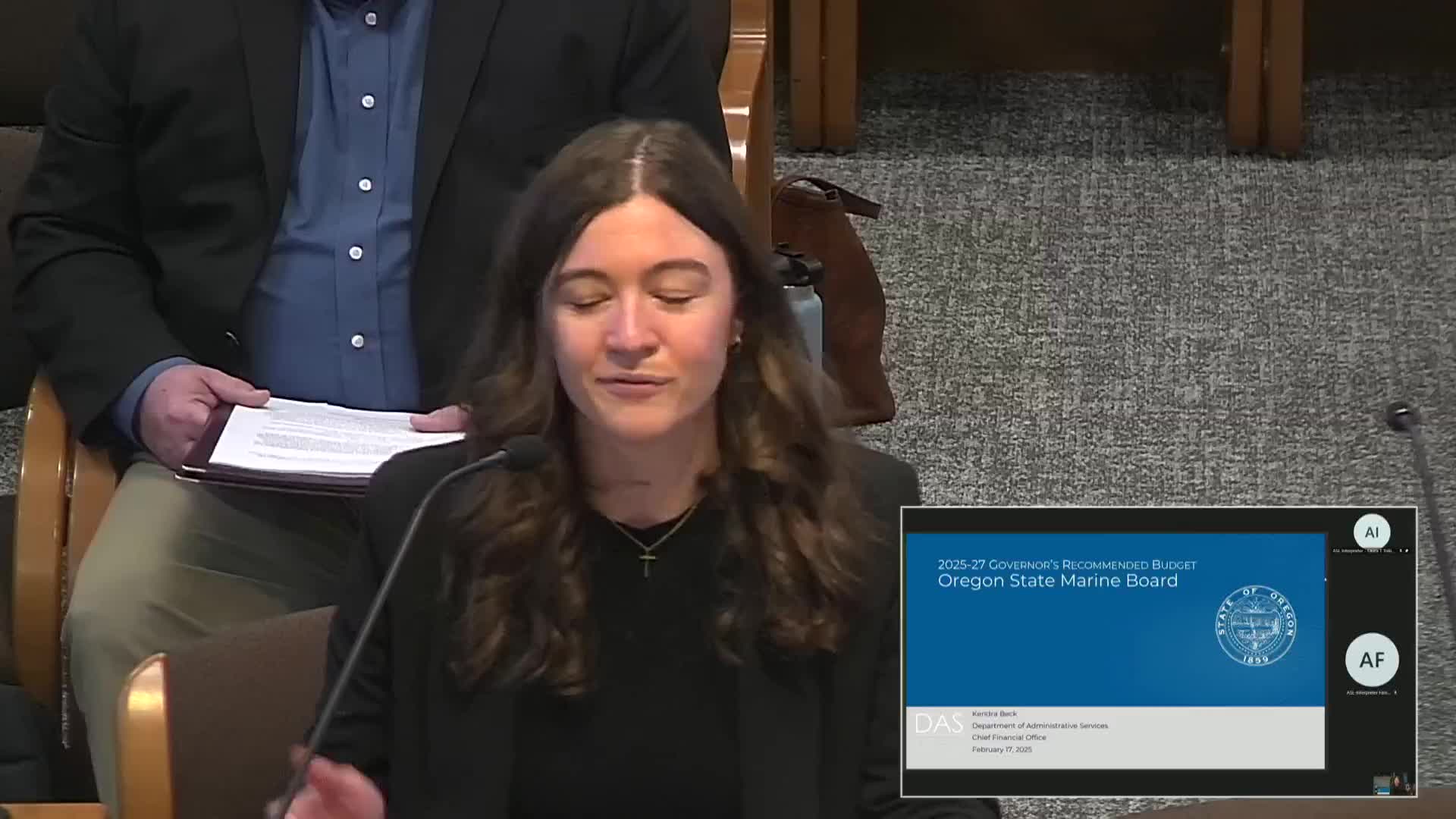
The Ways and Means Subcommittee on Natural Resources held a public hearing Feb. 17 on House Bill 5021, the governor's recommended budget for the Oregon State Marine Board.
The Ways and Means Subcommittee on Natural Resources held a public hearing Feb. 17 on House Bill 5021, the governor's recommended budget for the Oregon State Marine Board. Kendra Beck of the Department of Administrative Services Chief Financial Office presented the budget overview and Marine Board officials answered committee questions about revenue trends, proposed spending, and several policy packages included in the governor's recommendation.
The Marine Board told the committee the agency is “overall in a healthy position” going into the 2025–27 biennium but faces emerging revenue and cost pressures. ‘‘While the Marine Board is overall in a healthy position going into the 2527 biennium, there are 2 emerging issues facing the agency,’’ Kendra Beck said, noting that revenue from boat registrations and fuel tax transfers is the agency’s principal funding source and that motorized boat registrations have begun to decline.
The decline in registrations and rising costs matter because about 81% of the board’s other-fund revenue comes from registration/titling and the marine fuel tax. Christy Cornish, the Marine Board’s business services manager, told the committee registration and titling bring in roughly $18 million and the fuel tax about $11.8 million in the agency’s 2025 baseline. She also described recent price increases for facility construction: a 20-foot boarding-dock section cost roughly $15,000 in 2020, about $30,000 in 2023 and $38,000 in 2024, and asphalt prices more than doubled in five years.
Why it matters: the board distributes most of its money as grants and contracts. Cornish said special payments account for about 61% of the budget, personal services about 29% and supplies/IT about 10%. Law enforcement and facilities together are more than 70% of the agency’s budget, with marine law enforcement about $18 million and facilities about $13.1 million in the proposed budget.
Revenue, grants and balances
Director Larry Warren said the board under‑projected a recent fuel tax transfer tied to a four‑year fuel use survey; that underestimation temporarily increased the agency’s ending balance. Beck said the governor’s budget projects the agency to have about 10 months of ending balance under the recommended budget. Cornish added that about 12% of projected revenues are federal funds, primarily U.S. Coast Guard recreational boating safety grants and U.S. Fish and Wildlife grants.
The board also described its Waterway Access Program, created by the 2019 legislature and effective Jan. 1, 2020, which folded a prior nonmotorized aquatic invasive species fee into a waterway-access permit. Laura Jackson, chair of the Oregon State Marine Board, said through December 2024 the program had raised about $7.6 million since inception, with roughly $5.2 million directed to grants and program administration for nonmotorized projects and education, and about $2.4 million to aquatic invasive species prevention.
Program requests and proposals
The governor’s budget includes: an increase in expenditure limitation for waterway access grants (the board said it projects the revenue exists and is seeking the limitation to deploy grants rather than keep funds idle); one additional classified staff position in the titling and registration unit to reduce processing backlogs; and a fee restructure for the outfitter-and-guide program. Director Warren and staff said the requested titling position would improve response and reduce title-processing timelines after earlier process and technology improvements cut some title backlogs from nearly a year to roughly 65–80 days.
Outfitter-and-guide fee restructure
The board is proposing a fee restructure for its outfitter-and-guide registration program that would change fees for some in-state and out-of-state guides. Brian Paulson (boating safety manager) and other staff explained legislative counsel has flagged the existing structure for a legal problem under interstate-commerce principles. Christy Cornish described current fees as highly variable: an Oregon guide pays $150 under the present structure, while some out-of-state guides can be charged as much as $2,000 under reciprocity calculations. The proposed change would standardize many fees (the board said the plan would move many to a $350 level, with specific nuances for employees and a small amendment under development).
The board said the restructure is driven by legal advice that the current reciprocity-based fee differential risks violating the dormant commerce doctrine and that Legislative Counsel will not draft bills that leave that exposure unaddressed. The board said it has notified and consulted with guide associations and expects letters of support but acknowledged that some individual small businesses will have questions about fee increases.
Aquatic invasive species and inspections
Board members and staff emphasized aquatic invasive species (AIS) prevention as a funding priority. They described partnerships with the Oregon Department of Fish and Wildlife, which operates boat inspection stations funded in part by Marine Board grants. The board said it has detected invasive organisms on boats stopped at Oregon check stations and that an Idaho discovery on the Snake River heightened regional concern because of downstream connectivity. Board members said inspection capacity in Oregon lags some neighboring states and noted pending legislation would allow more local partners to staff inspection stations.
Derelict and abandoned-vessel cleanup
The Marine Board described coordinated work on derelict-boat removal. The board received $1 million in ARPA funds designated for abandoned derelict vessel cleanup and said those funds helped remove 88 vessels (the board provided examples of removal costs: the Denali removal cost about $180,000; smaller removals ranged from $25,000 to $52,000). Staff said the program is now primarily led by the Department of State Lands (DSL) but that the Marine Board maintains a $150,000 derelict vessel subaccount and continues to coordinate on removals.
Boating safety, facilities and law enforcement
Laura Jackson and staff described education and outreach efforts, including seasonal Boating Safety Advocates who distribute life jackets and provide multilingual materials at launch sites and events. The board said mandatory education has historically reduced fatalities and that recent outreach targeted at stand‑up paddleboard users reduced incidents after staff shifted messaging.
The board also highlighted facilities grants (engineering, planning and construction). The board said it has funded numerous projects — for example, a major rebuild at a Columbia Gorge launch site and a Hood River program that provides water‑safety programming for children of migrant farm workers — and reported awarding roughly $1.43 million in waterway-access grants in the last biennium, across 29 grants to 22 entities (10 nongovernmental organizations).
Key performance measures and reduction options
Staff proposed revisions to key performance measures to better reflect program outcomes and the agency’s return on investment. Among the changes discussed were keeping boating fatalities as a tracked measure, keeping AIS inspection counts, adding a boater-compliance measure (percentage of boat checks that find compliant boaters) and retaining a customer-service KPM. Cornish presented potential 10% reduction options that would cut about $4.42 million and two FTEs if required; examples included eliminating maintenance assistance at many sites and reducing patrol or rapid-response law-enforcement funding.
Discussion and next steps
Committee members asked about specific figures, regional inspection capacity, and the board’s outreach to guide and outfitter stakeholders. Board staff said they have undertaken outreach including large virtual meetings and in-person appearances at trade shows. No committee votes were taken at the hearing; the subcommittee will consider this material as it works on the governor’s budget and on any separate policy bills referenced during the hearing.
Ending: The co-chair closed the hearing on HB 5021 and announced the next committee meeting would include an informational presentation on Senate Bill 5543 from the Water Resources Department.