Get Full Government Meeting Transcripts, Videos, & Alerts Forever!
Get email alerts on the Wetlands topic
No spam. Unsubscribe anytime.
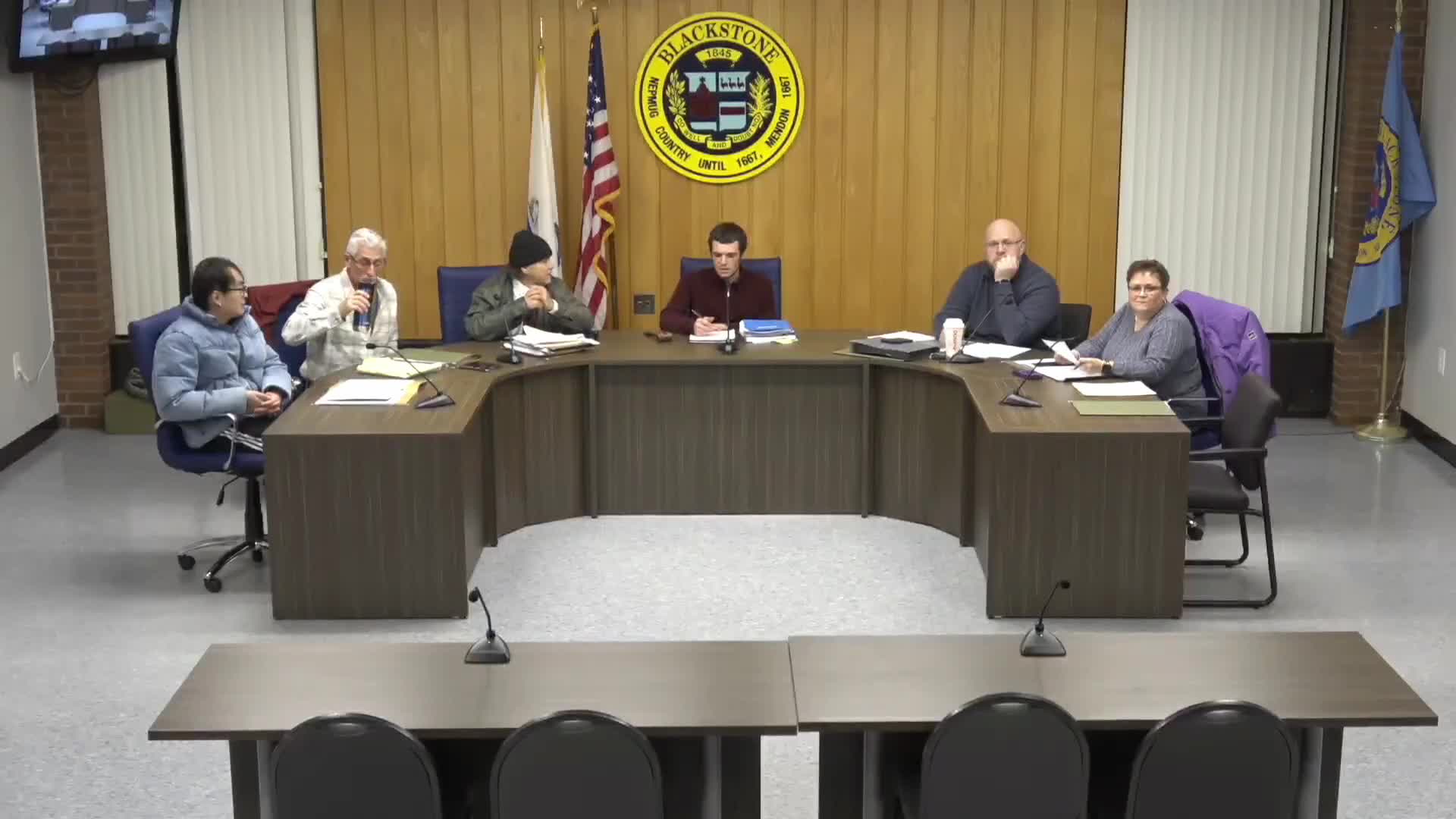
Conservation commission orders peer review, issues cease-and-desist after unauthorized clearing at 25 Milk Street
Summary
The Blackstone Conservation Commission required a peer review of a wetland delineation and voted to issue a cease-and-desist — allowing only installation of erosion controls — after evidence that trees were cleared without permits at a property tied to a notice of intent for 25 Milk Street.
The Town of Blackstone Conservation Commission voted Jan. 15 to require a peer review of the wetland delineation for a proposed house and barn at 25 Milk Street and to issue a cease-and-desist order that bars further regulated activity on the property except for prescribed erosion-control work.
The action followed testimony from the applicant and consultants and sustained questioning from commissioners and an abutter about extensive tree clearing that took place on the parcel before the filing. The applicant submitted a notice of intent and a wetland delineation; the commission agreed to continue the hearing to March 19 while the peer review is completed.
Why it matters: Commissioners said the extent of unpermitted tree clearing and uncertainty about site condition make an independent review necessary before the commission can issue an order of conditions. The enforcement order is intended to prevent further disturbance while peer review and a revised plan address mitigation and stabilization.
Applicant Ashton Gasco and Bruce Wilson, a principal with New England Environmental Design, presented the project, saying the submission now on file shows two wetland areas on the lot, a long driveway, a four-bedroom house footprint and a barn to the rear. Wilson told the commission the Board of Health had approved a Title 5 septic design on Dec. 21 and that groundwater was observed at about 4 feet in soil testing.
Commission members and the conservation agent, John Lopez, pressed the applicant about when the tree clearing occurred, whether the wetland delineation reflected the disturbed ground, and whether the Natural Heritage and Endangered Species Program data covered the site. "The delineation is valid for 3 years," Lopez told the commission, saying drought conditions in November 2024 would not invalidate soil- and vegetation-based delineation methods.
A neighbor who identified herself as an abutter told the panel she was concerned the grading and remaining woody debris could alter overland flow toward her land. Commissioners discussed requiring structural or vegetated measures — for example a curtain drain or stone swale at the limit of work — to address surface runoff.
After discussion the commission voted to hire an outside peer reviewer to examine both the delineation and any revised proposal; members said the revised plan, including proposed mitigation, should be the document reviewed rather than interim drafts. The commission also voted to issue a written cease-and-desist enforcement order that allows only the installation of siltation and erosion-control measures already agreed to by the applicant, and it set a continuation date for March 19, 2025.
Vote details: The motion to order a peer review passed unanimously. The enforcement order/cease-and-desist motion passed by a recorded margin (5–2); the commission directed that installation of erosion and siltation controls be permitted while the order remains in effect. The commission also voted to continue the public hearing to March 19, 2025.
What happens next: The commission directed the applicant to revise the site plan to include specific mitigation and permanent erosion-control measures, submit the peer-review funds and contract, and report back with the peer-review deliverable by the March meeting. The commission said the peer reviewer should inventory unauthorized activities (including the tree clearing), confirm wetland flags and hydrology, and evaluate the revised mitigation plan before the commission makes a final determination.
Context: Commissioners said an enforcement order protects both the regulatory process and abutters by providing clear direction about allowable work while technical review occurs. The applicant indicated he will install straw waddles and a temporary silt fence and work with the agent on revised plans.
The commission recorded that approximately 75–100 trees had been cut prior to the application and that the applicant estimates total disturbance on the lot at about 80,000 square feet; commissioners noted the town planning board permit threshold of approximately 20,000 square feet would be a separate review step if grading exceeds that limit.