Get Full Government Meeting Transcripts, Videos, & Alerts Forever!
Get email alerts on the Hud Consolidated Plan topic
No spam. Unsubscribe anytime.
Kalamazoo staff present draft five‑year HUD Consolidated Plan and 2025 action plan priorities
Summary
City staff presented a finalized draft five‑year HUD Consolidated Plan and a 2025 annual action plan to the Kalamazoo City Commission Committee of the Whole on Feb. 3, outlining critical priorities — preserving single‑family housing and expanding stable rental housing — and timelines for funding notices and requests for proposals.
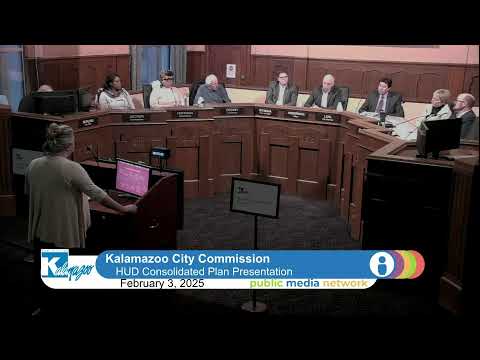
Kalamazoo City staff presented a finalized draft five‑year HUD Consolidated Plan and the related 2025 annual action plan to the City Commission’s Committee of the Whole on Monday, Feb. 3, asking commissioners to approve the draft so staff can begin notices of funding opportunity and request‑for‑proposal (RFP) processes ahead of HUD submission.
The draft plan sets priorities and funding goals for 2025–2029 tied to U.S. Department of Housing and Urban Development (HUD) entitlement requirements. City staff said the plan emphasizes two “critical” priorities: preserving existing single‑family housing for low‑income households and providing stable, affordable rental housing to prevent or resolve homelessness. City staff recommended these receive the largest share of funding over the five‑year period.
Housing development supervisor Sherilyn Parsons told commissioners, "We have finalized the draft consolidated plan," and said the plan builds on 2024 public outreach, neighborhood surveys, federal and local housing data and coordination with subrecipients and nonprofit partners. Julie, a city staff member leading the strategic and action plan presentations, summarized the priority ranking system: "Critical, important and desirable," explaining HUD requires prioritization rather than an undifferentiated list.
What staff presented
Staff described four primary goals that guide project choices: attainable and affordable housing; expanding access to public service grants; neighborhood beautification and improvement; and administration of HUD programs. The attainable and affordable housing goal was presented as the highest‑funding priority and blends two critical priorities with additional important and desirable items.
City staff cited several data points that informed the plan: the average single‑family home in Kalamazoo is about 65 years old, at least 56% of city households are renters, and staff estimate the plan’s public service investments could assist roughly 1,200 persons or households over five years based on current funding levels. Parsons said homeowner repair programs and rental assistance were repeatedly raised in outreach as essential to prevent displacement and preserve affordable stock.
Neighborhood and public service funding
The draft plan includes neighborhood enhancement funding and a public improvement project opportunity for five core neighborhoods — Eastside, Edison, Northside, Stewart and Vine — each represented by a neighborhood association. Staff said neighborhood work would include housing/code administration and one public facility or improvement project per core neighborhood. Public service grant funding, historically concentrated on youth programs, would be opened to a wider array of providers (seniors, special‑needs populations, violence prevention, economic development) with recommendations from the Community Development Advisory Committee (CDAC).
On CDAC, Parsons said the committee is made up of neighborhood‑referred members and at‑large residents who will review and score public service applications, conduct interviews, and perform biannual check‑ins with subrecipients. "They will be responsible for recommending the funding for all of those public service dollars," Parsons said.
Timelines, application process and next steps
Staff outlined the near‑term schedule: after local approval, the consolidated plan must be delivered to HUD by May 15 (staff aim to submit several days earlier to allow for IT or filing issues). Housing partner NOFOs/RFPs would begin shortly after local approval; public service applications will open later in the year (September). For program year 2025 only, staff proposed a single public‑service application that will cover funding for both program years 2025 and 2026 to simplify community submissions.
Parsons said some administrative updates will return to the commission after plan approval, including revisions to the city’s public participation plan, CDAC bylaws and definitions for what constitutes minor versus substantial amendments to the consolidated plan. She described planned changes to the funding allocation method so awards can be adjusted on a pro rata basis if final federal allocations differ from projections.
Point‑in‑Time count and other context
Commissioners asked about the recent Point‑in‑Time (PIT) count and whether temporary hoteling during an extreme cold event affected numbers. Julie explained that the PIT distinguishes sheltered and unsheltered people: "Our sheltered number in the PIT count is gonna go up dramatically from previous year because it's like we added 100 to 120 shelter beds," and that year‑to‑year comparisons will be more difficult because some people were counted as sheltered who would otherwise have been counted as unsheltered. Staff cautioned the verified PIT data will take months to publish.
Funding constraints and regional coordination
Commissioner Cooney and others noted funding limits. Cooney said a back‑of‑the‑envelope estimate of available funding over five years looked to be roughly $8.5 million and called the gap between needs and available dollars "painful." City staff discussed regional conversations about unallocated state CDBG funds in Region J (the seven‑county MSHDA region); staff said entitlement communities like Kalamazoo are generally not eligible for state CDBG and that smaller jurisdictions sometimes lack capacity to accept federal funds, which can lead to unallocated dollars.
Staff requested elected officials and community advocates monitor federal budget developments (including possible continuing resolutions) that affect HUD funding, and offered to prepare a short factual briefing on what CDBG/HOME funds support for distribution to congressional offices.
Votes at a glance
• Motion to excuse Commissioner Wilson from the meeting — moved by Commissioner Pradel; supported by Commissioner Cooney. Voice vote recorded as all in favor; motion adopted. (Yes: Commissioners Cooney, Decker, Hoffman, Pradel, Vice Mayor Hess, Mayor Anderson; outcome: approved.)
Why this matters
The consolidated plan directs how Kalamazoo will use HUD entitlement dollars (CDBG/HOME and related funding) for housing preservation, rental assistance, public services and neighborhood public improvements over the next five years. Approval of the draft and subsequent administrative steps will determine which local partners may apply for funds and what projects receive city‑administered federal support.
What’s next
Staff asked the commission to accept the draft and authorized staff to return with required administrative amendments and the final plan for submission to HUD by the May 15 deadline. Staff said they will begin the NOFO/RFP process for housing partners immediately after local approval and will open public service applications in September for program years 2025 and 2026 (the dual‑year application is a one‑time accommodation for this cycle).