Get Full Government Meeting Transcripts, Videos, & Alerts Forever!
Get email alerts on the Biosolids Management topic
No spam. Unsubscribe anytime.
Commission approves $12.38 million design contract for biosolids drying and thermal-oxidation project
Summary
The Kalamazoo City Commission voted unanimously to authorize a professional services agreement with Jones & Henry Engineers LTD for Phase 3 design of a biosolids dryer and thermal oxidation system aimed at cutting landfill hauling, odors and greenhouse-gas impacts.
The Kalamazoo City Commission on Monday approved a $12,375,000 professional services agreement with Jones & Henry Engineers LTD to advance design and project planning for a large-scale change in how the city manages wastewater biosolids.
Public Services Director Georgia Baker told commissioners the city currently hauls about 200 wet tons of biosolids a day to landfill, costing “over $13,000,000 a year.” The contract will fund detailed engineering for a system that dries biosolids to roughly 98% solids and uses thermal oxidation with energy recovery, she said.
The project team presented the change as a move away from daily hauling of wet material and toward producing a near‑dry product that can be stored, managed and pursued for beneficial use. “If we were to stop all of this work ... that is the most costly approach,” Baker said, summarizing analysis that showed continuing the current practice would carry the highest long‑term costs and environmental impacts.
Why it matters: the city said the cost of current landfill hauling is a major driver of wastewater rates. The proposed plan aims to reduce weight to be hauled by more than 98 percent, cut odor and greenhouse‑gas potential, and address emerging contaminants such as PFAS that complicate land application. Engineers estimated total construction capital in the $130 million to $150 million range; Baker said the project team expects to apply for funding through Michigan’s Clean Water State Revolving Fund and to seek other state and federal sources.
Timeline and financing: staff said they submitted an intent to apply to the CWSRF and plan a public meeting in March. If the city ranks in the fundable range, construction could start in 2026 with completion and operation targeted for 2030–31. City staff estimated a payback on the investment of roughly 10 years, driven largely by escalating hauling costs.
Commission discussion focused on emissions controls, reliability and site footprint. Baker said the system will include after‑treatment scrubbing and selective catalytic reduction and that the team consulted academic experts and vendor testing plans; she added that comprehensive emissions testing would be required and that initial testing alone could exceed $1 million. Commissioners also asked about the plant footprint; Baker said the new equipment would be sited within the existing Kalamazoo Water Reclamation Plant footprint, infilling an area north of the administration building.
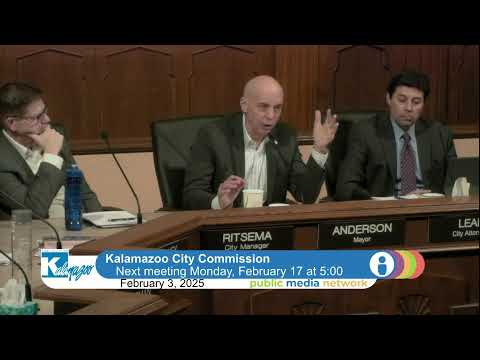
The motion to approve the professional services agreement was made by Commissioner Bridal, supported by Commissioner Decker, and passed on a roll call vote with all commissioners present voting yes.
Next steps: staff will finalize the project plan and submit the formal loan application to EGLE’s CWSRF project plan submittal in April and expects a fundable determination in September. If funded, staff said they would proceed with fourth‑quarter engineering and preparation for construction in 2026.