City staff outlines Bay City budget process, fund types and reserve policy
Loading...
Summary
A city finance presenter walked commissioners through the annual budget calendar, fund accounting, reserve policy and key revenue and expenditure categories ahead of the 2025–26 budget cycle.
At the Feb. 3 Bay City City Commission meeting, a staff member presented “Budget 101,” an overview of the city’s annual budget process, fund accounting and key policy limits for the coming fiscal year.
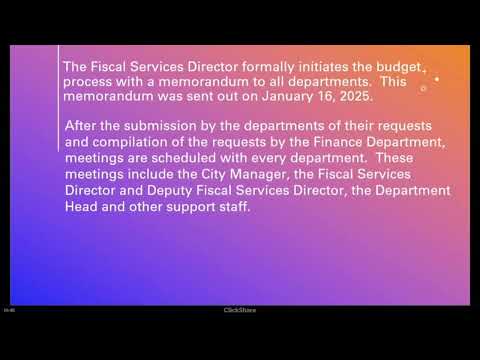
The presenter said the city charter requires the city manager to prepare and submit an annual budget and capital program to the commission and noted a 2004 resolution setting the delivery timing for the proposed budget. The presentation described a process that begins with a January memo from finance, department-level submissions in New World Financials, personnel cost compilations by Human Resources and a line-by-line review of departmental submissions with the city manager ahead of a City Manager Proposed Budget delivered in April.
Why it matters: the presenter said the commission follows a fund-balance policy that aims to keep the general fund reserve between 15% and 20% of the prior year’s amended expenditures. For the coming fiscal year the presenter said that range would translate to roughly $3.8 million to $5.1 million, and gave an example in which the city would target modest underspending to restore reserves if the beginning balance fell below the policy level.
The presentation described the city’s 48 separate accounting funds required to comply with Michigan law and governmental accounting standards. The presenter explained the distinctions among fund types — general fund, special revenue funds (for example local and major street funds, sanitation and CDBG), debt service funds used to satisfy bond covenants, capital project funds (including the public improvement fund), enterprise funds (water, sewer, electric, marina, airport, cemetery) and internal service funds such as the motor equipment revolving fund and the DPW building fund.
The presenter identified a number of specific items and constraints: the city has historically transferred excess general fund balance into the public improvement fund for capital work; the DPW building had a multi‑million‑dollar renovation and the building fund now collects rent and covers debt service tied to that work; two trust funds — a public safety/fire pension fund and a retiree health care trust — carry legal restrictions on use and cannot be drawn down without legal consequences.
Revenue sources discussed for the general fund included property taxes (the presenter cited approximately $15 million in tax revenue), state revenue sharing (budgeted at about $6.5 million), charges for services (roughly $3.6 million, including an indirect cost allocation billed to enterprise funds), and smaller amounts for federal and local grants. The presenter also explained that most non‑general funds are legally restricted to their stated purpose and gave the example of the sanitation fund, where customer fees must finance trash collection and cannot be transferred to the general fund without appropriate authority.
The presenter walked commissioners through the structure of the budget document — a budget letter from the city manager, revenue and expenditure summaries, individual departmental budgets (personnel, operating, capital), a personnel schedule and a debt schedule with amortization detail, followed by a five‑year capital outlay program. The adopted budget book will include the formal resolution that adopts the budget.
Commissioners asked clarifying questions during and after the presentation about timing, the difficulty departments face when the proposed budget changes before adoption, and how the public improvement fund and the $5 million bridge‑lease proceeds are being held for roads. The staff member said the city has not yet transferred a specific fiscal year’s excess general fund balance into public improvement because identified projects could be funded from other revenues and grant sources.
Staff recommended that the commission expect a balanced City Manager Proposed Budget in April and an adopted budget on or before June 30 as required by state law.