Get Full Government Meeting Transcripts, Videos, & Alerts Forever!
Get email alerts on the Sanitary Sewer Rehabilitation topic
No spam. Unsubscribe anytime.
Wastewater staff review decades-long sewer lining program; 35% of mains rehabilitated
Summary
Wastewater staff presented a history and progress report on the city's cured-in-place pipe (CIPP) lining program: about 35% of the sewer system has been lined, with roughly $7 million spent across 12 projects and an estimated $19 million saved versus full replacements.
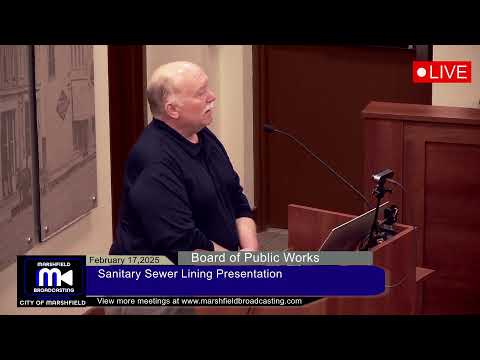
Mark Veil, wastewater superintendent, gave a presentation Feb. 17 outlining the city of Marshfield's sanitary sewer system and its multi-decade program to rehabilitate mains using cured-in-place pipe (CIPP) lining.
Veil said the city's sewer system covers roughly 7,500 acres and contains more than 700,000 feet of sewer main and over 2,500 manholes. He summarized the pipe material history: clay mains installed from the early 1900s through the 1940s (prone to leaks and root intrusion), concrete mains installed in the 1950s–1960s (susceptible to internal deterioration), and PVC mains used from the 1970s onward. Veil said the city first contracted a lining project in 1998 and has completed lining projects approximately every other year since then.
"Lining has typically cost in the neighborhood of $25 per foot," Veil said. He said there have been 12 lining projects over the past 25 years totaling about $7 million in rehabilitation work; he estimated that replacing those pipelines by excavation would have exceeded $26 million, meaning lining saved roughly $19 million over that period. Veil said roughly 35% of the system—about a quarter million feet—has been rehabilitated by lining to date.
Veil noted limits of lining: it cannot straighten crooked or sagging pipe and is not suitable for small-diameter (6-inch or smaller) clay mains, which must be replaced. He described spot lining for isolated defects and a newer T-liner technique that can form a watertight transition at laterals; he said the T-liner will be used on portions of South Maple this summer. Veil also showed inspection video comparisons of deteriorated pipe before and after lining.
Board member Russ asked about an observed PVC crack; Veil said PVC cracking is uncommon and usually results from a construction issue or a rock in the trench during installation. He explained how a preformed T-liner is inserted and expanded to seal a lateral and described hydrophilic gaskets that swell with moisture to create a seal.
Veil identified the portion of mains still needing work: about 3.5% are clay mains yet to be rehabilitated, about 8.5% are concrete lines remaining, and in total about 14.5% of mains still require rehabilitation by lining or replacement. He contrasted lining with full street reconstruction projects such as East Fourteenth Street (completed last year) and upcoming West Fifth and South Vine projects, which include full replacement of sewer and other utilities.
No formal action was taken on the presentation; the board thanked Veil for the update.