Get Full Government Meeting Transcripts, Videos, & Alerts Forever!
Get email alerts on the Economic Development topic
No spam. Unsubscribe anytime.
Berea council refers Cleveland Browns development agreements to committee after councilors outline tax and land terms
Summary
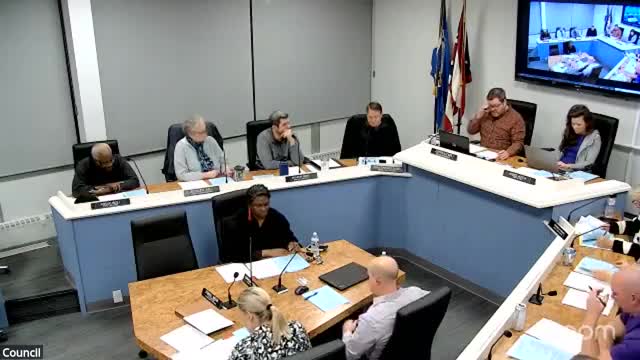
The Berea City Council on Feb. 3 substituted two ordinances tied to the proposed District 46 development by the Cleveland Browns and then voted unanimously to refer both amended measures to a coordinating-committee work session on Feb. 19 at 6 p.m.
The Berea City Council on Feb. 3 substituted two ordinances tied to the proposed District 46 development by the Cleveland Browns and then voted unanimously to refer both amended measures to a coordinating-committee work session on Feb. 19 at 6 p.m.
The legislation before council — identified in the meeting as ordinance 10-5a and ordinance 10-6a — updates previously circulated drafts and, according to the council discussion, codifies nine negotiated points covering taxes, a lease extension and land sale. Council members and city attorneys said the Browns’ and the city’s attorneys worked over recent months to resolve language and that the substituted drafts reflect those negotiations.
Council members and city staff described the items that appear across the two ordinances: the city will not take a share of several new taxes in the development (a new payroll tax, admissions tax and bed tax) for a limited period; the city would sell specified city-owned land for $1 million; the city would receive up to $1 million in permit fees; the city would retain new residential income tax from apartment units in the district; and the city would receive up to $4 million in cash flow paid as four $1,000,000 installments. Councilmember discussion and the ordinance language referenced a lease extension handled in 10-5 and the tax- and incentive-related provisions primarily in 10-6.
City law director Barb Jones said attorneys were not “renegotiating” the nine points but were “working out the language.” Jones and other speakers emphasized two clarifications recorded in the meeting: employees currently paying city payroll tax who are relocated to new office space connected to the project would not be subject to the new “rebate” language in 10-06; and the term during which the Browns would receive rebates on the new taxes was negotiated down from 30 years to 15 years.
Council members also discussed the role of tax increment financing (TIF). Jones said the TIF is mentioned in 10-6 but that the TIF terms would require a separate, later agreement and are not fully detailed in the current ordinance text. She noted the council would have 45 days following approval to proceed with related steps spelled out in the agreements.
Members of council pressed for the city’s principal outside attorney and the city’s investment adviser, Matt Stesinski, to attend the committee meeting. Councilmember Zacharias asked whether the Browns’ public timeline — social posts announcing a Barker Hotel (a Tribute Portfolio hotel) breaking ground in fall 2025 — would create scheduling pressure. Jones and other council members said the project’s public timeline was “aggressive” but stressed that the city must follow its PUD (planned-unit development) and other local review processes. Jones summarized the PUD path as a multistage process: stage 1 (concept/initial approval) has been completed; stage 2 requires traffic studies and drawings and will return to planning commission and then to council for a final decision on that phase.
Council substituted 10-5 with 10-5a (motion: Dozier; second: Zacharias) and 10-6 with 10-6a (motion: Zacharias; second: Schozen). Both substitutions passed on unanimous roll calls. Council later voted unanimously to place 10-5a and 10-6a into the coordinating committee for a date-certain work session on Wednesday, Feb. 19 at 6 p.m. (motions to refer: Brown; seconds: McManus). Several council members asked staff to circulate the ordinance texts and a summary “cheat sheet” of the nine points before the work session so members could prepare questions.
City staff reminded the public that the PUD process can occur in phases and that different components of District 46 — for example, the hotel and residential buildings — may come before the planning commission and council on different schedules. Jones also said that the city will strive to accommodate reasonable development timelines but will not skip required procedural or review steps.
Council members asked that the city’s primary attorneys be present at the Feb. 19 session to answer detailed legal and fiscal questions. No final approvals on incentives, TIF, land sale or lease extensions were taken on Feb. 3; the council’s action was to substitute the two ordinances with the attorney-drafted versions and to move them to a committee meeting for more detailed review.