Get Full Government Meeting Transcripts, Videos, & Alerts Forever!
Get email alerts on the Government Oversight topic
No spam. Unsubscribe anytime.
Council committee approves charter amendment to create separate boards for inspector general, ethics office
Summary
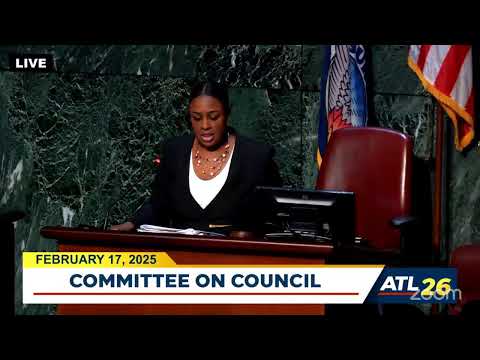
The Committee on Council approved, on second reading, an amendment to the City of Atlanta charter to establish separate governing boards for the Office of Inspector General (OIG) and the Ethics Office. The measure passed 6-1 after committee discussion about employee statements and investigative authority.
The Committee on Council on second reading approved an ordinance to amend the City of Atlanta charter to create separate governing boards for the Office of Inspector General and the Ethics Office, passing the measure 6-1.
The ordinance (25‑01009) was moved by Councilman Howard Shook and seconded by Councilwoman Andrea Boone. Committee members voted to carry the item after discussion about oversight roles and investigatory authority; the vote was recorded as 6 yays, 1 nay.
The ordinance amends the city charter, citing the Municipal Home Rule Act and recommendations from the city’s temporary task force that reviewed the OIG and Ethics Office. The legislation’s stated purpose is to “clarify respective roles and responsibility of the OIG and the ethics office” and to create separate governing boards for each office.
Joshua Everett, introduced as a senior community organizer and District 10 resident speaking on behalf of the NAACP Legal Defense Fund, urged changes to the draft that he said would preserve the OIG’s ability to investigate allegations that could amount to criminal conduct. Everett said the OIG was created in 2020 after a federal investigation that led to criminal indictments and that the office should retain authority to pursue “bribery or unlawful abuses of power that violate city, state, or federal criminal law.”
Ken Roblin, a public commenter, warned that creating separate governing boards could leave the offices vulnerable to politically motivated appointments and urged careful consideration of who would serve on those boards.
City Attorney (unnamed in the record) clarified a central procedural issue: under current law city employees are compelled to participate in OIG investigations and the ordinance as drafted does not change that compelled‑statement status. The city attorney said standard operating procedures for the governing board would be developed to notify employees of their rights and how compelled statements could be used.
Chair comments thanking committee members noted that the measure restores governing boards for both entities and aimed to find a “balance” between inspector general requests and the administration. The committee approved the substituted and amended version of the ordinance on second reading.
The committee record and the discussion do not state which member voted nay.
The measure now proceeds per council rules to the next step in the charter amendment process.